
Beyond the Rhetoric: Decoding India’s Strategic Evolution at Raisina Dialogue 2026
In his March 2026 Raisina Dialogue address, Minister of State Kirti Vardhan Singh articulated India’s evolving strategic doctrine through the civilizational lens of “Saṁskāra”—a process of refinement—structured around three core pillars: assertion, accommodation, and advancement. Assertion manifests as the disciplined defense of national interest through internal capacity building (manufacturing, infrastructure, nuclear energy via the SHANTI Act) and clear red lines on borders and maritime sovereignty; accommodation operates not as capitulation but as the art of building a human-centric, reformed multilateralism, exemplified by bringing the African Union into the G20 and maintaining diversified major-power partnerships; while advancement focuses on shaping global technology governance (through the New Delhi Declaration on AI Impact) and securing economic integration (via the landmark India-EU FTA). Together, these principles outline India’s path toward Viksit Bharat 2047, positioning the nation not as an adjuster to the global order but as a shaper of it, drawing on civilizational resources to navigate a multipolar world while championing Global South interests.
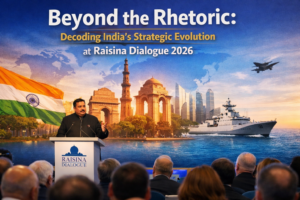
Beyond the Rhetoric: Decoding India’s Strategic Evolution at Raisina Dialogue 2026
When Minister of State Kirti Vardhan Singh took the stage at the 11th Raisina Dialogue on March 6, 2026, the carefully crafted phrases about “Saṁskāra” and civilizational refinement carried weight far beyond diplomatic nicety. What unfolded over the next thirty minutes wasn’t merely another policy speech—it was perhaps the most coherent articulation yet of how India’s foreign policy establishment has internalized a fundamental truth: the world order is no longer something India adapts to, but something India increasingly helps shape.
The setting itself spoke volumes. Fifteen years after the first Raisina Dialogue, India’s premier geopolitical conference has transformed from a coming-out party for Indian strategic thinking into a must-attend fixture on the global diplomatic calendar. The audience—foreign ministers, retired heads of state, tech billionaires, and the international press corps—listened with an attentiveness that would have been unthinkable in 2016.
The Conceptual Architecture: Why Saṁskāra Matters
Singh’s choice of “Saṁskāra” as the organizing principle deserves closer examination than most media coverage has afforded. In Sanskrit, the term carries connotations of refinement through iterative process—the tempering of metal, the molding of character, the gradual purification that transforms raw material into something durable and purposeful.
This wasn’t ornamental language. It represented a deliberate framing of India’s strategic evolution not as reactive adjustment to external pressures, but as an internal civilizational process with its own logic and tempo. The distinction matters enormously for how both Indian policymakers and foreign observers understand the country’s trajectory.
For decades, Western analysts have approached Indian foreign policy through a lens of strategic ambiguity or non-alignment 2.0—frameworks that implicitly position India as responding to others’ initiatives. The Saṁskāra framing inverts this entirely. It suggests India’s evolution follows an internal civilizational logic, and external events are mere accelerants or obstacles to a predetermined path of refinement.
This isn’t semantic gymnastics. It’s a profound assertion of agency that shapes everything from negotiating positions at climate conferences to military deployments along disputed borders.
Assertion: Beyond the Buzzword
The Minister’s elaboration of “assertion” as the disciplined defence of national interest contained several layers that merit unpacking. On the surface, it’s the kind of muscular rhetoric that plays well domestically—clear red lines, sovereignty, dignity of citizens. But beneath that lies a more sophisticated argument about the relationship between internal capacity and external influence.
“When assertion is the realization that in a fragmented world order, the answer is not external balancing alone, but internal restructuring too,” Singh noted, “in deepening our manufacturing, improving our infrastructure, and securing our strategic autonomy.”
This connection between domestic capability and international leverage represents hard-won wisdom from India’s policy establishment. The past decade has taught Indian strategists that alliances and partnerships, however valuable, cannot substitute for indigenous capacity. When semiconductor supply chains falter or energy markets convulse, countries with deep manufacturing bases and diversified energy portfolios fare better than those relying solely on diplomatic friendships.
The reference to energy security amid distant conflicts was thinly veiled acknowledgment of how India navigated the Russia-Ukraine war’s energy market disruptions—purchasing discounted Russian crude despite Western pressure, while simultaneously deepening energy partnerships with the United States and Gulf nations. This wasn’t hypocrisy or opportunism, as some Western commentators framed it. It was assertion operationalized: the pursuit of national interest through multiple channels, refusing to subordinate energy security to alignment politics.
The Border Calculus
Singh’s border remarks warrant particular attention: “Along our borders, we have made it clear that peace and tranquillity are indispensable for normalcy in relations. The dignity of our citizens and the status of our frontiers are not variables to be traded.”
The phrasing deliberately echoes but subtly modifies decades of Indian diplomatic language on border disputes. The traditional formulation treated peace and tranquillity as prerequisites for broader relationship development—a formula that essentially decoupled border management from other aspects of bilateral engagement.
Singh’s version retains this but adds an edge. By explicitly linking border status to “dignity of citizens” and treating frontiers as non-negotiable, the speech signals that India’s patience for incrementalism on territorial issues has limits. This isn’t a shift in legal position—India has always maintained its territorial integrity is inviolable. It’s a shift in signaling: the cost of border provocation, measured in overall bilateral relationship terms, has increased.
For neighboring countries listening, the message was unmistakable. The era when border tensions could be compartmentalized from trade, investment, and diplomatic cooperation—allowing economic engagement to flourish while military standoffs persisted—may be ending.
Maritime Realism
The maritime section of Singh’s speech received less attention than it deserves. “India consistently upholds freedom of navigation and UNCLOS, opposing unilateral attempts to change the status quo in the Indo-Pacific,” he stated, before adding a crucial qualification: “Our stand is anchored in the belief that stable maritime commons are essential for the Global South.”
This framing performs important diplomatic work. By linking maritime stability to Global South interests rather than great power competition, India positions itself as a trustee for developing nations rather than a participant in US-China rivalry. It’s a rhetorical move that allows India to cooperate with Quad partners on practical maritime security while maintaining political distance from anti-China coalition narratives.
The reference to UNCLOS—the UN Convention on the Law of the Sea—is equally significant. China’s maritime claims in the South China Sea rest on interpretations that many legal scholars find difficult to reconcile with UNCLOS. By anchoring India’s position in the treaty framework, Singh implicitly challenges the legal basis of expansionist maritime claims while avoiding direct confrontation.
The Nuclear Signal
The mention of the SHANTI Act 2025 in a foreign policy speech was strategic signaling to multiple audiences. The legislation, which modernizes India’s nuclear sector legal framework to attract private and foreign investment, represents a significant departure from decades of state monopoly in civilian nuclear energy.
For domestic audiences, the 100 gigawatts by 2047 target reinforces the government’s development narrative. For international investors, particularly from the United States, France, and Japan, it signals that India’s nuclear market is finally opening after years of legislative limbo following the 2008 Indo-US nuclear deal. For strategic partners, it suggests India takes its clean energy commitments seriously enough to undertake politically difficult reforms.
But the deeper message concerns technological sovereignty. By opening nuclear cooperation while maintaining strict non-proliferation credentials and indigenous technology development, India demonstrates that strategic autonomy doesn’t mean autarky. The goal isn’t self-sufficiency in the narrow sense—it’s control over critical technologies combined with selective integration into global supply chains.
Accommodation Reframed
“Accommodation is not capitulation,” Singh insisted, addressing what may be the most misunderstood dimension of Indian foreign policy. For critics who see India’s multipronged engagements as hedging or indecisiveness, the accommodation framing offers an alternative interpretation: the deliberate cultivation of relationships across geopolitical divides as a form of strategic depth.
The inclusion of the African Union in the G20 during India’s presidency exemplified this approach. It wasn’t charity or symbolic gesture—it was recognition that global governance institutions lacking African representation cannot claim legitimacy or effectiveness. By championing this expansion, India positioned itself as a voice for the Global South while building durable goodwill across fifty-four nations.
The upcoming BRICS chairship in 2026 represents the next test of this approach. Singh’s mention of the four pillars—Resilience, Innovation, Cooperation, Sustainability—suggests continuity rather than disruption. But the real challenge lies in managing BRICS expansion and navigating between members with increasingly divergent geopolitical orientations.
The Major Power Tightrope
Singh’s treatment of India’s major power relationships was masterfully balanced, perhaps too balanced for some tastes. The United States gets “free, open, inclusive, and resilient Indo-Pacific”—Quad language that signals continued security cooperation. Europe receives “shared democratic values and pragmatic negotiations”—a formulation that acknowledges value alignment while keeping trade disputes in view.
The crucial sentence came immediately after: “Yet partnerships do not prevent India from articulating independent positions on trade, technology governance, or regional crises.”
This is the operational heart of strategic autonomy in practice. India can simultaneously participate in the Quad, purchase Russian oil, deepen defense ties with France, maintain diplomatic engagement with Iran, and resist Western pressure on technology policy—not despite strategic coherence, but because of it.
Whether this remains sustainable as great power competition intensifies is perhaps the most consequential question facing Indian foreign policy. Singh’s answer, embedded in the speech’s structure, is that domestic capacity building (assertion) and diversified relationships (accommodation) together create the conditions for independent positioning. The bet is that a stronger India, with deeper manufacturing, better infrastructure, and technological capabilities, can withstand pressures that might bend weaker states.
The Trade Breakthrough
The India-EU Free Trade Agreement, described as “concluded this year,” represents a genuine diplomatic achievement that has eluded negotiators for over a decade. The numbers Singh cited—a unified market representing 25% of global GDP, preferential access for 99% of Indian exports—are striking enough. But the political significance may be larger.
Europe has spent much of the past decade tightening trade conditions around labor standards, environmental protections, and sustainability requirements—measures that many developing countries view as protectionism in environmental clothing. That India and the EU found common ground suggests either European flexibility or Indian willingness to accept provisions previously deemed unacceptable.
The TRUST framework, mentioned almost in passing, may prove equally significant. As supply chains reconfigure around resilience rather than pure efficiency, frameworks that facilitate trusted technology partnerships become strategic assets. India’s positioning as a trusted partner—democratic, with strong institutions, capable of scale—attracts investments that might otherwise flow to less reliable jurisdictions.
AI and the Global South Leadership
The India AI Impact Summit 2026 and the New Delhi Declaration on AI Impact represent India’s most ambitious effort yet to shape emerging technology governance. Singh’s framing—moving the conversation from “AI Risk” to “AI Impact”—subtly critiques the Western-dominated discourse on AI safety and existential risk.
For developing countries, the primary AI concern isn’t superintelligence or algorithmic bias in the abstract—it’s whether AI technologies will serve developmental priorities or concentrate benefits in already-advanced economies. By foregrounding impact rather than risk, India positions itself as champion of the Global South’s technology interests.
The Sanskrit phrase “Sarvajan Hitaya, Sarvajan Sukhaya”—welfare for all—provides civilizational cover for what is essentially a political argument about technology governance. When ninety nations sign onto a declaration shaped largely by Indian diplomacy, the message to Western technology powers is unmistakable: governance frameworks developed without meaningful Global South input will lack legitimacy and adoption.
The Unasked Questions
For all its sophistication, Singh’s speech left certain questions unaddressed. The relationship between domestic religious dynamics and foreign policy—a subject of increasing international concern—received no mention. The implications of India’s demographic transition for strategic capacity went unexplored. The specific mechanisms by which assertion, accommodation, and advancement would be balanced in actual crisis scenarios remained abstract.
These omissions aren’t necessarily evasions. Strategic documents at this level establish frameworks rather than operational details. But they point to areas where the conceptual elegance of Saṁskāra meets the messy reality of policy implementation.
The border assertion principle, for instance, sounds clear until applied to specific incidents requiring calibrated responses. Accommodation with China on trade and investment proceeds despite military tensions—how much accommodation, and at what cost to assertion? Advancement through technology partnerships requires trust that commercial partners won’t become vectors for strategic competition.
The Global Response
International reaction to Singh’s speech has been notably positive across diverse quarters. Washington appreciates the continued commitment to Indo-Pacific stability. Moscow notes the affirmation of strategic autonomy and BRICS engagement. Beijing has offered no official comment but reportedly studied the border language closely. The Global South response—particularly from African and Southeast Asian diplomats—has been warmest of all.
This universal approbation carries its own risks. When every partner hears what they want in Indian foreign policy, the danger is that contradictions remain papered over until crisis exposes them. The test of Saṁskāra as strategic doctrine will come not in Raisina Dialogue ballrooms but in the crucible of actual conflict—whether over borders, trade, or technology standards.
Toward 2047
The Viksit Bharat 2047 framework—developed India at the centenary of independence—provides the temporal horizon for Singh’s vision. Twenty-one years is simultaneously distant enough for ambitious planning and near enough to demand concrete action.
The three principles Singh outlined—assert with clarity, accommodate with confidence, advance with purpose—offer useful heuristics for assessing Indian diplomacy in the years ahead. They suggest that specific policy choices should be evaluated not in isolation but as contributions to long-term capacity building.
Critics will note that this framing risks subordinating everything to national power accumulation—a realpolitik approach dressed in civilizational language. Supporters will counter that every major power operates on similar assumptions, and India’s version includes genuine commitment to reformed multilateralism and Global South leadership that others lack.
The Civilizational Argument
Underlying the entire speech was a claim too large for explicit statement but too important to ignore: that India’s civilizational experience offers resources for navigating a multipolar world that purely Western frameworks cannot provide.
Saṁskāra as refinement through process resonates with traditions that view time as cyclical rather than linear, that value accommodation alongside assertion, that measure advancement in human flourishing rather than power accumulation alone. Whether this represents genuine alternative or diplomatic veneer depends on implementation.
The twenty-one countries that have joined India in AI governance initiatives, the fifty-four African nations that gained G20 voice through Indian advocacy, the trade partners signing agreements once thought impossible—these suggest something beyond rhetoric. They point to a India increasingly capable of converting civilizational narrative into diplomatic outcomes.
The Road Ahead
Minister Singh concluded with an observation that deserves to outlast the news cycle: “A stable international order cannot emerge on the Saṁskāra of only one civilisation or power centre.” In an era of great power competition and institutional decay, this reminder that pluralism applies to civilizations as well as states carries genuine weight.
India’s journey toward 2047 will test whether Saṁskāra as framework can guide policy through the inevitable crises ahead. The assertion principle will face its sternest test on borders where clarity meets complexity. Accommodation will strain when partners demand choices between them. Advancement will require sustaining reform momentum through political cycles and economic headwinds.
But for one March afternoon in New Delhi, the vision was clear: a India confident enough in its own civilizational resources to engage the world without fear, independent enough to maintain relationships across divides, and purposeful enough to shape global outcomes rather than merely respond to them.
Whether the coming years vindicate or complicate that vision is the question that will define Indian foreign policy for the remainder of this decade and beyond. The Raisina Dialogue 2026 offered not answers but a framework—and in a fragmented world, frameworks that provide coherence without rigidity may be the most valuable contribution of all.
You must be logged in to post a comment.