
Beyond the Red Carpet: When the Berlinale Became a Battleground for Gaza
At the 2026 Berlin Film Festival awards ceremony, filmmakers Abdallah Al-Khatib and Marie-Rose Osta used their acceptance speeches to deliver sharp condemnations of Israeli military actions in Gaza and Lebanon, with Al-Khatib specifically accusing the German government of being “partners in the genocide in Gaza,” prompting German Environment Minister Carsten Schneider to walk out in protest and triggering widespread political backlash. Berlin’s conservative mayor and other politicians denounced the speeches as “antisemitic outbursts” and an exploitation of the ceremony for “political destruction,” reigniting Germany’s uniquely sensitive debate over criticism of Israel given its historical responsibility for the Holocaust, while highlighting the ongoing tension between artistic expression and the country’s unwavering support for Israeli security amidst a war that has killed over 70,000 Palestinians.
Beyond the Red Carpet: When the Berlinale Became a Battleground for Gaza
The velvet seats of the Berlinale Palast had barely stopped creaking when the first wave of outrage began. On February 21, 2026, what should have been a night celebrating cinematic achievement transformed into something far more volatile—a flashpoint in the ongoing cultural war over how Germany talks about Israel, Palestine, and the ghosts of its own history.
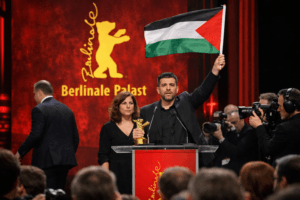
Syrian-Palestinian director Abdallah Al-Khatib stood at the podium, a Palestinian flag eventually raised in his hand, and delivered words that would echo far beyond the theater walls. “The German government are partners in the genocide in Gaza by Israel,” he declared after accepting the Best Feature Film Debut award for Chronicles From the Siege. Then came the warning: “The long awaited day is coming, and when people ask you what happened, tell them: Palestine remembers.”
Within minutes, German Environment Minister Carsten Schneider was walking out. Within hours, Berlin’s conservative mayor was denouncing the ceremony in the tabloids. And by morning, a familiar German debate had reignited with fresh fury—one that pits artistic freedom against historical responsibility, humanitarian concern against institutional memory, and the language of human rights against the unique weight of German guilt.
The Speeches That Shook the Room
To understand the backlash, you have to understand what was actually said—and what it meant in a country where criticizing Israeli policy operates under different rules than almost anywhere else in the Western world.
Al-Khatib’s words were carefully constructed, delivered by a man who acknowledged the risk he was taking. “Some people told me, maybe you have to be careful before you say what I want to say now, because you are a refugee in Germany, and there are so many red lines,” he told the audience. “But I don’t care. I care about my people, about Palestine.”
His film, Chronicles From the Siege, never explicitly names Gaza. But it doesn’t need to. The episodic drama follows Palestinian life amid the rubble of a destroyed city, capturing existence under conditions that most Berlinale attendees have only ever witnessed through screens. For Al-Khatib, accepting an award in Berlin while his people endured bombardment in Gaza created an unbearable contradiction—one he refused to paper over with grateful pleasantries.
He wasn’t alone on stage that night. Lebanese director Marie-Rose Osta, whose short film Someday a Child won the Golden Bear, used her moment to connect her artistic work to the reality outside the festival bubble. “In reality children in Gaza, in all of Palestine and in my Lebanon do not have superpowers to protect them from Israeli bombs,” she said. “No child should need superpowers to survive a genocide empowered by veto powers and the collapse of international law.”
Both directors spoke as artists whose work had been validated by a major European institution—but also as people from a region being devastated by a war that Germany, through weapons sales and diplomatic support, had materially enabled.
The Walkout and the Wrath
Carsten Schneider’s departure from the gala was the first visible crack in the evening’s veneer. The minister’s office later issued a careful statement calling the comments “unacceptable,” but the political class quickly escalated beyond measured bureaucratic language.
Berlin’s mayor Kai Wegner went straight to Bild, Germany’s most powerful tabloid, with words designed for maximum impact. The ceremony had been “misused for political destruction,” he claimed, depriving artists “of their unique moment of recognition for their work.” Then came the broader accusation: those expressing pro-Palestinian views at the festival “are not concerned with human rights. They are not concerned with dialogue, peace or nuanced criticism. They are solely concerned with hatred of Israel.”
On X, Alexander Hoffmann, a parliamentarian for Bavaria’s Christian Social Union, described “disgusting scenes” filled with “absolutely unacceptable…accusations of genocide, antisemitic outbursts and threats against Germany.” The language was striking—not just because it conflated criticism of Israeli policy with antisemitism, but because it framed the speeches as threats against Germany itself.
This is the peculiar geometry of German political discourse around Israel. Criticism of Israeli military action doesn’t just risk being labeled antisemitic; it risks being framed as an attack on Germany’s foundational postwar identity. For a political establishment that has built its moral authority on the phrase “Never Again,” any challenge to Israel’s actions becomes an implicit challenge to Germany’s understanding of its own redemption.
The Numbers Behind the Emotion
Lost in much of the coverage was the actual context that drove Al-Khatib and Osta to speak. The war in Gaza, which began after Hamas’s October 7, 2023 attacks killed approximately 1,200 Israelis and resulted in more than 250 hostages, has since killed more than 70,000 Palestinians according to official counts. A study published in The Lancet Global Health puts the death toll above 75,000, with women, children and elderly people comprising the majority of those killed.
Germany has continued weapons sales to Israel throughout the conflict, with only a brief pause between August and November 2025 when Chancellor Friedrich Merz cited concerns about German-made weapons being used in Gaza. Merz has criticized specific Israeli actions, but the overall trajectory of German policy has remained consistent: support for Israel’s right to self-defense, even as that defense has reduced entire neighborhoods in Gaza to rubble.
For Al-Khatib, watching from Europe as his people died with weapons potentially enabled by his host country, silence would have been its own form of complicity. “I don’t care” about the red lines, he said—a declaration of independence from the unwritten rules that govern what can be said about Israel in German cultural spaces.
The Ghost of Berlinale Past
This wasn’t the first time the Berlin Film Festival has found itself at the center of this particular storm. In 2024, the documentary No Other Land—which chronicles Israeli settler violence against Palestinians in the West Bank—won both the audience award and the best documentary prize. Its Israeli co-director Yuval Abraham used his acceptance speech to call out what he termed the “apartheid” system in Israel, triggering outrage from German politicians and accusations of antisemitism.
The film went on to win the Oscar for Best Documentary Feature, but in Germany the controversy lingered. Conservative politicians demanded investigations, festival programmers faced scrutiny, and a pattern emerged: Palestinian and Israeli critics of Israeli policy would be welcomed onto festival stages, then condemned when they actually spoke.
This year’s edition followed the same arc. Jury president Wim Wenders had already drawn fire earlier in the festival for suggesting, in response to a press conference question about Gaza, that filmmakers “have to stay out of politics.” The comment seemed almost willfully naive given the Berlinale’s long history of political cinema, and it set the stage for the confrontations to come.
By the awards ceremony, Wenders attempted a more nuanced position. The disputes, he suggested, reflected an “artificial discrepancy” between “the language of cinema”—which he called “empathetic”—and the “effective” language of social media activism. “Activists are fighting, mainly on the internet, for humanitarian causes, namely the dignity and protection of human life. These are our causes as well, as the Berlinale films clearly show,” Wenders said. “But does it need to be in competition with us? Do our languages need to clash?”
It was a plea for coexistence that satisfied almost no one. Activists heard a dismissal of their methods; filmmakers heard a defense of apolitical art that cinema’s greatest works have always disproven; and the politicians already sharpening their knives heard only weakness.
The Weight of German Memory
To understand why this particular controversy carries such voltage, you have to understand the unique position Germany occupies in discussions of Israel. The Holocaust—the systematic murder of six million European Jews—was planned and executed from German soil. The postwar German state built itself partly on the promise of never repeating that horror, and support for Israel’s security became a foundational element of German national identity.
This isn’t cynical politics for many Germans; it’s genuine moral conviction. When German politicians hear comparisons between Israeli actions and genocide, they don’t just hear political disagreement—they hear an assault on the framework that has guided their country for eighty years. If Israel can be a genocidal state, then what does “Never Again” even mean?
But that framework creates its own blind spots. German support for Israel has often translated into reluctance to criticize Israeli policy, even when that policy draws condemnation from human rights organizations and international law experts. Criticism of Israel becomes, in this context, not just politically uncomfortable but existentially threatening—a challenge to the very basis of German moral legitimacy.
The result is a public discourse where even measured criticism of Israeli military action can trigger accusations of antisemitism, and where Palestinian voices are frequently marginalized or silenced. Al-Khatib’s speech broke through that silence—and the backlash proved exactly why such silence had been enforced.
The Artists’ Dilemma
For filmmakers like Al-Khatib and Osta, the Berlinale presented an impossible choice. Accept awards without speaking and risk complicity in the very systems they critique. Speak truth as they see it and risk professional consequences, public vilification, and the weaponization of accusations they can never fully refute.
Al-Khatib was acutely aware of his vulnerability. A refugee in Germany, dependent on the hospitality of a country whose government he was condemning, he spoke anyway. The Palestinian flag at the end of his speech wasn’t just a symbol of national identity—it was a declaration that some things matter more than safety.
Osta connected her film about children to the children dying in Gaza and Lebanon, refusing to let art exist in a separate sphere from reality. “If this Golden Bear means anything, let it mean that Lebanese and Palestinian children are not negotiable,” she said—claiming the festival’s prestige for a humanitarian message that many in the room, and many more in the German political class, desperately wanted to keep separate.
What Comes Next
The Berlinale has promised to respond formally, though its statement won’t come until Tuesday—too late for the weekend news cycles but in time for the midweek papers. Whatever the festival says, it faces an impossible situation. Condemn the speeches and alienate the artists who make the festival matter. Defend them and invite renewed political attacks. Say nothing and be consumed by the controversy either way.
Meanwhile, the war in Gaza continues. The children Osta spoke about remain unprotected. The siege Al-Khatib documented shows no signs of ending. And Germany remains committed to a policy that provides Israel with weapons while struggling to accommodate the voices of those most affected by their use.
The controversy at the Berlinale will fade, replaced by other outrages, other speeches, other walkouts. But the questions raised on that stage won’t disappear so easily. Can German support for Israel accommodate criticism of Israeli actions? Can European cultural institutions truly welcome Palestinian voices without demanding their silence? And in a country built on the memory of genocide, what space exists for those who see genocide happening again, with their own government’s complicity?
Al-Khatib said Palestine will remember—who stood with Palestinians, who stood against them, who chose silence. But Germany remembers too, sometimes in ways that make genuine engagement impossible. The clash at the Berlinale wasn’t just about one night or one speech. It was about two memories colliding, two histories refusing to reconcile, and the impossibility of finding common ground when the ground itself is soaked in blood.
The velvet seats of the Berlinale Palast will host another ceremony next year. The speeches will be different, the controversies perhaps milder. But unless the underlying reality changes—unless the war ends, unless the weapons stop flowing, unless Palestinian voices can speak without being automatically suspect—the ghosts will return. They always do.
You must be logged in to post a comment.