
Beyond the Raid: Why the Assault on UNRWA is a Direct Attack on the Last Pillar of Stability in Palestine
In a unified diplomatic condemnation, eight influential Arab and Islamic nations—Pakistan, Egypt, Indonesia, Jordan, Qatar, Saudi Arabia, Türkiye, and the UAE—have denounced the Israeli military’s raid on the UNRWA headquarters in East Jerusalem as a flagrant violation of international law and the inviolability of UN premises. The ministers emphasized that this aggression directly contravenes a recent International Court of Justice advisory opinion obligating Israel, as the occupying power, to facilitate the agency’s work.
They underscored UNRWA’s indispensable and irreplaceable role as the critical lifeline for millions of Palestinian refugees, providing education, healthcare, and emergency aid, particularly amid Gaza’s unprecedented humanitarian crisis. The statement serves as a stark warning that any weakening of UNRWA would have severe regional repercussions, and it urgently calls upon the international community to ensure the agency’s sustained funding and operational freedom as a cornerstone of stability and human dignity until a just political solution is achieved.
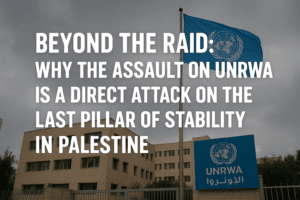
Beyond the Raid: Why the Assault on UNRWA is a Direct Attack on the Last Pillar of Stability in Palestine
Introduction: A Violation of the Unviolatable
In the pre-dawn hours of December 12, 2025, the familiar blue and white flag of the United Nations, symbolizing impartiality and protection under international law, failed to deter Israeli forces. The raid on the UNRWA headquarters in Sheikh Jarrah, East Jerusalem, was not merely another headline in the long Israeli-Palestinian conflict. It was a deliberate strike at the very heart of the international community’s most fundamental covenant: the inviolability of humanitarian space.
The swift, unified response from Pakistan, Egypt, Indonesia, Jordan, Qatar, Saudi Arabia, Türkiye, and the UAE reveals more than diplomatic solidarity. It exposes a raw nerve—a collective recognition that the assault on UNRWA is a catalyst for a potential regional unravelling. This statement is not just a condemnation; it is a stark warning about what happens when the last remaining scaffolding holding up a shattered society is deliberately kicked away.
The Legal Breach: More Than a Property Crime
The ministers’ statement meticulously anchors its outrage in specific legal frameworks, transforming the incident from a localized clash into a matter of global jurisprudence.
- Violation of UN Inviolability: The 1946 Convention on the Privileges and Immunities of the United Nations is unequivocal: UN premises, archives, and documents are “inviolable.” This principle is the bedrock that allows humanitarian and diplomatic work to proceed in conflict zones. The raid shatters this precedent, setting a dangerous template for other conflict zones where state actors might see UN symbols as mere inconveniences rather than protected entities.
- Defiance of the International Court of Justice (ICJ): The reference to the ICJ’s advisory opinion of October 22, 2025, is particularly potent. This recent ruling likely clarified (as per the statement) Israel’s obligation not to impede and to facilitate UNRWA’s work. The raid, therefore, is framed not as an isolated act of aggression, but as a state openly defying the world’s highest court. This elevates the crisis from a political dispute to a challenge of the international rules-based order itself.
- Contempt for UN Resolutions: The statement weaves a tapestry of legitimacy for UNRWA, citing its founding resolution (302 of 1949) and its recent three-year renewal. This highlights a profound disconnect: while the overwhelming majority of the international community votes to sustain and fund the agency, the occupying power on the ground physically storms its offices. This contradiction lays bare the fragility of international law when faced with unilateral force.
UNRWA: The Irreplaceable Lifeline in Gaza’s Perfect Storm
To understand the profound alarm in the ministers’ words, one must grasp what UNRWA truly represents on the ground, especially in Gaza. It is not simply an aid distributor; it is a parallel foundational infrastructure for a population under siege.
- A School System Amid Rubble: UNRWA runs over 280 schools in Gaza, educating nearly 300,000 children. In a territory where trauma is endemic, these schools provide not just literacy and math, but a fragile sense of routine, normalcy, and psychosocial support. Their collapse would mean a generation with no structured education, a fertile ground for desperation and radicalization.
- The Healthcare Backbone: With Gaza’s public health system decimated, UNRWA’s 22 health centers handle millions of patient consultations annually. They manage vaccinations, prenatal care, chronic diseases, and the relentless wounds of war. They are the primary—often only—reason outbreaks of cholera or severe pandemics have not already occurred.
- Logistics of Survival: The statement references Security Council Resolution 2803, which likely mandates humanitarian access. UNRWA possesses the only distribution network with the warehouses, trucks, and—most critically—the trusted local staff to navigate the treacherous landscape of checkpoints and ruined roads. No other organization, not even other UN agencies, has this granular, block-by-block capability. As one former aid official noted, “Without UNRWA’s lists and local knowledge, aid would simply pile up at the border or be looted.”
The ministers’ inclusion of the phrase “contributes to the implementation of President Trump’s Plan on the ground” is a fascinating and pragmatic diplomatic twist. It suggests an attempt to frame UNRWA’s work as a stabilizing force that serves broader geopolitical goals, even those initially seen as unfavorable to Palestinians, by enabling people to “remain in their land.”
The Geopolitical Calculus: Why These Eight Nations Spoke as One
The coalition behind this statement is a powerful mosaic of modern Islamic diplomacy, representing a combined population of over 1 billion and significant economic, political, and religious weight.
- The Frontline States (Egypt & Jordan): For Cairo and Amman, UNRWA’s stability is a direct national security issue. A total collapse in Gaza would exacerbate refugee pressures on their borders and fuel extremist narratives. They see UNRWA as a critical buffer.
- The Gulf Powers (Saudi Arabia, UAE, Qatar): While differing in their recent approaches to Israel, they converge on the necessity of preserving Palestinian societal integrity. Their funding is crucial for UNRWA. The raid threatens to destabilize the very institutions they invest in to prevent a total humanitarian catastrophe that would provoke unrest across the Muslim world.
- The Muslim Heavyweights (Pakistan, Indonesia, Türkiye): For these nations, the Palestinian cause remains a potent symbol of Islamic solidarity and justice. Their vocal stance is both a reflection of domestic public opinion and an assertion of their roles as leaders of the Muslim world. Türkiye, in particular, has positioned itself as a staunch advocate for Palestinian rights under Erdogan.
Their unified front signals to Washington and European capitals that support for Israel, even in its security concerns, cannot extend to the strangulation of an agency that is the sole barrier between Gaza and outright famine and societal disintegration.
The Historical Shadow and the Fear of “Alternatives”
The ministers’ insistence that UNRWA’s role is “irreplaceable” is a direct rebuttal to long-standing political efforts, primarily from Israel and some US lawmakers, to dismantle the agency. Their argument often posits that UNRWA “perpetuates” the refugee issue.
The reality on the ground, as the eight nations emphasize, is that no alternative exists. The idea that the UNHCR or a patchwork of NGOs could absorb UNRWA’s functions in the midst of active conflict and blockade is a fantasy. The transition would take years of stable conditions—the very conditions absent in Gaza, the West Bank, Lebanon, Syria, and Jordan. The “grave humanitarian, social, and political repercussions” warned of are not hypothetical. They would manifest as:
- Immediate suspension of food distribution to over 1 million people.
- The shuttering of every school for refugee children.
- The collapse of primary healthcare, leading to preventable deaths.
- A vacuum filled by non-state actors, further destabilizing the region.
Conclusion: A Line in the Sand for Humanity and Stability
The joint statement from these eight nations is ultimately a cry of strategic alarm. The raid on UNRWA’s headquarters is a symbol of a broader, more dangerous campaign of erosion. It is a test of whether the principles of humanitarian law and UN neutrality can survive the pressures of a prolonged, brutal conflict.
Supporting UNRWA, as the ministers conclude, is framed not as a pro-Palestinian political stance, but as the “cornerstone of maintaining stability and preserving human dignity.” It is a plea to see the agency not through the lens of political disputes over refugee status, but as the essential mechanics of survival for millions.
The world now faces a choice: interpret this raid as just another skirmish in a complex conflict, or heed the warning from a significant swath of the global community. To allow UNRWA to be crippled is not to take a side in a historical quarrel; it is to willingly dismantle the last functioning infrastructure in a tortured land and accept the assured, horrific consequences. The eight foreign ministers have not just condemned an action; they have sounded the alarm on a precipice. The international community’s response will reveal how much of its humanity, and its common sense, it retains.
You must be logged in to post a comment.