
Beyond the Raid: Why Eight Nations Are Drawing a Line in Jerusalem and What It Means for Palestine’s Future
In a significant show of unified political will, the foreign ministers of eight pivotal Arab and Islamic nations—Egypt, Jordan, Saudi Arabia, the UAE, Qatar, Türkiye, Pakistan, and Indonesia—have jointly condemned the Israeli raid on UNRWA’s Jerusalem headquarters, framing the incident as a direct assault on international law and the inviolability of UN premises that blatantly disregards a recent International Court of Justice advisory opinion.
Their statement strategically defends UNRWA not merely as a humanitarian aid provider but as an indispensable institutional buffer against total collapse, arguing that its unique schools, clinics, and distribution networks are the sole structures preventing a catastrophic escalation of hunger, displacement, and radicalization, particularly in Gaza. By uniting a bloc that includes both traditional leaders and normalization states, the condemnation serves as a stark warning to the international community that undermining UNRWA’s mandate and funding would not resolve the conflict but would instead guarantee severe humanitarian disaster and regional destabilization, making the agency’s support a fundamental pillar for stability and a test of commitment to international legal order.
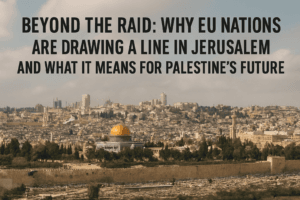
Beyond the Raid: Why Eight Nations Are Drawing a Line in Jerusalem and What It Means for Palestine’s Future
In the tangled, tense streets of East Jerusalem’s Sheikh Jarrah neighborhood, a place already emblematic of displacement and resistance, another front has opened. This time, the target wasn’t a family home, but a building flying the United Nations flag: the headquarters of the United Nations Relief and Works Agency for Palestine Refugees (UNRWA). The immediate image—Israeli forces raiding a UN compound—is stark enough. But the reverberating response, a unified joint statement from the Foreign Ministers of Pakistan, Egypt, Indonesia, Jordan, Qatar, Saudi Arabia, Türkiye, and the United Arab Emirates, signals something far more significant than a single diplomatic protest. It is a collective, calculated move to shield what these nations see as the last remaining institutional bulwark against the total unraveling of the Palestinian refugee issue, and a direct challenge to Israel’s compliance with international law.
To understand the depth of their condemnation, one must first look past the rubble of Gaza and recognize UNRWA’s unique and fraught place in history. Created in 1949 by UN General Assembly Resolution 302, UNRWA was always intended as a temporary agency, a humanitarian stopgap for those displaced by the 1948 war. Yet, temporary in the UN lexicon often becomes perpetual in the face of political deadlock. Seventy-six years later, UNRWA is not just an aid provider; it is a parallel governance structure for over 5.9 million registered Palestinian refugees across Jordan, Lebanon, Syria, the West Bank, and Gaza. It runs schools for over 500,000 children, health clinics serving millions, and a social safety net that, however frayed, maintains a semblance of order. Its very existence is a tangible, institutional reminder of the unresolved question of Palestinian refugee rights, codified in UN Resolution 194. This is precisely why it is perpetually in the crosshairs.
The Sheikh Jarrah raid, therefore, is not an isolated act of property violation. As the eight-nation statement explicitly frames it, it is a “flagrant violation of international law and the inviolability of UN premises.” The inviolability of UN facilities is a cornerstone of the UN Charter and the 1946 Convention on the Privileges and Immunities of the United Nations. Breaching it is a symbolic attack on the international order itself. More pointedly, the ministers link the raid directly to the advisory opinion of the International Court of Justice (ICJ) from October 22, 2025. That opinion, a powerful though non-binding legal instrument, clearly obliges Israel, as the occupying power, to facilitate, not impede, UNRWA’s operations. By storming its headquarters, Israel is seen as openly flouting the world’s highest court, a move that emboldens the ministers’ argument that this represents an “unacceptable escalation.”
The composition of the coalition behind the statement is itself a story of shifting alliances and convergent interests. It bridges traditional Arab leadership (Egypt, Jordan, Saudi Arabia), Gulf power (Qatar, UAE), and non-Arab Muslim-majority giants (Pakistan, Indonesia, Türkiye). This is not the old, often fragmented Arab League chorus. It represents a strategic bloc that combines diplomatic weight, economic heft, and, in some cases, recent normalization partners with Israel (like the UAE). Their unity here is a powerful message to Washington and European capitals: support for UNRWA is a non-negotiable red line for a significant part of the Muslim world, one that transcends the normal political fissures. For nations like Jordan, which hosts 2.2 million registered refugees, UNRWA’s collapse would be an existential threat to domestic stability. For others, it is a matter of regional credibility and defending a core pan-Islamic cause.
The statement’s most poignant, and arguably most insightful, section delves into the “unprecedented humanitarian crisis in the Gaza Strip.” Here, the ministers articulate a brutal truth: in the aftermath of war, where governance has evaporated and infrastructure lies in ruins, UNRWA is the state. Its distribution networks are the only mechanism to stave off famine. Its schools, operating in tents or shattered buildings, are the last defense against a “lost generation.” Its health clinics treat everything from shrapnel wounds to childhood diseases amidst critical shortages. The line noting that this work “enables the Palestinian people to remain in their land” is crucial. It subtly counters accusations that UNRWA perpetuates the refugee issue, arguing instead that by providing the bare minimum for survival, it prevents a second, forced displacement—a mass exodus from Gaza that would irrevocably alter the demographic and political landscape of the conflict.
Perhaps the most compelling argument made, and one aimed directly at donor nations in the West who have periodically threatened to defund the agency, is the pragmatic one: UNRWA is “irreplaceable.” As the ministers state, “No other entity possesses the infrastructure, expertise, and field presence.” The fantasy that NGOs or other UN bodies could seamlessly absorb UNRWA’s functions is just that—a fantasy. The collapse of UNRWA would not mean a more efficient transition of services; it would mean the immediate termination of schooling for half a million children, the end of primary healthcare for millions, and the collapse of food distribution in Gaza. The resulting vacuum would not lead to peace, but to uncontrollable desperation, radicalization, and violence, spilling across borders. The “grave humanitarian, social, and political repercussions” they warn of are not hyperbole, but a near-certain forecast.
The call for “sustainable and adequate funding” is the statement’s beating heart. UNRWA has lurched from one financial crisis to another for over a decade, its budget subject to the political whims of its largest donors. This makes long-term planning impossible and forces the agency to cut essential services, eroding its effectiveness and playing into the hands of its critics. The eight nations are effectively urging the international community to put its money where its mandates are. If the UN General Assembly routinely votes to renew UNRWA’s mandate with overwhelming majorities, then funding it is a logical, legal, and moral obligation.
In conclusion, the joint statement is more than a condemnation; it is a strategic repositioning. It frames support for UNRWA not merely as charity for Palestinians, but as a fundamental pillar of international law, regional stability, and basic human dignity. By invoking the ICJ opinion, they are legalizing their stance. By highlighting UNRWA’s operational indispensability, they are pragmatic. By uniting a powerful bloc, they are demonstrating political will.
The raid on the Sheikh Jarrah headquarters is a symptom. The underlying disease is the systematic effort to dismantle the international community’s commitment to Palestinian refugees, to memory, and to rights. These eight nations are issuing a stark warning: allowing UNRWA to be crippled or to fail is not a path to peace, but a recipe for a fire that will consume the region for generations. They are drawing a line, not just around a UN compound, but around the last collective agreement the world ever made about the Palestinian people. The world’s response will reveal whether that agreement still holds any weight.
You must be logged in to post a comment.