
Beyond the Price Tag: How a New Generation is Redefining Indian Art Collecting
Beyond the Price Tag: How a New Generation is Redefining Indian Art Collecting
For decades, the Indian art market operated on a relatively straightforward premise: a gallery showcased an artist, a collector admired the work, a transaction occurred, and the artwork moved from a white-walled space to a private living room. While this commercial cycle remains the lifeblood of the industry, a profound structural shift is currently reshaping the landscape. According to leading voices in the Indian art ecosystem, the market is moving decisively away from purely transactional, investment-driven acquisition toward a model defined by engagement, education, and long-term patronage.
In a recent discussion that brought together gallerists, curators, and educators, a consensus emerged: the Indian art world is no longer just about “buying art”; it is about living with it, understanding it, and supporting the ecosystems that create it.
The Engagement Economy: When Connection Precedes Collection
The old adage “collect what you love” is taking on a new, more rigorous meaning. Mamta Singhania, Founder and Director of Anant Art, articulated a philosophy that many galleries are now adopting as a survival strategy in a cluttered market. “We have always been less market-driven because we feel that, first come engagement, connections, interaction between audiences and artists, audiences and the art spaces, and then collectors follow,” she explained.
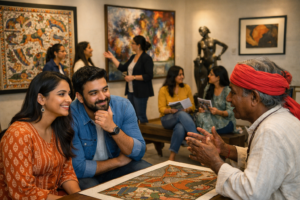
This approach flips the traditional commercial funnel. Instead of pushing sales, galleries are now functioning as discursive environments—spaces for dialogue. Singhania noted that first-time collectors are no longer walking in asking for the “best investment”; they are seeking clarity on artistic intent, cultural relevance, and the story behind the brushstroke. This shift is particularly driven by a younger demographic. Unlike previous generations who often viewed art as a status symbol or a hedge against inflation, younger collectors in their 30s and 40s prioritize emotional resonance and contextual meaning.
They want to know the artist’s journey, the socio-political context of the work, and the materials used. This desire for depth is transforming gallery visits from quick viewings into extended experiences involving walkthroughs, artist interactions, and discursive events.
The Indigenous Art Conundrum: Bridging Two Worlds
One of the most critical areas where this engagement-led approach is making a tangible difference is in the representation of indigenous, folk, and tribal art. Anubhav Nath, Founder and Director of Ojas Art Gallery, pointed out a persistent structural divide in the market. “By the indigenous arts, I mean the folk arts, tribal arts, the vernacular arts of India. It was a completely different market/ ecosystem,” he said.
Nath highlighted that the training systems, pricing structures, and visibility pathways for indigenous artists are vastly different from their contemporary, formally trained counterparts. While a contemporary artist might emerge from a prestigious institution like the M.S. University or the Sir J.J. School of Art with a network of curators and galleries, an indigenous artist—trained within community or family traditions—often operates in isolation.
“The price points were very different, much lower and even today, they remain to be lower as compared to the other markets,” Nath observed. This disparity isn’t just about economics; it’s about recognition. To integrate these rich practices into the broader contemporary art discourse, Nath argues that a different curatorial framework is required. It necessitates structured documentation, sustained exhibition platforms, publications, and collaborations that allow works by Gond, Warli, or Madhubani artists to sit alongside contemporary works without being relegated to the category of “craft” or “decoration.”
Initiatives like the Ojas Art Award are crucial here. By identifying practitioners from different regions and supporting their integration into curated exhibitions and institutional networks, they provide the scaffolding needed for these artists to build sustainable careers. For collectors, engaging with this category offers a unique opportunity: lower entry price points combined with the profound satisfaction of preserving and promoting heritage.
The Democratization of Art Education
If galleries are the frontline of engagement, then institutions, curators, and digital platforms are the engines of education. Shaleen Wadhwana, Curator and Art Educator, emphasized that structured educational programmes and residencies are vital for bridging the gap for emerging artists, particularly those from lesser-known art schools.
But education isn’t just for the artists; it’s for the audience. Wadhwana noted that the intimidation factor associated with art spaces is being actively dismantled. Gallery visits and art fairs are increasingly designed to encourage questioning and dialogue. Programming is becoming multilingual to ensure broader participation across India’s diverse linguistic communities. “You have to be a friend to the ecosystem,” Wadhwana said, advocating for a shift in mindset from passive viewing to active participation.
Furthermore, the role of digital access over the last three decades cannot be overstated. The internet has flattened the world for art enthusiasts. A student in Nagpur can now take a virtual tour of the Museum of Modern Art (MoMA) in New York, while a collector in Mumbai can follow the careers of South Asian artists exhibiting in London. This constant exposure has created a more informed, research-oriented audience. Collectors are arriving at fairs armed with knowledge, often more aware of international market trends and historical contexts than their predecessors.
The Rise of Long-Term Patronage
As the market matures, the relationship between collector and artist is evolving from a transactional one to a collaborative partnership. Mamta Singhania noted that collecting is increasingly being understood as long-term patronage. The most sophisticated collectors are those who follow an artist’s career over extended periods, supporting them through multiple exhibitions and stages of development. This continuity provides artists with the financial stability and psychological encouragement needed to take creative risks and push their practice forward.
This trend is amplified by experiential engagement. Anubhav Nath observed that younger collectors are participating in travel-based learning—visiting museums, festivals, and artist-led spaces. This is especially visible in the indigenous art category, where direct interaction with the artist in their native environment fosters a deeper connection than a gallery meeting ever could.
Navigating the Commercial vs. Aesthetic Tightrope
With the market shifting toward engagement, a delicate question arises: what happens to the commercial imperative? Is there a risk that art becomes too “educational” or that the demand for engagement pressures artists to produce palatable, easily explainable work?
The panellists offered a balanced perspective. Singhania dismissed the notion that commercial and aesthetic considerations are opposing forces. She argued that a healthy balance is essential—artists need economic support to maintain their creative integrity, and galleries play a key role in sustaining that equilibrium.
However, caution was advised. Nath warned against the danger of repetitive production driven solely by market demand. “There is a need to avoid repetitive production driven solely by market demand, particularly within indigenous art practices,” he noted. The role of the curator, he suggested, is to encourage experimentation and the development of new bodies of work that reflect evolving creative directions, rather than just churning out what sold last season.
Wadhwana added that resilience is key. Galleries and foundations must be willing to support artists over long timeframes, understanding that market recognition and valuation often evolve gradually across years, not in short auction cycles.
The Road Ahead: Friendship and Sustainability
As the Indian art ecosystem looks to the future, the panellists agreed that industry participation is essential. The growth of the sector relies on more than just buying and selling; it relies on the proliferation of awards, residencies, and mentorship programmes that build a robust infrastructure.
Ultimately, the message was one of holistic growth. As Wadhwana put it succinctly, “Just in expressing that friendship is how you actually learn and support the ecosystem.”
The takeaway for the modern Indian art enthusiast is clear. Whether you are a seasoned collector or a curious newcomer, the value of art is no longer just in its market price. It lies in the stories it tells, the communities it sustains, and the conversations it starts. The Indian art market is no longer just a marketplace; it is becoming a learning landscape, and those willing to engage deeply are discovering that the greatest returns are often not financial, but intellectual and emotional.
You must be logged in to post a comment.