
Beyond the Press Release: Inside IBM’s New India Hub and the Blueprint for Sovereign AI Infrastructure
IBM’s new Sangam Infrastructure Innovation Center in Bengaluru represents a strategic evolution beyond a traditional research lab, functioning as a collaborative hub where the company’s deepest systems engineers work alongside clients and Global Capability Centers to solve the complex, real-world challenges of deploying AI at scale. By focusing on the critical “last mile” of enterprise adoption—such as integrating data governance into hybrid cloud fabric, optimizing energy-intensive workloads, and ensuring security across core systems—the center directly addresses the shift from AI experimentation to industrialization. This move leverages India’s unique combination of deep technical talent and market velocity to build infrastructure solutions tailored for local needs, like supporting the scale of UPI, which are then designed to be exported globally as a blueprint for secure, responsible, and resilient AI.
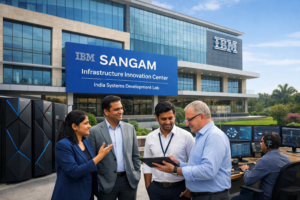
Beyond the Press Release: Inside IBM’s New India Hub and the Blueprint for Sovereign AI Infrastructure
On the surface, the ribbon-cutting at a new corporate facility is a familiar ritual. But when IBM inaugurated its first “Infrastructure Innovation Center” in India this week, the event signaled something far more profound than a simple real estate expansion. Nestled within the company’s new India Systems Development Lab (ISDL) campus, the center—dubbed the Sangam (a Sanskrit word meaning “confluence” or “coming together”)—represents a strategic inflection point for the tech giant and a potential blueprint for how enterprise artificial intelligence (AI) will be built, scaled, and governed in one of the world’s fastest-growing digital economies.
The announcement on March 4, 2026, comes at a pivotal moment. The global conversation around AI has shifted. It is no longer just about who has the most advanced large language model, but about who can deploy AI securely, sustainably, and at scale. The “compute arms race” is over; the “infrastructure endurance test” has begun. And IBM is betting heavily that the answer to this test will be engineered in India.
More Than a Lab: The ‘Sangam’ Philosophy
To understand the significance of the Sangam Infrastructure Innovation Center, one must first understand the evolution of IBM’s presence in India. The ISDL has long been a crown jewel in the company’s global engineering network, responsible for mission-critical work on mainframes, storage, and Power Systems. This new center, however, is not just an engineering outpost; it is designed as a collaborative war room for the AI era.
“We are moving from the era of experimentation to the era of industrialization,” a senior IBM architect at the new facility explained during a preview tour. “Clients don’t just want a demo anymore. They want to know: How do I run this AI model without crashing my core banking system? How do I govern data flowing from a thousand edge devices? That’s the messy, complex reality we’re here to solve.”
The center is architected to de-risk that reality. It brings together IBM’s top systems architects, infrastructure specialists, and AI engineers to sit side-by-side with clients, Independent Software Vendors (ISVs), and Global Capability Centers (GCCs). This co-creation model is a direct response to a glaring market gap: the silos between AI software developers and the hardware infrastructure teams.
Too often, a brilliant AI model fails in production because the underlying infrastructure—the hybrid cloud architecture, the storage latency, the security protocols—wasn’t designed for it. The Sangam center aims to bridge this gap, allowing a retail bank, for example, to simulate a fraud-detection AI workload on a test mainframe, tweaking the architecture in real-time with the very engineers who designed the silicon.
Why India? The Perfect Storm of Talent and Transformation
IBM’s decision to locate this global asset in India is not arbitrary. It is a recognition of a unique confluence of factors that exist nowhere else on the same scale.
First, there is the talent density. The ISDL represents decades of accumulated intellectual property in systems design. These are the engineers who understand the firmware, the microcode, and the thermal dynamics of the world’s most powerful computers. Applying that deep systems-level knowledge to the relatively nascent field of AI infrastructure creates a powerful competitive advantage.
Second, there is the market velocity. India is not just a services economy anymore; it is a product and innovation economy. As noted in the recent IBM Institute for Business Value study cited in the announcement, Indian enterprises are aggressively investing in AI readiness. The study’s finding that 58% of Indian organizations have increased infrastructure investments due to AI demand underscores a market that is leapfrogging legacy constraints. For a GCC of a global automotive company or a home-grown Indian fintech unicorn, having access to this center means they can build and test solutions for the Indian market—which has unique scale, linguistic diversity, and regulatory requirements—and then export that intellectual property to the rest of the world.
Subhathra Srinivasaraghavan, Vice President, IBM India Systems Development Lab, captured this sentiment perfectly when she stated, “AI is only as powerful as the infrastructure that supports it.” In an exclusive interview following the launch, she elaborated: “When we talk to clients here, they are worried about three things: security, skilling, and scalability. This center is our answer. We are not just showing them our technology; we are helping them build their technology on a foundation that is inherently secure and infinitely scalable.”
The Technical Core: Building for Resilience and Trust
While the collaborative aspect is a headline-grabber, the true value of the Sangam center lies in its technical focus areas. It is designed to tackle the “last mile” problems of enterprise AI.
One key area is “Responsible Operations.” As AI models become more autonomous, the infrastructure must enforce guardrails. At the center, teams will work on integrating governance policies directly into the hybrid cloud fabric, ensuring that an AI application accessing sensitive customer data does so in compliance with India’s evolving Digital Personal Data Protection framework. This is about baking trust into the silicon and software stack, not adding it as an afterthought.
Another critical focus is hybrid by design. The reality for most large Indian enterprises—from banks to government agencies—is that data cannot all live in a public cloud. It resides in core data centers, at the edge in retail stores, and in private clouds. The Sangam center is equipped to simulate these complex hybrid environments, allowing clients to test how AI workloads can be distributed seamlessly across on-premise IBM Z systems, Power servers, and public clouds like AWS, Azure, or IBM Cloud.
Finally, there is the sustainability angle. AI is power-hungry. As Indian enterprises scale their AI ambitions, energy consumption becomes a board-level concern. The infrastructure innovation center will showcase advances in liquid cooling, energy-efficient processor design, and workload-optimized architectures that promise to deliver more compute per watt. For a country powering its digital future, building sustainable infrastructure isn’t just good PR; it’s an operational necessity.
A Catalyst for the GCC Ecosystem
Perhaps the most strategic element of this launch is its timing with the explosion of Global Capability Centers (GCCs) in India. Multinational corporations are establishing their own captive centers in the country to drive internal innovation. These GCCs are hungry for cutting-edge infrastructure but often lack the deep hardware expertise that IBM possesses.
By opening its doors to this community, IBM is positioning itself as the engineering partner of choice for the GCC economy. A European bank’s GCC in Bengaluru can now use the Sangam center to architect its next-generation core banking platform on IBM’s latest LinuxONE system, with the confidence that the same architecture can be replicated for its headquarters in Frankfurt.
Sandip Patel, Managing Director of IBM India & South Asia, emphasized the local-to-global nature of the investment. “This Center reflects IBM’s long-term commitment to India and strengthens our ability to design, build, and scale infrastructure solutions locally; tailored to India’s unique market needs while contributing to global innovation,” he said.
This is a subtle but crucial point. The solutions born in the Sangam center—perhaps an AI model optimized for detecting fraud in the Unified Payments Interface (UPI) system, or a telco analytics platform designed for India’s hyper-competitive data market—will have relevance far beyond India’s borders. They will become part of IBM’s global product portfolio, solving similar challenges in other emerging markets and developed economies alike.
Conclusion: The Infrastructure of Possibility
The launch of the Sangam Infrastructure Innovation Center is a statement of intent. It signals that the next wave of AI innovation will not be driven by software breakthroughs alone, but by the robust, secure, and intelligent infrastructure that underpins them.
By choosing India as the birthplace for this initiative, IBM is acknowledging that the future of technology is increasingly multi-polar. The problems to be solved in India—extreme scale, diversity, and the need for secure, compliant digital public goods—are the same problems the rest of the world will eventually face.
As enterprises pack up their proof-of-concepts and get serious about production, they will need more than just cloud credits and APIs. They will need a partner with the engineering depth to help them navigate the complex confluence of systems, data, and models. In Bengaluru, at the new ISDL campus, that partner is now open for business. The Sangam center is more than a lab; it is a workshop where the future of enterprise AI is being assembled, one secure, scalable system at a time.
You must be logged in to post a comment.