
Beyond the Press Release: Decoding Tata Steel’s Strategic Pivot to China for Green Innovation
This strategic partnership between Tata Steel and China’s University of Science and Technology Beijing transcends a typical corporate agreement, representing a calculated move by the Indian steel giant to access China’s advanced, large-scale laboratory facilities and hard-won expertise in low-carbon metallurgy. By jointly researching areas like scrap-based steelmaking and carbon capture, Tata Steel is pragmatically bridging geopolitical divides to accelerate its Net Zero 2045 goal, recognizing that the climate crisis necessitates cross-border collaboration where Indian industrial ambition meets Chinese experimental scale to solve the monumental challenge of decarbonizing one of the world’s hardest-to-abate sectors.
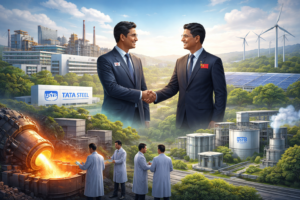
Beyond the Press Release: Decoding Tata Steel’s Strategic Pivot to China for Green Innovation
On paper, it looks like a standard corporate handshake: a Memorandum of Understanding (MoU) signed between an Indian steel giant and a prestigious Chinese university. The press release, issued from Mumbai on March 17, 2026, ticks the usual boxes—collaboration, sustainability, innovation.
But beneath the formal language of the Tata Steel and University of Science and Technology Beijing (USTB) partnership lies a narrative far more complex and significant. It is a story about the shifting geography of industrial knowledge, the urgent reality of the climate crisis forcing old rivals to collaborate, and a strategic hedge in a world where green technology is the new currency.
To understand why this agreement matters, one must look beyond the bullet points of “scrap-based steelmaking” and “carbon capture” and examine the tectonic plates shifting beneath the global steel industry.
The 800-Million-Ton Elephant in the Room
To appreciate the strategic genius of this move, we must first acknowledge the current state of the global steel industry. Steel production is responsible for approximately 7-9% of global carbon dioxide emissions. It is one of the so-called “hard-to-abate” sectors because the chemical processes involved—specifically the use of coking coal to convert iron ore into metallic iron—are inherently dirty.
For decades, the Western world and India have looked to China with a mix of awe and apprehension. China is the undisputed king of steel, producing more than half of the world’s annual output (over 1 billion tons compared to India’s ~140 million tons). However, for a long time, the narrative surrounding Chinese steel was about quantity—dumping, overcapacity, and environmental recklessness.
That narrative is now obsolete.
China has quietly transformed itself from the world’s biggest polluter into its most aggressive green-tech innovator. Facing domestic pressure to clean up its cities and a strategic desire to dominate the industries of the future, Beijing has poured billions into decarbonizing its heavy industries. USTB, the “Cradle of China’s Steel Industry,” sits right at the epicenter of this transformation.
When Tata Steel signed this MoU, it wasn’t just signing up for academic papers. It was buying a front-row seat to the world’s largest laboratory for low-carbon metallurgy.
Why USTB? The “Sandbox” Advantage
The press release mentions USTB’s impressive credentials: the State Key Laboratory of Advanced Metallurgy, thousands of patents, and top-tier global rankings. But the real value proposition for Tata Steel is access to USTB’s scale of experimentation.
In India, piloting a radical new steelmaking process can be prohibitively expensive and logistically challenging. In China, the relationship between academia and industry is uniquely fluid. USTB doesn’t just theorize; it builds. It has pilot-scale facilities that can mimic industrial conditions, allowing researchers to fail fast, iterate, and scale.
For Tata Steel’s Vice President, Subodh Pandey, this is the crux of the matter. As he stated, the goal is to “unlock potential ideas and co-create technologies.” This isn’t about licensing ready-made technology from China; it’s about joint discovery.
Consider the four research themes outlined in the agreement:
- Scrap-based steelmaking: As India accelerates its infrastructure development, it will eventually become a “scrap-rich” nation. Currently, India relies heavily on primary steelmaking. China, having built and now demolished vast cities, is grappling with how to effectively recycle that steel without degrading its quality. Learning from China’s circular economy mistakes and solutions is invaluable.
- Steel waste valorisation: For every ton of steel made, significant waste is generated—slag, dust, and sludge. In a circular economy, “waste” is just a resource out of place. USTB has been at the forefront of turning this industrial detritus into valuable materials for construction and agriculture.
- End-product performance: Low-carbon steel is useless if it breaks. As we change how we make steel (using more scrap or hydrogen), the metallurgical properties change. Ensuring that “green steel” performs as well, if not better, than traditional steel is the hidden challenge of the energy transition.
- Carbon Capture & Utilisation (CCU): This is perhaps the most pragmatic point of the agreement. While the ultimate goal is zero emissions, the reality is that blast furnaces will exist for decades. USTB’s research into capturing carbon and using it as a chemical feedstock (rather than just storing it) offers a bridge to the future.
The Human Element: Bridging Two Giants
High-level collaborations often fail because of cultural and operational friction. However, the personal dynamics here are key. The press release quotes Prof. Shuqiang Jiao and Academician Xinping Mao, both towering figures in Chinese metallurgy.
Academician Mao’s comment that the “green transformation… is a major challenge faced by the global steel sector” is a subtle acknowledgment that this problem is too big for any one company or country to solve alone. This transcends the geopolitical tensions that have strained India-China relations in recent years. Steel, in this context, becomes a neutral ground—a common language of chemistry and physics that both sides speak fluently.
Moreover, this isn’t a blind date. The press release hints at a “long-standing partnership.” For years, Tata Steel’s researchers have likely been engaging with USTB’s faculty, attending symposia, and sharing ideas. This MoU formalizes and deepens a relationship built on trust—a crucial ingredient when sharing proprietary data about furnace operations or yield failures.
Tata Steel’s Net Zero Calculus
For Tata Steel, which has set a lofty target of Net Zero by 2045, this partnership is a critical pillar of its R&D strategy.
Tata Steel is not putting all its eggs in one basket. Domestically, it is exploring hydrogen injection and has its own proprietary HIsarna technology (a smelting reduction process that cuts emissions). In Europe, through its Dutch subsidiary, it is navigating the complex political and economic landscape of transitioning the IJmuiden plant to green hydrogen.
So, why China?
Because China represents the volume solution. If Tata Steel can co-develop a technology with USTB that reduces emissions by just 10% but can be retrofitted to its massive Indian plants in Jamshedpur and Kalinganagar at a reasonable cost, the absolute reduction in tons of CO2 would be staggering. It’s a play for practical, scalable impact rather than just headline-grabbing moonshots.
The Geopolitics of Green Steel
We cannot ignore the geopolitical undertones. As the world moves toward carbon border taxes—like the European Union’s Carbon Border Adjustment Mechanism (CBAM)—steel becomes a geopolitical weapon.
By partnering with a Chinese university, Tata Steel is effectively hedging its bets. It is ensuring that it has a technological bridge to the Eastern bloc, just as it maintains strong ties with European and Japanese technology providers. If the West closes its markets to “dirty steel,” Tata Steel needs to have the cleanest production technology, regardless of its origin. If that technology comes from a joint lab in Beijing, so be it.
This move signals that while governments may bicker over Himalayan borders or trade deficits, industrialists are pragmatically following the science and the capital. The race to zero emissions is forcing a level of technical collaboration that political relations often cannot.
A Blueprint for the Future
Ultimately, this MoU between Tata Steel and USTB is more than a press release; it is a blueprint for the future of heavy industry.
It demonstrates that in the fight against climate change, intellectual property and national pride must sometimes take a backseat to survival. It shows that the next great breakthrough in steelmaking is less likely to come from a lone genius in a garage and more likely to emerge from a cross-border consortium of engineers staring at molten metal in a Beijing pilot plant.
For the reader, this partnership is a reminder that the green transition is not just about solar panels and electric vehicles. It is happening in the hot, noisy, and complex guts of industry. And in those guts, Indian ambition and Chinese execution are joining forces to reinvent the material that built the modern world.
As we watch this collaboration unfold over the coming years, we won’t just be watching a corporate venture. We will be watching two of Asia’s giants attempt to solve the hardest puzzle of the 21st century: how to keep building the world without breaking the planet.
You must be logged in to post a comment.