
Beyond the Premium Price Tag: How Hero and Valeo Are Democratizing Radar Safety for the Masses
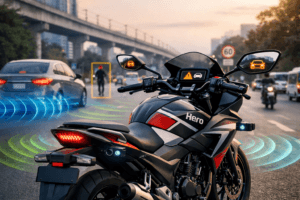
Hero MotoCorp’s strategic partnership with Valeo to co-develop radar and camera-based Advanced Rider Assistance Systems (ARAS) represents a pivotal move to democratize life-saving safety technology, aiming to shift these features from the domain of premium motorcycles into the mass-market segment. By creating a 360-degree safety envelope with functions like blind-spot detection, collision warnings, and pedestrian recognition—designed to work across both ICE and electric models in Hero’s portfolio, including its Vida brand—the collaboration tackles the core challenge of affordability and scale.
This initiative not only future-proofs Hero’s lineup against potential safety regulations but also places pressure on the entire industry to prioritize accessible innovation, potentially triggering a widespread cultural shift where advanced rider aids become standard, essential equipment for everyday commuters rather than luxury novelties.
Beyond the Premium Price Tag: How Hero and Valeo Are Democratizing Radar Safety for the Masses
The image of a high-tech motorcycle has long been associated with a hefty price tag. Features like cornering ABS, traction control, and especially radar-assisted safety systems have been the exclusive domain of premium European and Japanese brands, adorning machines that cost as much as a small car. For the millions of commuters, delivery riders, and families across India and emerging markets, whose two-wheelers are a lifeline, such advanced protection remained a distant dream. That landscape is poised for a seismic shift. The recent strategic partnership between Hero MotoCorp, the world’s largest manufacturer of motorcycles and scooters, and French automotive technology giant Valeo, isn’t just another corporate collaboration—it’s a pledge to democratize safety. This move signals the beginning of the end for the era where life-saving technology was a luxury.
Decoding the Tech: More Than Just Beeps and Buzzers
At the heart of this partnership is the co-development of an Advanced Rider Assistance Systems (ARAS) platform. To understand its significance, we must move past the acronym and envision a tangible, 360-degree digital safety shield.
Valeo brings to the table a sophisticated fusion of radar and smart camera systems. The radar, likely a compact unit integrated discreetly into the vehicle’s body, continuously scans the surroundings. It’s not unlike the technology used in adaptive cruise control on cars, but refined for the unique dynamics of two-wheelers. This enables:
- Blind Spot Detection: A critical feature for chaotic urban traffic where lane-splitting is common. A visual or haptic alert on the mirror would warn a rider of a vehicle lurking in the zone they can’t easily see.
- Rear Collision Warning: Sensors detecting a vehicle approaching too rapidly from behind, giving the rider precious seconds to potentially move aside.
- Forward Collision & Distance Warning: Monitoring the gap to the vehicle ahead, helping mitigate rear-end collisions, a frequent accident type.
Complementing the radar, the smart camera acts as the system’s eyes, processing visual data for:
- Lane Departure Warning: Crucial for long-haul riders battling fatigue on highways.
- Traffic Sign Recognition: Ensuring speed limits and other signs are never missed.
- Pedestrian Detection: Particularly vital in dense urban environments where pedestrians often step onto roads unpredictably.
The promise that this suite will function in low-light conditions addresses a major pain point in regions with inadequate street lighting, making it a genuinely practical solution, not just a fair-weather feature.
The Strategic Masterstroke: Why This Partnership is a Game-Changer
Hero MotoCorp’s move is a masterclass in forward-thinking strategy. It operates on multiple levels:
- Preemptive Leadership in Safety: With increasing global discourse on two-wheeler safety regulations (inspired by Euro NCAP for cars), Hero is positioning itself not as a follower, but as a pioneer. By investing in ARAS now, they are future-proofing their portfolio, preparing for a day when such systems might move from “desirable” to “mandatory.”
- Bridging the ICE-Electric Divide: The technology is being developed for both internal combustion engine (ICE) and electric (Vida) models. This is crucial. It sends a message that safety innovation is not solely the banner of the electric revolution but a universal right for every rider, regardless of powertrain. It protects the core of Hero’s current business while elevating its future-facing Vida brand.
- From Premium to Pragmatic: The proof-of-concepts showcased at CES 2026 are not just vanity projects. By targeting both “entry-level and premium segments,” Hero is confronting the biggest barrier to adoption: cost. Valeo’s expertise in scalable automotive tech is key here. The goal will be to simplify and integrate systems to achieve robustness without prohibitive expense. The recent example of Ultraviolette offering radar on the X47 shows the trend is nascent; Hero has the scale to mainstream it.
The Human Impact: What This Means for the Everyday Rider
Imagine a delivery executive navigating monsoon rains in Mumbai, with reduced visibility and slick roads. A blind-spot alert could prevent a catastrophic lane-change collision with a speeding bus. Consider a family riding on a scooter at dusk; a pedestrian detection system could identify someone crossing a poorly lit street. This technology translates to:
- Reduced Cognitive Load: Riding in congested traffic is mentally exhausting. ARAS acts as a second set of hyper-aware senses, allowing the rider to focus more on navigation and control.
- Empowerment Through Awareness: Many accidents occur due to “I didn’t see them” moments. These systems are designed to eliminate those moments.
- A Cultural Shift in Safety: By making high-tech safety visible and available, Hero can help shift the perception from “helmets are enough” to a more holistic, technology-aided safety culture.
The Road Ahead: Challenges and the Ripple Effect
The path to widespread adoption is not without speed bumps.
- Cost Absorption: The central question remains: how much of the cost will be passed to the consumer? Hero’s challenge is to integrate this so seamlessly into manufacturing that it becomes a standard, like electric start, rather than a costly optional extra.
- User Education: A system is only as good as the user’s understanding. Riders need to be educated that these are assistance systems, not autonomous replacements for vigilance. Over-reliance could be dangerous.
- The Competitive Ripple: This announcement is a clarion call to every other mass-market manufacturer. Brands like Bajaj, TVS, and Honda will now be compelled to accelerate their own ADAS roadmaps. The ultimate beneficiary? The rider, as innovation and competition drive better, more affordable solutions.
Conclusion: A New Benchmark for Responsible Mobility
The Hero-Valeo partnership is more than a tech upgrade; it’s a redefinition of value in the two-wheeler space. It argues that the true premium feature isn’t just more horsepower or flashy graphics—it’s the assurance of safety. By aiming to deploy radar and camera-based ARAS across its vast portfolio, Hero MotoCorp is taking a monumental step toward legitimizing advanced rider aids as essential equipment.
This move has the potential to create a new global benchmark, particularly in markets where two-wheelers are the backbone of transport. It’s a commitment that speaks to the core of Hero’s identity: understanding the needs of the masses. In the coming years, as these systems trickle down to the scooters and motorcycles that fill the streets of cities from Chennai to Cairo, we may look back at this 2026 partnership as the moment the two-wheeler world truly began to embrace a safer, smarter, and more inclusive future for every rider on the road.
You must be logged in to post a comment.