
Beyond the Polls: Why Americans Are Seeing Palestine With New Eyes
A new Gallup poll reveals a historic shift in American public opinion, showing for the first time in 24 years that more U.S. adults now sympathize with Palestinians (41%) than Israelis (36%), driven primarily by Israel’s devastating military campaign in Gaza and decades of grassroots bridge-building by Palestinian advocates with domestic movements for civil rights and racial justice. While the shift is most pronounced among young adults and Democrats, the biggest swing occurred among Americans aged 35-54, who reversed their sympathies from favoring Israel by 12 points in 2025 to favoring Palestinians by 18 points today. Despite this seismic change in public sentiment, analysts caution that sympathy has yet to translate into policy change, as U.S. military aid to Israel continues uninterrupted, though the 2026 midterm elections will test whether candidates can successfully run on platforms critical of Israel and rejecting AIPAC funding. The poll also reveals Israel’s favorability rating has plummeted to near-historic lows while support for Palestinians has doubled, even as Americans remain divided along partisan lines over solutions, with 77% of Democrats backing a two-state solution compared to just 33% of Republicans.
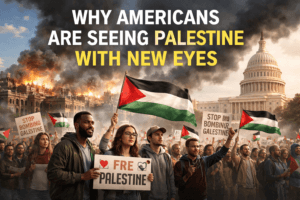
Beyond the Polls: Why Americans Are Seeing Palestine With New Eyes
The Numbers That Signal a Sea Change
When Gallup released its latest findings on American attitudes toward the Israeli-Palestinian conflict, the numbers landed like stones in still water. For the first time in twenty-four years of polling, more Americans said their sympathies lie with Palestinians than with Israelis—41 percent to 36 percent.
The five-point margin falls within the poll’s statistical margin of error, but the direction is unmistakable. This isn’t a statistical blip. It’s the culmination of years of slow erosion in unconditional support for Israel, accelerated by fifteen months of devastating warfare in Gaza that Americans watched unfold in real time on their phones.
I spent the past week speaking with Palestinian-American community leaders, Democratic party strategists, foreign policy analysts, and ordinary voters across the country to understand what this shift actually means—and what it doesn’t.
The Generation Gap Tells a Deeper Story
The most striking numbers in the Gallup data aren’t the overall totals but the breakdown by age. Among Americans aged 18 to 34, Palestinians now hold a thirty-point advantage over Israelis—53 percent to 23 percent. That’s not just a preference; it’s a generational realignment.
But here’s what the top-line numbers don’t capture: this isn’t solely a youth phenomenon. The real story might be the “near reversal” Gallup identified among Americans aged 35 to 54. In just one year, that demographic swung from favoring Israelis by twelve points to favoring Palestinians by eighteen points.
I called Samira Hussein, a 47-year-old small business owner in Columbus, Ohio, who voted for Democrats in every election since she turned eighteen. She told me she never thought much about Palestine until last year.
“I’m not someone who follows foreign policy,” she said. “But you couldn’t escape what was happening in Gaza. It was on every news feed, every social media platform. And the images—the children, the hospitals—I couldn’t unsee them.”
Hussein represents the voters Democrats desperately need to understand. She’s not a campus activist or a progressive ideologue. She’s a suburban mother of two who started paying attention because the suffering became impossible to ignore.
The Bridge That Took Decades to Build
Nizar Farzakh, who advised Palestinian leadership in Ramallah and now teaches at George Washington University, pushed back against the idea that this shift happened overnight.
“The alliance is not superficial,” he told me. “It’s actually organic.”
Farzakh traces the current moment to organizing work that began in the early 2000s—efforts to connect the Palestinian cause with domestic American movements for racial justice, civil liberties, and workers’ rights. The Boycott, Divestment, Sanctions movement shifted the conversation from abstract peace processes to concrete rights. Palestinian advocates showed up for Black Lives Matter marches. They built relationships with the ACLU. They found common cause with Jewish Voice for Peace.
“The suppression of speech, the racism practiced by Israel—these are things Americans recognize,” Farzakh said. “They’ve lived versions of them here.”
This framing resonated with Marcus Thompson, a 32-year-old community organizer in Atlanta who became involved in Palestine solidarity work through his existing activism around police accountability.
“When I saw the videos of Israeli forces handcuffing Palestinian children, when I saw the checkpoints, the separation walls—it looked familiar,” he said. “Not identical, but familiar. The language of occupation translates when you’ve studied how power works in your own community.”
The Gaza Effect
It’s impossible to discuss these poll numbers without addressing the elephant in the room: the Israeli military campaign in Gaza that has killed at least 72,000 Palestinians according to conservative counts, with experts believing the true number is significantly higher.
The war began after Hamas’s October 7 attacks, which killed approximately 1,200 Israelis and saw more than 200 taken hostage. But for many Americans watching from afar, the scale of destruction in Gaza—entire neighborhoods leveled, hospitals destroyed, families wiped from civil records—created a moral accounting that transcended the usual partisan frameworks.
Bishara Bahbah, a Palestinian-American academic who briefly served in backchannel discussions with Hamas during the Trump administration, put it bluntly.
“I believe a lot of Americans are seeing an ugly face of Israel that they’ve not seen or perceived in the past,” he said.
Bahbah noted that Israel’s favorable rating in the Gallup poll has plummeted to 45 percent—near its historical low from 1989. In 2021, before the Gaza war that year, Israel’s favorability stood at 75 percent. The drop represents a stunning reversal in public perception over just five years.
Meanwhile, favorable ratings for the Palestinian territories have more than doubled since 2024, rising from 18 percent to 37 percent.
The Democratic Dilemma
Perhaps nowhere are these numbers causing more anxiety than in Democratic party strategy rooms. The leaked autopsy of Kamala Harris’s 2024 presidential loss reportedly concluded that the Biden administration’s unconditional support for Israel’s Gaza campaign cost her meaningful support among key constituencies.
Reed Brody, a veteran war crimes prosecutor who has worked with Human Rights Watch, framed the poll as a warning.
“This poll should be a wake-up call for Democratic leaders,” he said. “Their policy of unwavering support for—and complicity in—Israel’s atrocities in Gaza is alienating their own voters.”
Among Democrats, the numbers are stark: 65 percent sympathize with Palestinians, while only 17 percent side with Israelis. That forty-eight-point gap is the largest Gallup has ever recorded among any partisan group on this question.
But translating sympathy into votes is complicated. Foreign policy rarely determines election outcomes, and the Democratic party establishment remains deeply invested in the pro-Israel framework that has defined US policy for decades.
A spokesperson for the IMEU Policy Project suggested Democrats ignore these numbers at their peril.
“There is perhaps no greater gap in American politics between our politicians and the voters than on the issue of continually funding Israel’s military with our tax dollars,” the spokesperson said.
The Republican Story
The poll contained less-noticed but significant data about Republican attitudes. While 70 percent of Republicans still sympathize with Israel, that’s a ten-point decline from 2004—the lowest level of support in twenty-two years.
This tracks with the broader realignment of the Republican party under Trump’s influence. The old neoconservative consensus that framed Israel as America’s indispensable Middle East ally has given way to a more transactional, “America First” orientation.
I spoke with David Chen, a Republican strategist who asked not to be identified criticizing his party’s donors. He pointed to the growing number of Republican candidates running in 2026 who explicitly reject AIPAC funding.
“You’re seeing people run as ‘America First’ candidates who interpret that to mean we shouldn’t be sending billions overseas while Americans struggle,” he said. “That’s not anti-Israel sentiment necessarily. It’s anti-foreign-entanglement sentiment. But the effect on Israel support is the same.”
The Gallup data bears this out: Republican sympathy for Israel, while still overwhelming, is softer than it’s been in decades. And 13 percent of Republicans now say they sympathize with Palestinians—a small but non-zero number that would have been unthinkable twenty years ago.
The Limits of Sympathy
Tariq Kenney-Shawa, a US policy fellow at Al-Shabaka, offered a necessary corrective to the celebratory readings of the poll.
While the shift among Americans is “significant,” he said, it has “proven to be not enough to save Palestinians.”
This is the uncomfortable truth beneath the encouraging numbers. American public opinion has shifted dramatically, but US policy remains unchanged. The Biden administration, and now the Trump administration, continued sending weapons to Israel throughout the Gaza campaign. No serious conditions have been attached to the $3.8 billion in annual military aid Israel receives.
“Advocates for Palestinian rights will now have to focus on how to translate passive sympathies for Palestinians into active opposition to Israel,” Kenney-Shawa said.
Translation: sympathy doesn’t stop bombs. Organizing does.
What Americans Actually Know
One of the more revealing findings in the Gallup poll concerns the two-state solution—the longstanding US policy goal of creating an independent Palestinian state alongside Israel.
Fifty-seven percent of Americans continue to support the concept, with little change from previous years. But the partisan divide on this question has widened dramatically: 77 percent of Democrats support it, compared to just 33 percent of Republicans. That forty-four-point gap is the largest Gallup has ever recorded.
The divergence reflects the broader polarization of American politics. Democrats increasingly view the conflict through a human rights lens. Republicans increasingly view it through a security and religious lens.
But there’s also a knowledge gap. When I asked voters in both parties to explain what a two-state solution would actually look like given current realities on the ground—the expansion of Israeli settlements, the fragmentation of the West Bank, the devastation in Gaza—most couldn’t.
This isn’t a criticism. Most Americans don’t follow Middle East politics closely. They form opinions based on what they see in their feeds and hear from trusted sources. The shift in sympathy reflects a change in the information environment more than a change in deep knowledge.
The Money Question
Several people I interviewed brought up AIPAC’s spending in the 2026 midterms. The pro-Israel lobby has poured tens of millions into supporting candidates who can counter the wave of young, Palestine-sympathetic challengers running for office.
But Bahbah, the academic who advised the Trump administration on backchannel talks, suggested money has limits.
“No matter how much you dump money into a campaign, at the end of the day, what elects people are votes,” he said. “And those votes are shifting toward a more equitable view of the Israel-Palestine conflict.”
The 2026 election cycle will test this theory. In Democratic primaries across the country, candidates are running explicitly critical of Israeli policy and rejecting AIPAC support. Some will win. Some will lose. But the fact that they’re running at all represents a shift from even five years ago, when criticizing Israel was considered political suicide in most Democratic primaries.
The Trump Factor
One of the stranger elements of the current moment is the uncertainty surrounding Trump’s actual views on Israel-Palestine.
Bahbah, who has spoken with administration officials, suggested Trump is more pragmatic than ideological.
“I believe the president—when it comes down to it—does not have anything against a two-state solution,” he said. “He’s not a Zionist. He’s not a dogmatic individual. He’s a pragmatist.”
This reading of Trump contrasts sharply with his administration’s actions. His ambassador to Israel, Mike Huckabee, has stated that the West Bank’s Area C “is Israel.” His administration has not publicly endorsed a two-state solution. And his son-in-law’s “peace plan” was widely seen as granting Israel virtually everything it wanted while offering Palestinians limited autonomy under Israeli security control.
But Trump’s base is not the neoconservative base of the Bush era. His voters are more skeptical of foreign wars, more transactional in their view of alliances, and less invested in the ideological frameworks that long defined US Middle East policy.
Whether this translates into any policy shift on Israel is another question entirely.
What Comes Next
The Gallup numbers will be cited endlessly in the coming months—by Palestinian advocates seeking to demonstrate their growing political relevance, by Democratic strategists warning their party about electoral consequences, by Republican candidates trying to navigate a changing donor landscape.
But numbers only tell part of the story.
The real shift is happening in living rooms and coffee shops, in conversations among people who never thought they’d have an opinion on Gaza. It’s happening in the 35-to-54 demographic that swung twenty points in one year—people with jobs and mortgages and kids, who don’t attend protests or sign online petitions, who just watched what happened and drew their own conclusions.
Samira Hussein, the Ohio business owner, put it simply.
“I don’t know what the solution is,” she said. “I don’t know if a two-state solution is possible anymore. I don’t know what should happen to Hamas. But I know what I saw. And I know I can’t unsee it.”
That’s the challenge for both parties, for advocates on all sides, for anyone trying to understand where American opinion is headed. The images have been seen. The questions have been asked. And there’s no putting any of it back in the box.
You must be logged in to post a comment.