
Beyond the Podium: The Human Chaos Behind India’s Grand AI Summit
Beyond the Podium: The Human Chaos Behind India’s Grand AI Summit
The India AI Impact Summit in New Delhi was supposed to project a message of sleek technological ambition to the world. Instead, it delivered something far more interesting: a thoroughly human spectacle of dropped calls, cultural friction, and the kind of organizational chaos that makes international conferences memorable for all the wrong reasons.
For five days in February, the Indian capital played host to a gathering that aimed to position the country as a serious third pole in the global artificial intelligence conversation, sandwiched between the familiar dominance of Washington and Beijing. The official communiqués spoke of multilateral cooperation, ethical frameworks, and inclusive technological development. The reality, experienced by the thousands of delegates, journalists, and tech executives who descended upon New Delhi, was considerably messier.
The Empty Chairs on Center Stage
Nothing quite sets the tone for a leadership summit like the absence of the leaders themselves. Hours before he was scheduled to deliver a keynote address that organizers had been promoting for weeks, Bill Gates pulled out. The Microsoft co-founder and philanthropist was facing renewed media scrutiny over his past associations with Jeffrey Epstein, and his team apparently decided that the summit podium was not where they wanted him fielding questions.
The Gates Foundation moved quickly to install Ankur Vora, its president for Africa and India operations, as a replacement. But the substitution carried an unavoidable subtext. Here was a summit about humanity’s technological future, and one of its central figures was sidelined by questions about his past—a reminder that in the world of high-level diplomacy, personal history rarely stays personal.
Then there was Jensen Huang. The Nvidia CEO, whose company has become something of a bellwether for the AI industry’s commercial prospects, had been expected to make a prominent appearance. Instead, he was reportedly laid up somewhere with an illness contracted during his relentless global travel schedule—a mundane but deeply relatable explanation. Even the architects of our technological future, it turns out, are not immune to the bugs of the present.
The absences created an odd vacuum. Walking through the summit’s main halls, one could hear the question whispered among attendees: if the people who were supposed to be here aren’t here, who exactly is steering this conversation? The empty chairs on stage became an unintentional metaphor for the broader uncertainty surrounding AI governance itself.
When the World’s Calendars Collide
The summit’s timing emerged as a recurring sore point. February in the international diplomatic calendar is already overcrowded. Davos comes in late January, draining energy and attention. The Munich Security Conference follows in mid-February, pulling defense and foreign policy establishments across the Atlantic. Adding a major AI summit in New Delhi immediately after Munich meant asking the same pool of experts and officials to extend their travel fatigue by another week.
“It’s just too much,” confessed one attendee who had made the rounds in both Bavaria and Delhi, speaking on condition of anonymity because they didn’t want to appear ungrateful to their hosts. “I’m going to put a blanket over my head when I get home.” The exhaustion was palpable in the corridors—bloodshot eyes over name badges, coffee cups clutched like lifelines during afternoon sessions, the particular glaze that settles over people who have spent too many consecutive days in conference centers.
The calendar complications ran deeper than simple fatigue. Chinese New Year fell squarely within summit week, which meant that Beijing’s delegation arrived without its top political leadership. Whether this was a diplomatic signal or simple scheduling oversight, the effect was the same: a major conversation about the future of technology proceeded without one of its principal architects fully present.
Then Donald Trump, never one to let someone else’s news cycle go unpunished, chose summit Thursday to launch his Board of Peace. The announcement pulled Tony Blair, the former British prime minister who has reinvented himself as a technology adviser, out of his scheduled appearance. He was needed elsewhere, his team explained. Everyone understood.
The Robot Dog That Wasn’t Quite Made in India
If there was a moment that captured the summit’s strange energy better than any keynote speech, it happened in the exhibition hall.
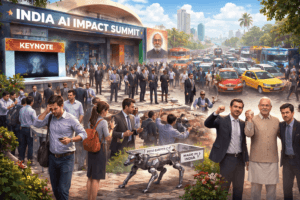
Galgotias University, a private institution with campuses near Delhi, had set up an impressive display. The centerpiece was a robotic dog, trotting and gesturing on command, drawing crowds of curious onlookers. University representatives presented it as a showcase of Indian innovation, a homegrown technological achievement that demonstrated the country’s capacity to compete in advanced robotics.
The internet, as it tends to do, had questions.
Within hours, fact-checkers and robotics enthusiasts had identified the dog with uncomfortable precision. It was a Unitree Go2, manufactured by China’s Unitree Robotics and available for commercial purchase at approximately $2,800. The same model can be found in countless YouTube reviews, Chinese tech expos, and increasingly, in the living rooms of early adopters who want to know what it feels like to have a robot follow them around.
The backlash was swift and merciless. For a summit ostensibly about India’s emergence as a technological counterweight to China, presenting a Chinese robot as indigenous innovation struck many as embarrassing rather than ambitious. University officials scrambled to clarify that they had merely been demonstrating the dog’s capabilities, not claiming to have built it from scratch. But the damage was done. In the age of reverse image search and viral fact-checking, the line between demonstration and deception becomes very thin very quickly.
The episode became an instant meme, shared across WhatsApp groups and Twitter threads as evidence of the gap between India’s technological aspirations and its current reality. It also highlighted a genuine tension running through the entire summit: how does a country position itself as an alternative to Chinese technological dominance when so much of its actual hardware still comes from across the Himalayan border?
The Awkwardness of Rivalry Captured in a Single Frame
Sam Altman and Dario Amodei have been described as rivals, competitors, and occasionally as visionaries with fundamentally different views of where artificial intelligence is heading. Their companies, OpenAI and Anthropic, represent competing philosophical approaches to AI safety and development. In normal circumstances, their interactions are carefully managed, their public appearances separated by handlers and schedules.
The summit’s closing ceremony dispensed with such niceties.
As Prime Minister Narendra Modi stood center stage for the traditional group photograph, a cluster of tech executives gathered around him. Cameras flashed. Hands were raised in the customary gesture of unity and accomplishment. And for a brief moment, Altman and Amodei found themselves unsure of the choreography.
Should they shake hands? Raise fists? Clasp hands together? The hesitation lasted perhaps two seconds, but in the compressed reality of diplomatic photography, two seconds is an eternity. They settled eventually on raised, clasped fists—the standard conference pose. But the uncertainty was visible, and the internet, ever hungry for subtext, devoured it.
“First time I’ve laughed out loud at an international conference moment in years,” tweeted Hudson Institute senior fellow Bill Drexel, calling it “a very visible representation of a rift.” The observation may have read more into a moment than was actually there, but it captured something true about how we now consume these events. The official program is one thing. The viral moments are another. And sometimes, the latter carry more weight than any number of carefully drafted communiqués.
Altman later offered a disarmingly simple explanation: “I didn’t know what I was supposed to do.” Amodei, through a spokesperson, declined to comment. Sometimes a photo is just a photo. Sometimes it isn’t.
The Summit You Couldn’t Reach
Perhaps the most consistently discussed aspect of the India AI Impact Summit had nothing to do with artificial intelligence at all. It had to do with getting there.
Delhi traffic is legendary in the way that natural disasters are legendary—everyone has heard stories, but experiencing it firsthand is something else entirely. The summit coincided with heavy security protocols around Prime Minister Modi’s movements, which meant that roads that were merely congested on normal days became impassable barriers on summit days.
Attendees received messages warning them not to come to the venue at certain hours. Others arrived at designated entrances only to find them locked, were redirected to secondary entrances that were also locked, and eventually found themselves walking circuits around the perimeter of the conference center, badges dangling, frustration mounting.
Inside, the challenges continued. Signage was sparse or contradictory. Moving from one hall to another could mean passing through multiple security checks, each requiring bag searches and badge verification. Laptops were sometimes treated as potential threats, sometimes waved through. Car keys set off occasional alarms. The cumulative effect was a constant low-grade friction, a sense that the organizational infrastructure hadn’t quite caught up to the summit’s ambitions.
Veterans of Delhi conferences offered a different perspective. By local standards, they pointed out, summit week was comparatively well-run. The roads were passable, eventually. The security checks, however numerous, were conducted professionally. The venue, however confusing, was at least modern and functional. It was a reminder that expectations are relative, and that the same experience can feel chaotic to a first-time visitor and reasonably organized to someone who has seen worse.
The Runner and the City
Amid the diplomatic maneuvering, the absent speakers, and the logistical headaches, one moment stood out for its sheer normalcy.
Emmanuel Macron, the French president, arrived in India with the usual security entourage and diplomatic apparatus. But before he plunged into summit proceedings, he did something that most world leaders only do in carefully staged photo opportunities. He went for a run.
Along Mumbai’s Marine Drive, as the sun rose over the Arabian Sea, Macron jogged in athletic wear and the aviator sunglasses that have become something of a personal trademark. Bodyguards kept pace, but otherwise, the scene was unremarkable—a man exercising in a beautiful location, observed by curious morning walkers who recognized him but mostly continued their routines.
The moment resonated because it was uncalculated. Macron wasn’t delivering a speech or shaking hands or performing presidential duties. He was simply being human, preparing for a long day of meetings in the same way millions of people prepare for their own long days. The sunglasses helped, of course—they gave the moment a certain style, a visual hook for the inevitable social media posts. But the appeal ran deeper. In a week of high-stakes diplomacy and AI anxiety, here was a reminder that the people making decisions about our technological future are, at the end of the day, just people.
They get tired. They get sick. They go for runs. They occasionally forget how to pose for photographs.
What the Chaos Revealed
Summits like this one are judged by their official outcomes—the declarations signed, the partnerships announced, the frameworks established. By those measures, the India AI Impact Summit achieved what it set out to achieve. India positioned itself as a serious actor in global AI governance. Conversations about regulation and development moved forward. The machinery of international diplomacy turned.
But the unofficial moments told a different story. The absences suggested that even the biggest names have competing priorities and personal complications. The robot dog controversy revealed the gap between aspiration and capability that defines so much of technological development. The traffic and security chaos reminded everyone that grand ambitions must contend with mundane realities. The awkward photograph captured, however accidentally, the genuine tensions between competing visions of the future.
And Macron’s morning run offered something the official program never could: proof that beneath the titles and the security details and the carefully managed public appearances, the people shaping our world are fundamentally like the rest of us. They deal with illness and exhaustion. They make mistakes. They occasionally find themselves in the wrong place at the wrong time, unsure how to pose for a photograph.
The India AI Impact Summit closed with ambitious statements about the future. But its most lasting impressions came from the present—messy, human, and stubbornly resistant to the orderly narratives that conferences try to impose upon it. In that sense, perhaps it was more honest than anyone intended. The future of artificial intelligence will not be shaped by carefully staged photographs and flawlessly delivered keynotes. It will be shaped by people doing their best under complicated circumstances, occasionally succeeding, occasionally failing, and somehow moving forward anyway.
You must be logged in to post a comment.