
Beyond the Pilot: Why Google’s Latest Accelerator Signals a New Era for Indian AI Startups
The Google for Startups Accelerator: India 2026 cohort marks a pivotal shift from experimental AI to mission-critical deployment, inviting Seed to Series A startups building in Agentic AI, Multimodal AI, Physical AI, and Sovereign AI to apply by April 19th. The equity-free, three-month program offers hands-on collaboration with Google DeepMind experts, Cloud TPU access, and tailored OKR support—benefits that helped previous alumni like Resilience AI boost accuracy by 35% and VideoSDK double revenue. Success hinges on solving uniquely Indian challenges with measurable traction, moving beyond generic AI wrappers to deep, specialized solutions that address local language, infrastructure, and regulatory nuances. With an intensive Bengaluru bootcamp kicking off in late June, the accelerator is a strategic launchpad for founders ready to scale AI that works in India’s unique context and beyond.
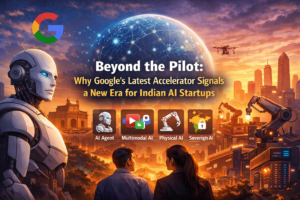
Beyond the Pilot: Why Google’s Latest Accelerator Signals a New Era for Indian AI Startups
The Indian AI ecosystem has officially matured. For the past few years, the narrative has been dominated by experimental chatbots, proof-of-concept demos, and the general excitement surrounding generative AI. But if the latest call for applications for the Google for Startups Accelerator: India tells us anything, it’s that the era of “playing with AI” is over. We have now entered the era of deployment.
Announced for the 2026 cohort, this program isn’t just another corporate accelerator. It is a strategic filter designed to identify the startups that are moving from “nice-to-have” AI features to “mission-critical” AI infrastructure. With a focus on Agentic AI, Multimodal AI, Physical AI, and Sovereign AI, Google is signaling exactly where it sees the tectonic plates of innovation shifting in the subcontinent.
For Indian founders, this is more than an opportunity for cloud credits; it is a roadmap for relevance. Here is a deep dive into why this cohort matters, what the focus areas really mean, and how startups can position themselves to not just apply, but to win.
The Shift from General to Specialized
One of the most telling lines in the announcement is the observation that Indian startups are moving “from general generative models to highly specialized, Sovereign AI and Agentic Workflows.” This reflects a global trend with local nuances.
For the last two years, many startups built wrappers around Large Language Models (LLMs) to solve generic problems. While that was a great way to enter the market, the low barrier to entry also meant high competition and thin margins. The 2026 cohort is looking for depth.
The success stories from the previous cohort—like Dview’s 4x revenue growth or Superjoin’s 50% improvement in latency using Gemini 3.0—aren’t just metrics; they are proof points that the market is rewarding deep technical integration. It’s no longer enough to have an AI feature; startups must demonstrate that AI is the core engine that fundamentally alters operational efficiency or unlocks new revenue streams that were previously impossible.
Decoding the Four Pillars of the Cohort
To understand if your startup fits, it’s essential to look beyond the buzzwords. Google has defined four specific verticals. Here is what they are actually looking for in each:
- Agentic AI: The Workforce of the Future
While chatbots answer questions, Agentic AI performs tasks. Google is looking for startups building systems that don’t just suggest an action but execute it autonomously across complex enterprise workflows.
- The Human Insight: In India, where businesses often grapple with legacy systems and fragmented data, Agentic AI represents a massive opportunity. Think of startups that can deploy AI agents to handle GST reconciliation, automate supply chain disputes, or manage customer service escalations without human intervention. The value proposition here isn’t just cost-cutting; it’s about enabling Indian enterprises to scale their operations without linearly scaling their headcount.
- Multimodal AI: Bridging the Indic Divide
Text-based AI often fails in a country as diverse as India. Multimodal AI—systems that understand audio, video, and images—is the key to true inclusion. The mention of audio and video generation is critical.
- The Human Insight: India is a video-first and voice-first nation. Startups that can leverage models like Veo and Lyria to create vernacular content, or use computer vision to revolutionize quality control in manufacturing, are poised for exponential growth. The success of Vaani AI, which processed over a million minutes of voice monthly, highlights that the market for Indic voice AI is vast and underserved. If your startup is using AI to break down language barriers in rural banking, education, or healthcare, you are building in the right space.
- Physical AI: The Intersection of Bits and Atoms
For a country aiming to become a global manufacturing hub, Physical AI—robotics and smart manufacturing—is the bridge between software innovation and hardware reality.
- The Human Insight: Physical AI is hard. It requires domain expertise in mechanical engineering, real-time data processing, and edge AI. Google is looking for startups that can bring the intelligence of the cloud to the factory floor. This could be AI-driven quality inspection systems that reduce defect rates in textile manufacturing, or robotics startups that are automating warehouse logistics for India’s booming e-commerce sector. The willingness of Google to support this space suggests a recognition that India’s AI story will be written not just in code, but in hardware.
- Sovereign AI: Owning the Data Stack
Perhaps the most geopolitically significant category is Sovereign AI—specialized, localized models. This is about building AI that reflects Indian culture, languages, and regulatory needs, rather than relying solely on models trained on Western data.
- The Human Insight: The Indian government and large enterprises are increasingly wary of data sovereignty. Startups building foundational models trained specifically on Indian languages (not just translated data) or models tailored for Indian legal systems, healthcare regulations, or agriculture are solving a trust deficit. The work done by AiSteth—creating an offline, encrypted smart stethoscope that worked across 20 states without internet—is a prime example of sovereign technology. It’s AI that works in Indian conditions, for Indian patients.
Beyond the Credits: The Strategic Value of Google’s Support
While the offer of free Cloud TPUs and Google Cloud credits is financially attractive, the true value of this accelerator lies in the “hands-on collaboration” with Google’s AI divisions.
For a startup, getting direct mentorship from specialists at Google DeepMind or the Google Cloud AI team is akin to having a masterclass in scaling AI. The difference between a model that works in a lab and a model that works for a million users often comes down to infrastructure architecture—knowing when to use Gemini for reasoning versus a fine-tuned Gemma model for edge deployment.
Moreover, the “Tailored OKR Support” is a feature that many founders overlook. Startups often fail not because of a bad product, but because of poor execution cadence. Having dedicated success managers to help you hit product, technology, and growth targets provides a level of accountability that is rare in the early-stage ecosystem.
Lessons from the Alumni: Real-World Impact
The press release highlights four startups that exemplify the impact of this program. These are not just feel-good stories; they are blueprints for what the accelerator aims to replicate.
- Resilience AI improved accuracy by 35% using Gemma. This is a lesson in model optimization. You don’t always need the largest model; you need the right model for your use case.
- VideoSDK cut costs by 40% and doubled revenue using the Gemini Live API. This shows that integrating Google’s advanced APIs can be a direct revenue driver, not just a technical upgrade.
- Pulse identified $3M in at-risk revenue. This highlights the enterprise value of AI—moving from operational tool to strategic risk management asset.
How to Craft a Winning Application
With the application deadline set for April 19th, founders need to move quickly. Here is how to ensure your application stands out:
- Focus on the “Indian Challenge”: Google is explicitly looking for startups solving “uniquely Indian challenges.” If your solution works for a bank in Mumbai, but it’s a carbon copy of a US fintech, you need to refine your narrative. Highlight the specific friction points in the Indian market that your AI solves—be it language diversity, infrastructure unreliability, or regulatory complexity.
- Show Evidence of Traction: The program is designed for Seed to Series A startups. While a great idea is necessary, you need data. Use metrics similar to the alumni: revenue growth (like Dview), user numbers (like AiSteth’s 75,000 patients), or operational efficiency (like Vaani’s 75% reduction in manual calls).
- Be Specific About Technical Needs: The application asks what you need. Don’t just say “more compute.” Be specific. Mention that you want to fine-tune a Gemma model for a specific Indic language, or that you need help optimizing latency for a voice agent. Specificity shows that you have a deep understanding of your technical roadmap.
- Prepare for the Bootcamp: The program kicks off with an intensive one-week in-person bootcamp in Bengaluru in late June. This is not a passive experience. It’s designed to accelerate founders. Be prepared to be hands-on, to pivot based on feedback, and to network intensely with mentors and peers.
The Road Ahead
As the Google for Startups Accelerator opens its doors for 2026, it is doing so at a pivotal moment. India is no longer just a market for AI consumption; it is rapidly becoming a hub for AI innovation. The focus on Sovereign AI and Physical AI indicates a belief that the next generation of world-changing AI companies will emerge from India, solving problems that are relevant to the Global South and scalable to the world.
For founders, this is an invitation to move beyond the pilot phase. It is a call to build resilient, scalable, and deeply integrated AI systems that define the next decade of Indian technology.
The application window is open, but the clock is ticking. In the world of AI, the speed of execution determines market leadership. If your startup is building at the intersection of these four pillars, this is your opportunity to accelerate with the best in the business.
You must be logged in to post a comment.