
Beyond the Photo Op: India’s Grand AI Dream Meets Geopolitical Reality
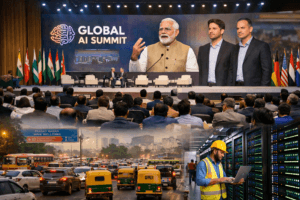
The streets of New Delhi were, as is often the case, a churning river of chaos. But the gridlock outside the sprawling Pragati Maidan convention centre felt different this week. It wasn’t just the usual tangle of auto-rickshaws and commuters; it was the physical manifestation of the friction between India’s soaring ambitions and the hard, slow-moving barriers of reality. Inside, the Global AI Summit was underway, a grand stage set by Prime Minister Narendra Modi’s government to position India not just as a user of artificial intelligence, but as a crucial architect of its future.
The image the world was meant to see was one of unity and purpose. On the final day, a line of tech luminaries and government officials clasped hands and raised them in the air, a choreographed show of solidarity for the cameras. But as with any good photograph, the real story was in the details—the subtle, unguarded moment that spoke volumes. There, in the middle of the frame, stood Sam Altman of OpenAI and Dario Amodei of Anthropic, two of the most powerful men in AI. As everyone around them linked up, their hands remained stubbornly at their sides, refusing to touch. It was a perfect, unintentional metaphor for the summit’s core tension: India’s push for a collaborative, shared, and regulated AI future colliding with an industry and a geopolitical superpower driven by competition, secrecy, and deregulation.
The Vision of a Digital Commons
For India, the stakes could not be higher. As the world’s most populous country and a nation where a significant portion of its $300 billion IT services workforce stares down the barrel of AI-driven automation, this is not an abstract philosophical debate. It is an economic imperative. Prime Minister Modi’s address to the summit was a direct appeal to the conscience of the tech giants. “Some countries and companies believe that AI is a strategic asset and should therefore be developed confidentially,” he stated. His counter-argument was simple yet profound: a technology with the power to reshape humanity’s most fundamental challenges—healthcare, education, agriculture—would “only benefit the world when it is shared.”
This vision of an “AI commons” is deeply appealing, especially to the Global South. It speaks to a fear that the transformative power of AI will become another tool of division, creating a world split between the “AI-haves” (the US and China) and the “AI-have-nots.” India, with its vast pool of engineering talent and its own massive, complex societal problems, sees itself as the natural bridge. It wants to be the voice that ensures AI models are trained not just on English-language internet data, but on the myriad languages and cultural nuances of billions. It wants algorithms that can diagnose diseases from a rural clinic with spotty internet, or advise a farmer in Punjab on crop prices in Punjabi, not just generate sonnets in English.
The summit was a platform to broadcast this vision. Panels were sprinkled with discussions on using AI for social good. Google’s senior vice-president, James Manyika, spoke of the technology’s potential to accelerate progress on the UN Sustainable Development Goals. Indian startups like Sarvam AI, which launched a new Large Language Model (LLM) at the event, showcased a homegrown approach—focusing not on beating GPT-4 at complex math, but on solving practical, day-to-day problems for the average Indian.
The Washington Consensus: No Regulators Here
But for all the high-minded rhetoric in the conference halls, the real power dynamics were playing out in the corridors and closed-door meetings. The message from the United States was clear, and it was delivered with surgical precision by Michael Kratsios, the White House’s chief technology officer. “We believe AI adoption cannot lead to a brighter future if it is subject to bureaucracies and centralised control,” he told attendees, essentially pouring cold water on any notion of a global governance framework. The US position was a “total” rejection of the kind of multilateral approach India was championing.
This wasn’t just a policy difference; it was a philosophical chasm. For Washington, and by extension its AI champions like OpenAI, Google, and Anthropic, AI is the new frontier of strategic competition. It is an asset to be developed, protected, and weaponized in a technological cold war with China. Ceding control to an international bureaucracy is anathema to that worldview. For the American companies, regulation is a four-letter word, a potential anchor on the breakneck speed of innovation that has made them the undisputed global leaders.
A person familiar with the discussions between Indian officials and US tech giants put it bluntly: with no pressure from their own government to agree to a global framework, the companies felt “absolutely no need to even agree to a baseline.” The result was a polite but firm rebuff of India’s core ambition. The voluntary commitment India managed to secure—for companies to share data on how their models are being used and their effectiveness in multilingual contexts—felt like a consolation prize. It was a step towards transparency, but a far cry from the binding, shared framework Modi had envisioned.
The Infrastructure Paradox
Beyond the geopolitical headwinds, the summit also laid bare a more fundamental, prosaic problem: India simply doesn’t have the hardware to play in the big leagues yet. Building an LLM is an incredibly resource-intensive process, requiring vast “AI factories”—clusters of thousands of high-end chips like Nvidia’s H100s, consuming enormous amounts of power and water.
James Manyika of Alphabet highlighted this critical bottleneck. “The world has not got enough capacity… It’s particularly acute in the global south,” he told the Financial Times. While the summit was a stage for announcing eye-watering investment pledges totaling over $220 billion, the vast majority of this was earmarked for building data centres. This is the digital equivalent of laying the foundation of a factory before you can even think about buying the machines to put inside it. It will take years for this infrastructure to come online.
This creates a cruel paradox for India’s AI startups. They are full of ambition and talent, but to train a truly world-class foundational model, they are largely dependent on computing power owned by the very Western giants they hope to compete with. It’s like trying to build a car when you have to rent the factory floor and tools from Ford or Toyota. Until the domestic infrastructure is built, India’s AI ambitions will, to a large extent, run on borrowed time and borrowed chips.
The Elephant in the Room Adapts
Yet, to focus only on the summit’s shortcomings would be to miss the more subtle, ground-level shifts taking place. India’s immense IT services sector, the back office of the global economy, has long been seen as the most vulnerable to AI-driven disruption. For years, the threat was discussed in hushed, worried tones. At the summit, that narrative had completely flipped.
TCS and Infosys, the twin pillars of Indian IT, arrived not with a story of fear, but of adaptation. They announced partnerships with the very companies that were supposed to displace them. TCS is working with OpenAI, Infosys with Anthropic, to help their global clients adopt and integrate AI. The message was clear: if you can’t beat them, join them—and then charge them for your expertise in implementation. They are pivoting from being low-cost code writers to high-value system integrators for the AI age. This pragmatic, business-first approach might ultimately be more consequential for India’s economy than any government-led initiative.
Sam Altman’s own presence underscored this market reality. Despite the policy disagreements, he was there to tout India’s importance, calling it the fastest-growing market for Codex, OpenAI’s AI-powered coding assistant. The message was clear: the Indian developer is a crucial customer. The country might not be building the next ChatGPT, but its massive pool of tech talent is on the front lines of using it, shaping how the technology is applied in the real world.
A Summit Marred by the Mundane
For all its geopolitical significance, the summit was also a very Indian story of ambition bumping up against everyday logistical chaos. The meticulously planned event was undercut by the messy reality of the city hosting it. Attendees, including foreign delegates and journalists, found themselves trapped for hours in traffic. Long, serpentine queues snaked outside the venue, a test of patience for those who had come to discuss the future of humanity. The absence of star power was palpable. The last-minute cancellations of Nvidia’s Jensen Huang and Bill Gates robbed the event of some of its wattage, leaving a slightly diminished stage.
This friction—between the vision of a sleek, efficient, digital future and the creaking, chaotic present—was the summit’s unspoken theme. It played out in the contrast between Modi’s soaring rhetoric and the gridlocked streets, between the $220 billion in pledges and the nascent computing infrastructure, between the call for global unity and the refusal of two rival CEOs to even clasp hands.
In the end, the Global AI Summit was not the turning point India had hoped for. It did not produce a “Delhi Declaration” on AI governance. It did not convince the US or its tech titans to embrace a new, collaborative model. But it did provide a stark, clear-eyed assessment of where India stands. It is a country with undeniable ambition, a vast pool of talent, and a compelling moral argument for democratizing AI. It is also a country grappling with infrastructural deficits, geopolitical realities, and the sheer, unyielding force of an industry driven by competitive advantage.
The image of Altman and Amodei, hands by their sides, will linger. It was a reminder that in the race for AI dominance, cooperation is often the first casualty. India’s challenge now is not to lament this reality, but to navigate it. Its path forward will likely be less about leading a global consensus and more about a multi-pronged, pragmatic strategy: building its own infrastructure one data centre at a time, empowering its startups to solve local problems, helping its massive IT sector adapt and thrive, and continuing to make its voice heard on the world stage, even if it’s not yet setting the agenda. The summit showed that the road to India’s AI future is long, and it’s currently stuck in traffic.
You must be logged in to post a comment.