
Beyond the Photo Op: Decoding India’s High-Stakes Tightrope Walk in West Asia
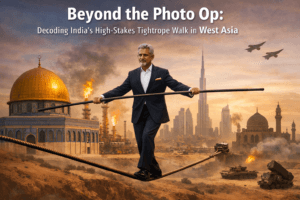
Beyond the Photo Op: Decoding India’s High-Stakes Tightrope Walk in West Asia
The image was powerful and deliberate: Prime Minister Narendra Modi and Israeli Prime Minister Benjamin Netanyahu, walking shoulder-to-shoulder, a tableau of unwavering camaraderie. For Mr. Netanyahu, it was a much-needed political embrace on the world stage. For Mr. Modi, it was a continuation of a decade-long project to elevate a once-clandestine relationship into a public and strategic partnership. But beneath the warm handshakes and the signing of 15 MoUs during this 24-hour whirlwind visit to Jerusalem, a far more complex and precarious geopolitical narrative is unfolding—one that tests the limits of India’s cherished policy of strategic autonomy.
The visit, culminating in the upgrade of ties to a “Special Strategic Partnership,” was undeniably a bilateral triumph. Agreements spanning critical technologies, artificial intelligence, agriculture, and a plan to employ 50,000 Indian workers in Israel over the next five years speak to a relationship that has matured far beyond its defence-centric origins. This is a partnership built on tangible, mutually beneficial outcomes. For India, Israeli technology is a force multiplier; for Israel, India is a vast market and a rising diplomatic power.
Yet, a bilateral relationship does not exist in a vacuum. It is particularly true in West Asia, a neighbourhood India defines as its “extended strategic neighbourhood,” home to nearly nine million Indian expatriates and the source of a significant portion of its energy needs. The timing and tenor of this visit, set against the backdrop of a devastating war in Gaza and escalating tensions over Iran, have transformed what could have been a routine diplomatic engagement into a high-stakes referendum on India’s role in a rapidly fracturing region.
The Shadow of Gaza and the Politics of Presence
The most immediate and consequential context for Mr. Modi’s visit is the ongoing Israeli military campaign in Gaza, launched in the wake of the horrific Hamas terror attacks on October 7, 2023. India was swift and unambiguous in its condemnation of terrorism, a stance consistent with its long-standing principles. However, as the military operation has exacted a staggering toll—with the provided text noting more than 72,000 Palestinian deaths—the international community’s outcry has grown. Even traditionally measured nations like Germany, France, and the UK have publicly condemned Israel’s proposed West Bank settlements and the humanitarian catastrophe in Gaza.
It is within this climate of Israel’s growing isolation that Mr. Modi’s visit, and especially his address to the Knesset, the Israeli parliament, must be scrutinized. The Prime Minister’s words were carefully chosen. He spoke of India sharing the “pain and grief of every life lost” in the October 7 attack. He obliquely referenced Palestinian sovereignty only through the lens of the U.S.-led Gaza Peace Initiative, noting it “holds the promise of a just and durable peace… including by addressing the Palestine Issue.” He did not mention the devastating toll of the Israeli strikes, nor did he publicly call for a ceasefire.
This rhetorical tightrope walk is a hallmark of Indian diplomacy, an attempt to acknowledge one tragedy without seemingly validating the other. But in the current, highly polarised environment, silence is often interpreted as a stance. The absence of a public expression of concern for Palestinian civilian casualties, juxtaposed with the deeply personal and effusive reception by the Israeli leadership, signals a perceptible tilt in India’s traditional posture. It bolsters Mr. Netanyahu politically at a time when he faces a corruption trial, scrutiny over the security failures of October 7, and an impending election that serves as a referendum on his leadership. Mr. Modi’s presence provided a powerful image of legitimacy and friendship that the Israeli leader can leverage on the campaign trail.
This has not gone unnoticed in New Delhi. The Indian National Congress, the main opposition party, was quick to criticise the Prime Minister, accusing him of “diminishing India’s moral standing” by failing to adequately address the Palestinian plight. Domestically, the visit has reignited a debate about the soul of India’s foreign policy: is it principled and balanced, or is it becoming increasingly realpolitik and transactional, favouring one partner at the expense of a long-standing friend?
The Historical Balancing Act: From Moral Support to Multi-Alignment
To understand the gravity of this moment, one must look back. For decades, India’s policy on the Israel-Palestine conflict was a cornerstone of its Non-Aligned Movement identity. It was a policy of unambiguous support for the Palestinian cause, rooted in anti-colonial solidarity. India was the first non-Arab state to recognize the Palestine Liberation Organization (PLO) and was a staunch advocate for a two-state solution. Full diplomatic relations with Israel were only established in 1992, a pragmatic shift that signalled India’s post-Cold War realignment and its growing defence needs.
For the subsequent two decades, Indian governments, both Congress and BJP-led, meticulously maintained a policy of “de-hyphenation”—treating Israel and Palestine as two distinct and independent tracks of its foreign policy. This allowed India to build a robust defence and technology partnership with Israel while continuing to rhetorically and financially support the Palestinian cause. The high-water mark of this balancing act was Mr. Modi’s own 2017 visit to Israel, which he famously followed up with a landmark visit to Ramallah in 2018, becoming the first Indian Prime Minister to do so. This “visiting both sides” approach was the physical manifestation of India’s carefully calibrated balance.
The current visit, however, lacked that counterpart. It was a solo performance in Jerusalem. The onus is now on New Delhi to reaffirm its commitment to the Palestinian people, a step the article’s author explicitly hopes for. Without a corresponding high-level engagement with Palestine, the perception of a strategic shift becomes harder to dispel.
The Geopolitical Ripple Effect: The Arab World is Watching
While the domestic and bilateral optics are significant, the most profound consequences of this visit may unfold in India’s relationship with the broader Arab and Muslim world. For years, India has cultivated deep and strategic ties with key powers like Saudi Arabia, the United Arab Emirates (UAE), Qatar, and Iran. These relationships are multifaceted, encompassing energy security, trade and investment (exceeding $240 billion annually with the Gulf Cooperation Council countries), and the welfare of the massive Indian diaspora.
The Arab street and, more importantly, Arab leadership are deeply invested in the Palestinian cause. While some Gulf nations have pragmatically pursued their own national interests, including normalisation talks with Israel, the visceral public anger over Gaza remains a potent force. An overt Indian embrace of Israel, perceived as downplaying Palestinian suffering, risks alienating public opinion in these crucial partner nations. This could manifest in cooled enthusiasm for major initiatives, increased scrutiny of Indian workers, or a subtle shift in diplomatic alignment.
It is telling that Mr. Modi’s itinerary and statements heavily featured the India-UAE-Israel (I2U2) format and the India-Middle East-Europe Economic Corridor (IMEC). These initiatives, which seek to integrate the region through trade and infrastructure, represent a bold vision for a post-conflict future. By championing them, New Delhi is signaling its belief that these economic partnerships can transcend the current political turmoil. It’s a bet on the future, but it requires immense diplomatic finesse in the present.
The risk is that by standing so visibly with Israel, India may be perceived as taking a side, making it harder to act as a credible bridge-builder or a neutral partner for Arab nations. As the article states, this could come “at the cost of India’s relations with other West Asian powers, which expect India to remain steadfast to its historically calibrated regional balance.” These nations have long valued India precisely because it was not a Western ally parroting Western talking points, but an independent voice with its own moral and political compass.
The Unspoken Factor: Iran
Adding another layer of complexity is the mention of the “threat of U.S. attacks on Iran.” While not a central theme of the visit, it hangs in the air. India has a long and complex relationship with Iran, centred on the strategic Chabahar Port, which provides India with a trade route to Afghanistan and Central Asia, bypassing Pakistan. This relationship is a vital part of India’s regional connectivity strategy.
A full-blown US-Israel conflict with Iran would place India in an excruciating position. Publicly siding with Israel and the US would jeopardize its investment in Chabahar and its relationship with a major energy producer. Remaining neutral or trying to balance would be seen as insufficient by its new strategic partners. Mr. Modi’s visit, by reinforcing the India-Israel partnership, subtly complicates its manoeuvrability in any future Iran contingency. It narrows the window for the kind of strategic ambiguity that India has historically prized.
Conclusion: Walking a Tightrope Without a Net
Prime Minister Modi’s 24-hour visit to Israel was a masterclass in bilateral optics, cementing a partnership that delivers real, tangible benefits to both nations. The agreements signed will boost innovation, create jobs, and deepen technological ties. On this level, the visit was an unqualified success.
However, the true test of Indian statecraft lies not in the photo opportunities in Jerusalem, but in the quiet diplomacy that must now follow in Riyadh, Abu Dhabi, Tehran, and Ramallah. India’s foreign policy has always been strongest when it has been able to hold multiple, sometimes contradictory, ideas in its head at once: a friend to Israel and a supporter of Palestine; a strategic partner of the US and a longstanding partner of Iran; a champion of realpolitik and a voice for moral principle.
This visit has tilted the scales perceptibly. The risk is not that India has damaged its ties with the Arab world overnight—those relationships are too deep and interdependent for that. The risk is one of slow erosion. It is the risk of being perceived as a less reliable, less empathetic partner by nations that have stood by India through thick and thin.
India’s historic position on the Israel-Palestine conflict was never just about morality; it was a strategic asset. It was the key that unlocked doors across the Arab and Islamic world, granting India a unique stature and influence. The challenge for New Delhi now is to ensure that in its pursuit of the considerable benefits of its partnership with Israel, it does not inadvertently misplace that key. The coming months, and whether a visit to Ramallah materialises, will reveal whether India is still walking the tightrope with a steady gaze, or if it has begun to lean dangerously to one side.
You must be logged in to post a comment.