
Beyond the Pellet: The Teaneck Shooting and the Anatomy of a Modern Bias Crime
Beyond the Pellet: The Teaneck Shooting and the Anatomy of a Modern Bias Crime
The late afternoon sun cast long shadows over the intersection of Jefferson Street and Ogden Avenue in Teaneck, New Jersey. To anyone passing by, it was a quiet, residential corner in one of the most famously diverse towns in America. But for a 19-year-old Jewish man walking home, that corner became the stage for a terrifying confrontation that would echo far beyond its tranquil sidewalks.
On that day, a black sedan slowed to a crawl. A question, sharp and provocative, cut through the suburban quiet: “Do you support Israel or Palestine?” Before the young man could even process the query, let alone answer, a pellet from a gel gun stung his skin. The car sped off, only to circle back moments later, emboldened, as its occupants unleashed another volley of pellets at him.
Hours later, three suspects were in custody, and a 17-year-old from Englewood, New Jersey, was facing a half-dozen charges, including the weighty accusation of bias intimidation. This incident, captured in part by the unblinking eyes of license plate readers, is more than just a local news brief. It is a microcosm of a disturbing trend: the intersection of global conflict, juvenile delinquency, and deeply ingrained hate, playing out on the streets of American suburbs.
The Weapon and the Wound: More Than Just a Pellet
At first glance, a “gel pellet gun” or “gel blaster” might sound like a child’s toy. These weapons, which shoot water-absorbed polymer beads, are often marketed for recreational play. But to minimize their use in a crime is to misunderstand the nature of the act.
When a projectile is fired from a moving vehicle at a pedestrian, the intent is not play; it is terror. While the physical injury from a gel pellet is often minor—a sting, a bruise, a temporary welt—the psychological wound is profound. For the victim, the world suddenly becomes a more dangerous place. A walk home, a trip to the synagogue, or simply being visibly identifiable as a Jew becomes an act of courage.
“People hear ‘pellet gun’ and think it’s not serious,” says clinical psychologist Dr. Miriam Klein, who specializes in trauma related to identity-based violence. “But the victim isn’t thinking about the caliber of the weapon. They are thinking about intent. In that moment, they are being targeted for who they are. The message is, ‘You don’t belong here,’ or ‘Your identity makes you a target.’ That feeling of safety being shattered can lead to hypervigilance, anxiety, and a deep-seated sense of vulnerability that lasts long after the bruise fades.”
The suspects’ decision to return for a second round of shooting is particularly telling. It was not a spontaneous, heat-of-the-moment act. The U-turn and second attack suggest a desire to escalate, to reinforce the threat, and to savor the power dynamic they had created. It transforms a drive-by from a reckless act into a campaign of intimidation.
Teaneck: A Crucible of Diversity
To understand why this attack sent such powerful shockwaves through the community, one must understand Teaneck itself. Incorporated in 1895, Teaneck has deliberately cultivated an identity as one of the most integrated and diverse towns in the United States. It was the first town in the nation with a majority-white population to voluntarily vote to desegregate its schools in the 1960s. This legacy is a point of immense pride.
Today, Teaneck is a vibrant mosaic. It is home to one of the largest and most influential Modern Orthodox Jewish communities in North America, with dozens of synagogues and a bustling eruv (a ritual enclosure). It also has a significant Black population, a growing Latino community, and families of Korean, Filipino, and Indian descent. On any given day, you might see families walking to shul on a Saturday morning, children playing soccer in the park, and neighbors chatting over front-yard fences, representing a spectrum of cultures and backgrounds.
This diversity is not just a statistic; it is the town’s social contract. The implicit agreement is that difference is not just tolerated but celebrated. An attack like the one on Jefferson Street is not just a crime against an individual; it is a violation of that contract. It’s a direct challenge to the town’s very identity.
Tim Torell, the Jewish Community Security Director for the Jewish Federation of Northern New Jersey, understands this intimately. His role, a necessary position in the 21st century, involves distributing safety pamphlets and coordinating with local police. His advice to the community is a stark reflection of the new reality: “Stay aware, report suspicious vehicles.” The fact that such vigilance is required in a town like Teaneck is a heartbreaking irony. The very openness that makes the town special is also what makes it vulnerable to those who would exploit it.
The Question: “Israel or Palestine?”
The question allegedly asked by the suspects—”Do you support Israel or Palestine?”—is the key that unlocks the “bias” element of this crime. It transforms a simple assault into a hate crime.
The prosecutor’s office will have to prove that the victim was targeted because of his perceived Jewish identity, and that the question was a direct precursor to the violence. In the context of rising global tensions, particularly the ongoing Israeli-Palestinian conflict, this question has become a dangerous proxy. On social media, in protests, and now, apparently, in the streets of New Jersey, it is used as a litmus test.
For the victim, it was a trap. Any answer, or even a non-answer, could be used to justify the attack. For the assailants, the question served to dehumanize the victim, turning him from a person into a symbol of a political entity they oppose.
This phenomenon is what experts call “proxy hate.” Individuals who may have little understanding of the complex geopolitics of the Middle East adopt the conflict as a justification for targeting local minorities. They see a person in a kippah or a traditionally Jewish neighborhood and project their anger about events half a world away onto them. This dynamic has led to a surge in antisemitic incidents across the United States and Europe whenever tensions flare in Israel.
Technology as a Witness: The Role of License Plate Readers
In the immediate aftermath of the shooting, the victim did what most people do: he called the police. But the investigation’s swift resolution was due to a silent, pervasive witness: the Automated License Plate Reader (ALPR) network.
Teaneck Police were able to use this technology to track the suspect vehicle, capturing not only its plates but also an image of a person hanging out the passenger window, weapon in hand. In a matter of hours, the car was located and the teenager was in custody.
The use of ALPRs is a double-edged sword that sparks important civil liberties debates. Privacy advocates worry about the mass collection of location data on law-abiding citizens, creating a searchable database of everyone’s movements. They argue that this represents a form of warrantless surveillance.
However, in cases like this, the technology is undeniably effective. It provided immediate, concrete leads, preventing a protracted investigation and offering a sense of swift justice to a frightened community. For Teaneck’s Jewish residents, many of whom were already on edge, the quick arrest was a balm.
“I also have to, at this point, commend the Teaneck Police for doing such a quick job,” Torell said, explicitly linking the police work to community safety. “It’s just a great example of ‘you see something, you say something.'” In this context, the “something” seen wasn’t just a witness, but a machine.
The 17-Year-Old Suspect: A Question of Upbringing
The face of the accused is a 17-year-old boy. He sits in the Bergen County Detention Center, facing charges that could alter the entire trajectory of his life. This fact forces a difficult and uncomfortable question: How does a teenager end up in a car, asking a stranger a loaded political question, and then firing a weapon at them?
While the details of his life are not public, his age is significant. At 17, he is on the cusp of adulthood, but his brain—specifically the prefrontal cortex responsible for impulse control, decision-making, and understanding long-term consequences—is still developing.
This does not excuse his alleged actions, but it provides a framework for understanding them. Teenagers are highly susceptible to group dynamics, peer pressure, and the intoxicating pull of social media echo chambers. It is possible he was radicalized online, consuming content that paints complex geopolitical conflicts in stark, us-versus-them terms. It is possible the thrill of the moment, egged on by others in the car, overwhelmed his capacity for reason.
The legal system will have to grapple with this duality. He is being charged as an adult with serious, life-altering felonies. But the community must also grapple with the failure it represents—a failure of education, of mentorship, and of the social fabric that allowed a young person to harbor such hatred.
A Community’s Response
In the days following the incident, the corner of Jefferson Street and Ogden Avenue returned to its quiet routine. But the ripples of the event continue to spread. Synagogues have reviewed their security protocols. Parents are having difficult conversations with their children. The local chapter of the NAACP and the Jewish Community Relations Council have likely been in contact, reaffirming their commitment to the town’s pluralistic values.
The incident is a stark reminder that the fight against hate is not a historical artifact; it is a daily, ongoing effort. It happens not just in grand marches, but in the small moments—in how we talk to our children about people who are different, in how we challenge bigoted jokes, and in how we respond when a car full of teenagers decides to turn a neighborhood street into a hunting ground.
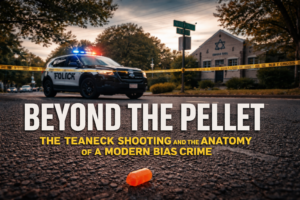
The tiny orange gel pellet that an Eyewitness News crew found on the street is a potent symbol. It is small, soft, and seemingly insignificant. But when fired from a weapon and propelled by hate, it carries the weight of centuries, capable of wounding not just one man, but an entire community’s sense of peace and belonging. The charges against the teenager are a legal conclusion, but the community’s work to heal and reaffirm its identity is just beginning.
You must be logged in to post a comment.