
Beyond the Paycheck: How Geopolitics and the Gig Economy Collide on Amazon’s Warehouse Floor
Amid rising living costs driven by LPG shortages linked to geopolitical tensions in West Asia, the Amazon India Workers Union (AIWU) has demanded wage revisions and better incentives for warehouse workers—a call that Amazon has countered by asserting the union does not represent its employees. The standoff underscores the fragility of India’s e-commerce labor model, where workers face the squeeze of inflation without the protection of collective bargaining, highlighting a deeper conflict between the efficiency-driven gig economy and the urgent need for sustainable, inflation-responsive labor practices.
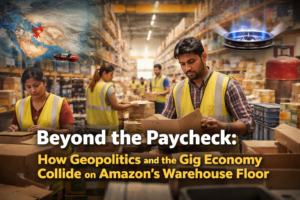
Beyond the Paycheck: How Geopolitics and the Gig Economy Collide on Amazon’s Warehouse Floor
In the sprawling, algorithm-driven labyrinth of an Amazon fulfillment center in India, the hum of conveyor belts rarely stops. For the thousands of workers who navigate these aisles, packing orders and meeting targets measured in seconds, life has always been a balancing act between efficiency and endurance. But recently, a new variable has entered their economic calculus—one that has little to do with Prime Day sales or quarterly delivery targets and everything to do with a maritime chokepoint thousands of miles away.
As the sun rose over New Delhi last week, the Amazon India Workers Union (AIWU) delivered a letter to the e-commerce giant’s management. The request was simple on its face: revise wages and enhance incentives. But the context underlying the demand reveals a far more complex story about the fragility of the modern economy, where a conflict in West Asia is now dictating the cost of a warehouse worker’s dinner.
The AIWU’s appeal comes at a moment when the supply chain is not just moving goods from sellers to buyers but is also tightening the screws on those who do the moving. The ongoing disruptions in West Asia, specifically the limitations placed on liquefied petroleum gas (LPG) shipments transiting the Strait of Hormuz, have triggered a sharp increase in the cost of living. For workers in the gig and logistics economy—who often live paycheck to paycheck—this isn’t just an abstract geopolitical headline; it is the immediate reality of spending a larger portion of their daily wage on cooking fuel and transportation.
The Anatomy of a Crisis: From Geopolitics to the Kitchen
To understand the urgency behind the AIWU’s letter, one must first look at the Strait of Hormuz. This narrow strip of water between Oman and Iran is the world’s most critical oil and gas chokepoint. When maritime tensions escalate in this region, the ripple effects are felt globally. In India, a country heavily reliant on energy imports, the result is immediate: a squeeze on LPG supplies and a spike in prices.
For an Amazon warehouse worker in a city like Mumbai, Hyderabad, or Gurugram, the economics are brutal. Many live in rented accommodations where cooking gas is a non-negotiable expense. When the price of a refill surges by 15% or 20% within weeks, it doesn’t just impact the household budget; it erodes the very purpose of working. If the cost of survival rises faster than the wage, the value of labor diminishes in real-time.
The AIWU’s demand, therefore, is not merely about a salary hike in the traditional sense. It is a plea for wage indexation—a recognition that in a globally connected economy, compensation cannot remain static while the cost of essential commodities fluctuates violently due to external shocks.
The union’s letter is understood to have proposed a revision in the base pay alongside an enhancement of performance incentives. In the high-pressure environment of Amazon’s warehouses, incentives often make up a substantial portion of a worker’s take-home pay, tied to productivity metrics like pick rates and packing speeds. But with inflation eating into disposable income, workers argue that the current incentive structure no longer cushions the blow of rising living costs.
The Representation Question: Who Speaks for the Blue Badge?
However, the narrative takes a sharp turn when Amazon responds. The company has issued a statement asserting that the AIWU does not represent its warehouse workers. This is a critical point of contention. In India, the labor ecosystem, particularly in the tech-driven logistics sector, is fragmented. While there are registered trade unions, the nature of contractual and temporary employment often leaves workers in a grey area regarding representation.
Amazon’s rebuttal highlights a deeper structural challenge in India’s gig and blue-collar economy. While the AIWU claims to be the voice of the workers, Amazon’s denial of their representational status effectively creates a vacuum. If the union isn’t recognized, who negotiates?
This is not merely a semantic dispute. Collective bargaining is a cornerstone of labor rights. Without a recognized body, individual workers are left to negotiate their terms in a system driven by algorithms. The AIWU’s push for wage revision is as much about the money as it is about establishing legitimacy—forcing the e-commerce giant to acknowledge that the workforce has a collective voice that needs to be heard, especially in times of economic distress.
The Gig Economy’s Growing Pains
The situation at Amazon is a microcosm of a larger storm brewing in India’s gig economy. The country has witnessed an explosion in e-commerce and delivery services over the last decade. Companies like Amazon, Flipkart, Zomato, and Swiggy have created millions of jobs. But these jobs often exist in a legal gray zone.
The classic distinction between “worker” and “employee” is blurring. Amazon warehouse workers, while not “gig” workers in the sense of app-based delivery partners, often face similar instability. Many are on contract, lacking the full benefits that come with permanent employment. They are subject to strict productivity algorithms that dictate their every move.
When a crisis like the LPG shortage hits, these structural vulnerabilities become painfully apparent. A permanent employee in a traditional manufacturing sector might have a cost-of-living allowance (CLA) built into their contract. But for the modern logistics worker, such protections are often absent. The AIWU’s intervention is an attempt to force a conversation that the industry has been reluctant to have: How do we ensure that the workers who power the e-commerce boom are shielded from the volatility of global markets?
The Human Cost of “One-Day Delivery”
There is an often-invisible irony in the e-commerce business model. The same supply chain efficiencies that allow a customer to order a gas stove at 10 PM and receive it by 8 AM the next day are the efficiencies that squeeze the labor costs to make that speed possible.
The demand for “Faster” and “Cheaper” delivery has led to a relentless optimization of labor. Workers in fulfillment centers are monitored by sophisticated software that tracks idle time down to the second. The promise of “incentives” is often the carrot dangled to ensure that workers push their physical limits.
With the rising cost of essentials like LPG, the calculus of whether these incentives are worth the strain is shifting. One worker, speaking on condition of anonymity, noted, “Earlier, the overtime and incentives felt like a bonus. Now, they feel like a necessity just to cover the basics. When the price of gas goes up, I have to work longer hours just to stay in the same place.”
This sentiment captures the essence of the current labor unrest. It is not just about greed; it is about the erosion of the value of labor. When essential utilities become unaffordable on a standard wage, the implicit social contract between employer and employee begins to fracture.
Looking Ahead: A Turning Point?
As the standoff between the AIWU and Amazon management continues, the broader implications for India’s industrial relations landscape are significant. The e-commerce sector has largely enjoyed a reputation for being “disruptive,” often operating outside the traditional frameworks of labor law that apply to brick-and-mortar retail or manufacturing.
But the current crisis—rooted in global geopolitics but felt in the household budgets of warehouse staff—is forcing a recalibration. The government, too, is watching closely. With the push for a comprehensive framework for gig and platform workers, the Amazon case could serve as a precedent.
For Amazon, the challenge is balancing operational efficiency with employee retention and morale. A workforce struggling to afford cooking gas is unlikely to be a productive workforce. The company’s response to the AIWU’s letter—whether it chooses to engage in dialogue or maintain that the union lacks representation—will set a tone for how it navigates future labor disputes in the region.
For the workers, the path forward is fraught with risk. Forming a union and pushing for wage hikes in a competitive market requires solidarity, but it also invites scrutiny. Yet, as the AIWU’s letter demonstrates, the silence has become too loud to ignore.
Conclusion
The conflict unfolding on the outskirts of India’s metropolitan cities is more than a dispute over rupees and paise. It is a collision of global forces—geopolitical instability, algorithmic management, and the urgent need for sustainable labor practices.
As West Asia continues to simmer and the Strait of Hormuz remains a flashpoint, the cost of instability will continue to trickle down. For the Amazon warehouse worker packing a box of LPG cylinders for a customer, the irony is stark. In the race to digitize India and deliver convenience, the human hands that make it possible are struggling to afford the very fuel needed to cook their own meals.
The AIWU’s demand for a wage revision is not just a labor issue; it is a litmus test for the resilience of the Indian e-commerce model. If the giants of the industry cannot ensure that their workforce is insulated from the basic volatilities of life—like the price of a gas cylinder—then the model may prove to be built on a foundation far shakier than the supply chains they manage.
As the summer heat builds in India, so too does the pressure on policymakers, corporations, and unions to find a new equilibrium. The outcome of this tug-of-war will determine whether the e-commerce boom becomes a sustainable engine for inclusive growth or simply a monument to widening inequality.
You must be logged in to post a comment.