
Beyond the Orange Alert: How Chennai Prepares for Cyclone Ditwah’s Wrath – A Deep Dive into Resilience, Science, and Survival
As Cyclone Ditwah approaches the Tamil Nadu coast, the Indian Meteorological Department has issued an orange alert for Chennai, warning of intense rainfall and thunderstorms, while placing Cuddalore and Puducherry under a higher-risk red alert. The storm’s parallel movement along the coast threatens prolonged heavy rains and strong winds, already causing significant disruption, including the cancellation of 47 flights at Chennai International Airport.
This event triggers a practiced response from residents, who draw on memories of past floods to secure homes and supplies, even as authorities deploy NDRF teams and essential workers. The situation underscores the perennial vulnerability of India’s eastern coast to such cyclonic systems and highlights the critical importance of heeding official warnings, preparing emergency kits, avoiding coastal areas, and fostering community vigilance to navigate the immediate threat and its aftermath safely.
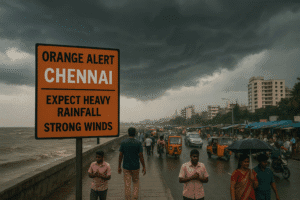
Beyond the Orange Alert: How Chennai Prepares for Cyclone Ditwah’s Wrath – A Deep Dive into Resilience, Science, and Survival
The air in Chennai carries a familiar, charged weight—a blend of saline breeze from the Marina and the metallic scent of impending rain. Skies, usually a relentless blue, are a dramatic tapestry of leaden grey, moving with a purpose that whispers of the churning Bay of Bengal. This isn’t just another monsoon shower; it’s the palpable approach of Cyclone Ditwah. As the Indian Meteorological Department (IMD) sounds an orange alert for the city and a more severe red alert for the vulnerable coasts of Cuddalore and Puducherry, a complex machinery of preparedness, anxiety, and stoic resilience swings into motion. This event is more than a weather bulletin; it’s a story of a city confronting nature’s fury, armed with lessons from the past and science for the future.
The Anatomy of an Alert: Decoding Ditwah’s Threat
For the layperson, an “orange alert” might sound abstract. But in meteorological terms, it’s a clear, staged protocol communicating risk. The IMD’s colour-coded system is a masterclass in public communication:
- Red (Extreme Risk): As issued for Cuddalore and Puducherry, it signifies a call for immediate action. “Extremely heavy rainfall” is forecast, often exceeding 20 cm in 24 hours, with winds capable of causing structural damage, widespread flooding, and a complete halt to normal life.
- Orange (Be Prepared): For Chennai, Thiruvallur, Kancheepuram, and others, this is a serious warning to brace. It predicts heavy to very heavy rainfall (6 cm to 20 cm), squally winds, thunderstorms, and significant disruption to travel and infrastructure.
- Yellow (Watch): For the rest of Tamil Nadu, it advises caution and to stay updated.
Cyclone Ditwah’s projected path—moving northwards, parallel to the coast, coming within 30-70 km—is particularly tricky. This “skirting” movement can prolong the period of intense weather, subjecting coastal areas to relentless onshore winds and torrential rainbands, even if the eye doesn’t make landfall directly. The threat isn’t just from wind; it’s from water. Coastal storm surges, the inundation of seawater pushed by cyclonic winds, and subsequent inland flooding from rains are often the deadliest aspects.
Ground Zero: The Ripple Effects Before the Rain
The impact of Ditwah began long before the first drops hit the ground. At Chennai International Airport, the cancellation of 47 flights—connecting key domestic hubs like Madurai and Tiruchi, and international links to Colombo and Jaffna—is a stark reminder of our interconnected vulnerability. Each cancellation represents a cascade of disrupted plans: business deals, family reunions, critical medical travel. It’s the first tangible economic and social cost of the cyclone.
Across the city, a quiet, systematic preparation unfolds. In low-lying areas like Pallikaranai and sections of the Adyar basin, residents perform a grim, familiar ritual—moving belongings to higher shelves, checking emergency kits, and securing documents in plastic pouches. Street vendors hurriedly pack up, while supermarkets see a rush for essentials, notably batteries, candles, and drinking water. This collective memory is fresh, shaped by the devastating floods of 2015 and previous cyclones like Vardah (2016). The trauma has, in a way, forged a muscle memory for preparedness.
The Human Insight: Between Panic and Paralysis
The true story of a cyclone lies in the human response, which exists on a spectrum between informed caution and dangerous nonchalance. For the seasoned Chennai resident, the drill is almost routine: stock up, stay in, avoid waterlogged roads and underpasses. They recall how quickly the city’s arteries can get clogged, not just by traffic, but by water.
Yet, there’s always a segment that underestimates the threat. The sight of young people venturing to the Marina to “see the waves” is a recurring nightmare for disaster management officials. This is where the real value of consistent messaging lies—emphasizing that an orange alert is not a spectator sport. The authorities’ plea to avoid coastal routes and stay indoors is born from painful experience.
Simultaneously, there’s an army of first responders and essential workers gearing up. The National Disaster Response Force (NDRF) teams, reportedly airlifted to the city, symbolize state readiness. But equally crucial are the unsung heroes: the electricity board linemen on standby, the civic body workers clearing storm drains, and the hospital staff ensuring generators are fuelled. Their preparedness is the bedrock of resilience.
The Science Behind the Storm: Why the East Coast is a Magnet
Cyclone Ditwah is not a random event but a seasonal geographical certainty. The Bay of Bengal is a notoriously fertile ground for cyclogenesis, especially in the post-monsoon months of October-December. The reasons are scientific: the bay’s warmer sea surface temperatures (often above 28°C), its enclosed nature that allows heat to pool, and the favorable atmospheric conditions provide the perfect energy cocktail for cyclones to form and intensify.
Understanding this pattern is key to moving from a reactive to a proactive stance. It underscores the importance of robust forecasting, which India has significantly improved. The IMD’s track and intensity predictions now provide a critical window of 3-4 days, enabling the intricate logistics of warning, evacuation (if needed), and resource mobilization.
Adding Value: A Reader’s Guide to Cyclone Preparedness
Beyond reporting the event, genuine value lies in actionable insight. For a reader in the path of Ditwah or future storms, here is a distilled checklist:
- Information is Infrastructure: Bookmark official sources like IMD and your state disaster management authority. Avoid social media rumours.
- The Emergency Kit: Beyond water and food, include a first-aid kit, necessary medicines, a power bank, a portable radio, cash (ATMs may fail), and important documents in a waterproof bag.
- Home Fortification: Secure loose objects on balconies, park vehicles in safe zones, and fully charge all devices. Have a plan for power outages.
- The Golden Rule: Avoid unknown water. Do not walk or drive through flooded streets. Electrocution and open manholes are invisible killers.
- Community Check: Touch base with vulnerable neighbours—the elderly or those living alone. Collective vigilance saves lives.
Looking Ahead: The Long Shadow After the Clouds Clear
The passage of Cyclone Ditwah will be marked by the peak of the storm, but its story will continue for days. The aftermath involves assessing damage to crops, particularly in the agrarian belts of the alerted districts, rehabilitating disrupted livelihoods, and restoring urban infrastructure. It also reignites critical conversations about sustainable urban planning, the preservation of natural buffers like wetlands, and the urgent, overarching challenge of climate change, which is intensifying such extreme weather events.
As Chennai hunkers down under its orange alert, the situation is a powerful reminder. Modern cities, for all their concrete and digital prowess, remain profoundly at the mercy of nature. The measure of a metropolis is not just in its gleaming towers, but in its capacity to weather the storm—through scientific warning systems, efficient governance, and, most importantly, the shared wisdom and solidarity of its citizens. Cyclone Ditwah is a test, and the answer lies not in fear, but in prepared, resilient action.
You must be logged in to post a comment.