
Beyond the Numbers: Why Bihar’s Holdout Threatens India’s Dream of Total Literacy and the Path to a Solution
India’s ambitious national goal of achieving 100% literacy by 2030 through the ULLAS scheme faces a critical bottleneck due to Bihar’s non-participation, as the state’s massive population of nearly 2 crore non-literates is pivotal to the mission’s success. The impasse stems from a complex interplay of administrative friction—where Bihar has not utilized released central funds—and a assertion of state autonomy, with Bihar preferring its long-running Akshar Anchal programme over the federal scheme. This standoff highlights deeper challenges of centre-state coordination and the need for flexible convergence of schemes rather than duplication, emphasizing that true literacy extends beyond statistics to encompass digital and financial empowerment, and that overcoming political and logistical inertia through cooperative federalism is essential to transform this national target into a social reality for all.
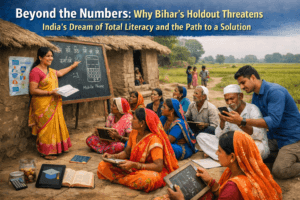
Beyond the Numbers: Why Bihar’s Holdout Threatens India’s Dream of Total Literacy and the Path to a Solution
India’s ambition to achieve 100% literacy by 2030, a cornerstone of its National Education Policy and a commitment to global Sustainable Development Goals, is a monumental task that requires every state to move in lockstep. At the heart of this national mission is the ULLAS (Understanding Lifelong Learning for All in Society) scheme, a comprehensive federal initiative designed to eradicate illiteracy among adults. Yet, this ambitious project faces a critical paradox: the state that arguably needs it the most, Bihar, has chosen to remain on the sidelines. This standoff is not merely a bureaucratic hiccup; it is a profound test of cooperative federalism, revealing the complex layers of politics, governance, and social reality that underlie a simple statistical target.
ULLAS: Redefining Literacy for the 21st Century
Launched in 2022, ULLAS represents a paradigm shift in how India conceptualizes adult education. Moving beyond the traditional metric of rudimentary reading and writing, the scheme adopts an expanded, holistic definition of literacy. As per its August 2024 guidelines, true literacy now encompasses:
- Foundational skills of reading, writing, and numeracy with comprehension.
- Digital literacy: Empowering citizens to navigate an increasingly online world.
- Financial literacy: Enabling better personal economic management.
- Critical life skills: Promoting legal, health, and civic awareness.
This broadened scope aligns with the NEP 2020’s vision of lifelong learning, recognizing that literacy in today’s world is the key to unlocking dignity, economic participation, and informed citizenship. The scheme’s operational model is community-driven, leveraging volunteerism (“Utkrishta Bharath Volunteers”) and flexible online-offline learning modes to reach non-literate individuals above 15 years of age. The progress is promising, with states like Himachal Pradesh and Mizoram already declared fully literate under the scheme. However, this progress shines a spotlight on the regions lagging behind, making Bihar’s absence not just conspicuous, but consequential.
Bihar’s Reluctance: A Tangle of Administration, Pride, and Politics
With a literacy rate of 74.3% (2023-24 PLFS), the second lowest in India, and nearly 2 crore non-literates in the 15-59 age group, Bihar is the epicenter of India’s literacy challenge. Its non-participation in ULLAS, therefore, is a major obstacle. The state’s stance is rooted in several interconnected factors:
- The Akshar Anchal Anchor: Bihar has operated its own state-funded literacy programme, Akshar Anchal, for over 15 years. Focused intensely on Dalits, Mahadalits, Extremely Backward Classes, and women aged 15-45, the scheme has an established grassroots institutional mechanism. The state government argues that Akshar Anchal, with its larger financial outlay and deep familiarity with local socio-cultural landscapes, makes ULLAS redundant. For Bihar, switching to a central scheme is seen not as an upgrade, but as a disruptive reinvention of the wheel.
- Administrative and Financial Stalemate: The Centre has flagged serious implementation gaps. While ₹16 crore was released to Bihar as the central share in 2023, the funds were reportedly not transferred to the mandatory Single Nodal Agency (SNA), no annual plan was submitted, and the money remains underutilized. This triggers a cycle of distrust: the Centre cites non-compliance, while the state may view the requirements as cumbersome or politically inconvenient.
- The Politics of Federal Autonomy: At its core, this impasse reflects a tension in India’s federal structure. Education is a concurrent subject, but flagship schemes often come with a strong central imprint. Bihar’s resistance can be interpreted as an assertion of state autonomy—a declaration that it understands its unique demographic and social challenges better than a one-size-fits-all national template. There is an unspoken political dimension where aligning entirely with a central scheme may not offer the same symbolic credit as a state-owned initiative.
The Deeper Challenge: More Than Just a Scheme Conflict
The Bihar-ULLAS stalemate unveils deeper, systemic challenges in India’s quest for total literacy:
- The Gender Gap Imperative: Of Bihar’s 1.32 crore non-literate women, their education isn’t just a statistic; it’s a multiplier for social development, affecting child health, family planning, and economic resilience. Any effective literacy mission must have gender-centric strategies at its heart, which requires sensitive, localized approaches that both Akshar Anchal and ULLAS claim to provide.
- The Duplication vs. Integration Dilemma: The real loss in this standoff is suffered by the intended beneficiary—the non-literate individual. The debate shouldn’t be about “Akshar Anchal vs. ULLAS,” but about how the strengths of both can be synthesized. Can ULLAS’s updated curriculum and digital tools be dovetailed with Akshar Anchal’s existing volunteer network and community trust?
- Beyond Certificates to Capability: The ultimate measure of success is not the number of certificates issued, but a tangible improvement in life outcomes. Does a newly “literate” individual feel empowered to access government services online, understand a bank document, or help their children with homework? This requires robust, third-party assessment and long-term tracking, areas where both schemes need strengthening.
A Way Forward: Collaboration, Flexibility, and Convergence
For India to realistically approach its 2030 goal, a rigid, top-down insistence will fail. A more pragmatic, cooperative approach is essential:
- Framework Integration, Not Replacement: The Centre should propose a “convergence model” where ULLAS provides the broader framework, curriculum, and technological platform, while allowing states like Bihar to adapt and implement it through their existing structures like Akshar Anchal. This respects state autonomy while ensuring national standards.
- Incentivize, Don’t Just Penalize: Instead of highlighting fund freezes and penalties, the Centre could create performance-linked incentives for states that not only achieve literacy targets but also demonstrate progress in closing gender and caste gaps. Positive reinforcement can be more effective than bureaucratic admonishment.
- Community-Led Monitoring: Empower local civil society organizations, women’s self-help groups, and village councils to monitor progress and outcomes. This creates bottom-up accountability and ensures the programme remains responsive to ground realities.
- Political Diplomacy and Narrative Building: This requires high-level political dialogue that moves beyond administrative letters. Framing Bihar’s success as a national imperative and celebrating its existing efforts (Akshar Anchal) as a foundation to build upon can create a more collaborative atmosphere.
Conclusion: Literacy as a Social Compact
India’s journey to 100% literacy is a marathon, not a sprint. Bihar’s reluctance is not an insurmountable barrier but a critical juncture for reflection. It forces a question: Is the goal merely to hit a numerical target, or is it to forge a more inclusive, empowered society?
The solution lies in moving from a mindset of scheme implementation to mission adoption. The ULLAS mission must be owned not just by the Union Education Ministry, but by state governments, district administrations, and every village community. For Bihar, and for India, achieving literacy is more than an educational objective; it is the fulfillment of a fundamental social compact—a promise of dignity and opportunity for every citizen. Bridging the gap between Patna and Delhi’s perspectives is the first, most crucial lesson in making that promise a reality.
You must be logged in to post a comment.