
Beyond the Numbers: The Human Landscape of 9,300 Lives in Israeli Detention
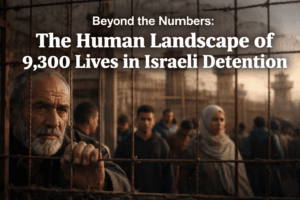
Beyond the Numbers: The Human Landscape of 9,300 Lives in Israeli Detention
Introduction: A Statistic with a Soul
On a cold February morning in 2026, as the world’s headlines cycled through political summits and economic forecasts, a bulletin from Ramallah quietly laid bare a relentless reality. According to a joint statement by Palestinian prisoner rights groups and data sourced from the Israeli Prison Service, over 9,300 Palestinians are currently held inside Israeli prisons. This number is not static; it’s a breathing, aching entity that grows and shrinks with the rhythms of occupation and conflict. But to reduce this to mere data is to miss the entire story. Each digit represents a life interrupted, a family in limbo, and a legal and moral quagmire that has defined the Israeli-Palestinian conflict for decades. This article delves beyond the headline to explore the human architecture of incarceration, the controversial policies that sustain it, and the profound consequences for any future peace.
Deconstructing the 9,300: Who Are the Detained?
The total figure of 9,300 is a mosaic of legal statuses and personal tragedies, each category revealing a different facet of the detention system.
- The Shadow World of Administrative Detainees (3,358 Individuals)
The most striking figure is the 3,358 Palestinians held under administrative detention—a practice wherein individuals are imprisoned without charge or trial, based on secret evidence unavailable to them or their lawyers. Israel employs this measure, citing “security reasons,” under military orders that are renewed in six-month intervals, potentially indefinitely. This number, noted as the highest proportion among detainee categories, signals a significant shift toward extra-judicial imprisonment. Critics, including major human rights organizations like Amnesty International and B’Tselem, condemn it as a violation of fundamental rights to due process and a fair trial, enshrined in international humanitarian law. For the detainee, it’s a psychological purgatory: no known endpoint, no ability to mount a defense, a perpetual state of uncertainty that families describe as “a torture of the mind.”
- The “Unlawful Combatant” Classification (1,249 and Beyond)
A particularly opaque category is the 1,249 individuals classified as “unlawful combatants.” This designation, established by an Israeli law in 2002, applies primarily to detainees from Gaza and, as noted, includes some from Lebanon and Syria. It creates a legal gray zone, offering fewer procedural protections than even administrative detention. The statement clarifies that this number excludes “all Gaza detainees held in Israeli military camps,” suggesting the true figure is vastly higher. These detainees often exist in a total information blackout—their whereabouts, conditions, and legal status hidden, leaving families to rely on whispers and rumors. This classification effectively places them outside the scope of both civilian criminal law and prisoner-of-war protections under the Geneva Conventions, a situation legal scholars warn dangerously erodes international norms.
- The Young and the Innocent? (350 Children + 2 Minor Girls)
Among the most harrowing figures are the 350 children held in Megiddo and Ofer prisons, plus two minor girls among the 56 female prisoners. International law, notably the UN Convention on the Rights of the Child (which Israel has ratified), stipulates that the detention of children should be a measure of last resort and for the shortest appropriate time. Yet, reports from UNICEF and Defense for Children International-Palestine consistently detail systemic issues: night arrests, coercion, lack of legal counsel, and trials in military courts that have a conviction rate exceeding 99%. For these minors, incarceration often means severed education, trauma, and a future shaped by the very system that might radicalize rather than rehabilitate. Their presence behind bars represents not just a legal failure but a profound societal one.
- Women Behind Bars (56 Prisoners)
The 56 female prisoners, including minors and likely mothers, face unique hardships. Reports speak of inadequate medical care, humiliating searches, and isolation from their children. Their detention reverberates powerfully through Palestinian society, where women are often pillars of the family structure. Their stories, less frequently told, highlight the gendered dimensions of the conflict’s carceral system.
The Machinery of Detention: How Did We Get Here?
The current high tally cannot be divorced from the broader political context. The period leading into 2026 has likely been marked by continued tensions, escalations in the West Bank, and the aftermath of the devastating 2023-2024 Gaza war. Israeli policy often sees a correlation between security crises and a spike in arrests, both as a deterrent and a preemptive measure. The military court system in the West Bank processes thousands of cases annually, with Palestinians subject to a different legal code than Israeli settlers in the same territory—a two-tiered system that many label as apartheid.
Furthermore, the explosion in administrative detainee numbers suggests a policy shift. It may indicate a move away from the logistical burden of prosecution in military courts toward a mechanism that allows for indefinite containment based on intelligence. For the Israeli security establishment, this is a necessary tool to thwart terror plots without compromising sources. For Palestinians, it’s the embodiment of arbitrary power.
The Human Tapestry: Stories Woven into the Data
Behind the number 9,300 are stories like that of Khaled (not his real name), a 45-year-old teacher from Hebron, now entering his third year of administrative detention. His wife, Aisha, recounts the midnight raid, the blindfold, and the 18 months of not knowing what he was accused of. “We are living a life of paused,” she says. “My children’s birthdays, our anniversary—all are dates we mark with his absence, with no answer to ‘when?’”
Then there is 14-year-old Ahmed, sentenced to eight months for throwing stones. His father, a day laborer, describes a boy who returned from Ofer prison withdrawn, fearful of soldiers, and struggling to return to school. “They didn’t just take months of his life,” he says. “They took his childhood.”
And there are the families of the “unlawful combatants” from Gaza, whose anguish is compounded by total silence. With no Red Cross visits permitted for these detainees and no official registry, their families cling to the testimonies of released prisoners who might have seen a familiar face in a camp. This is a unique form of agony, a disappearance within a formally acknowledged system.
The Israeli Perspective: Security vs. Justice
To present a complete picture, one must engage with the Israeli rationale. The Israeli security apparatus views the prison population not as an abstract human rights issue but as a direct reflection of an ongoing, low-intensity conflict. From this perspective, every individual detained is believed to pose a tangible threat—whether as an active militant, a recruiter, or an inciter of violence. The use of administrative detention is defended as a critical tool to prevent imminent attacks when presenting evidence in open court would expose intelligence networks. The military courts, while criticized, are seen as a necessary judicial component for a territory under military occupation where the local authority (the Palestinian Authority) is not trusted to prosecute security offenses. The detention of minors, while described as regrettable, is framed as a response to their involvement in life-threatening activities, such as knife attacks or orchestrating violent riots.
This security-first narrative resonates deeply within an Israeli public that has lived through waves of terrorism. However, the sheer scale and the systemic use of practices like administrative detention lead even some within Israel to question whether the current model is sustainable or ultimately corrosive to Israel’s own democratic fabric.
The Ripple Effects: Prisoners as a Central Political Nexus
Palestinian prisoners are not merely casualties of conflict; they are a central political and social nexus. Their fate is a primary issue for both the Palestinian Authority and factions like Hamas. Prisoner swaps have historically been among the most emotionally charged negotiations, underscoring how deeply the issue is woven into the national psyche. The prisoners’ movement itself has been a site of political organizing, hunger strikes, and martyrdom. Thus, the 9,300 figure represents a massive pool of potential future leaders, hardened radicals, or broken individuals, depending on their experience. Their treatment today directly shapes the attitudes of the next generation.
Conclusion: The Metric of a Stalemate
The February 2026 snapshot of 9,300 Palestinian detainees is more than a statistic; it is a key metric of a worsening stalemate. It reflects a conflict where trust is absent, judicial processes are weaponized, and the line between security and collective punishment is persistently blurred. The overwhelming reliance on administrative detention and the “unlawful combatant” classification suggests a hardening of approach, a move toward legal mechanisms designed for permanence rather than resolution.
For true change to occur, this system must be addressed not merely as a humanitarian concern but as a core political issue. It demands a reintegration of international law, a commitment to transparent judicial processes, and a recognition that the mass incarceration of a population under occupation is incompatible with a just and lasting peace. Until then, each monthly count from the Prisoner’s Society will remain a bleak chronicle of lives suspended, a testament to a conflict measured not only in land and rockets but in the thousands of keys to prison cells.
You must be logged in to post a comment.