
Beyond the Numbers: Decoding Delhi’s February Freeze and the ‘Poor’ Air We Breathe
The article expands on a routine Delhi weather report—a minimum temperature of 11.1°C and ‘Poor’ air quality—to explore the deeper human and environmental reality behind the statistics, framing February 16th as a transitional day that encapsulates the city’s complex relationship with its climate. It explains the meteorological tug-of-war creating the warm, misty conditions and analyzes the ‘Poor’ AQI as a significant improvement from winter’s peak pollution, driven by factors like subsiding temperature inversion and local emissions rather than seasonal crises. Most importantly, it delves into the lived experience of residents, showing how they navigate the day—from enjoying the pleasant 27-degree high to weighing the health risks of prolonged exposure—and argues that this “baseline” pollution serves as a reminder that Delhi’s environmental challenges require year-round vigilance, not just seasonal concern.
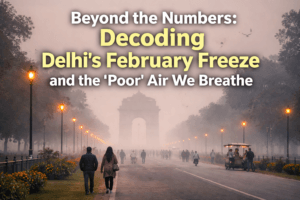
Beyond the Numbers: Decoding Delhi’s February Freeze and the ‘Poor’ Air We Breathe
The morning news alerts pinged on our phones with the familiar rhythm of a Delhi winter morning: “Minimum temperature at 11.1 deg C,” “Air quality ‘poor’.” For the uninitiated, these are just data points. But for the over 20 million residents of India’s capital, they are the defining parameters of daily life, especially in the twilight weeks between the departing winter and the arriving spring.
On this particular Sunday, February 15th, the India Meteorological Department (IMD) reported a minimum of 11.1 degrees Celsius, a maximum predicted to hover around a pleasant 27 degrees, and a blanket of morning mist with 89% humidity. The Central Pollution Control Board (CPCB) likely pegged the Air Quality Index (AQI) in the ‘Poor’ category (between 201 and 300). On the surface, it seems like a manageable day—a far cry from the hazardous peaks of November or the chilling single-digit lows of January. But to understand what this news truly means, we have to look beyond the statistics and into the science, the history, and the very real human experience of a Delhi winter day.
The Thermal Tug-of-War: A February Phenomenon
Let’s start with the temperature. 11.1°C is cool, but not cold. The forecasted high of 27°C suggests a significant jump—a diurnal variation of nearly 16 degrees. This isn’t just a weather report; it’s a forecast for how we must dress, plan, and even feel throughout the day.
February is Delhi’s transitional month. It’s a meteorological tug-of-war between the retreating western disturbances that bring chill and rain from the mountains, and the advancing heat of the sun as the Earth tilts on its axis. The 11.1°C low is a lingering whisper of the winter that was. Just a few weeks prior, the city was likely shivering in the grip of a ‘cold day’ or even a ‘cold wave’, with minimums dropping below 5°C. The 89% humidity recorded at 8:30 AM is a classic indicator of this transition. High moisture in the air, combined with the cool temperature, is what creates that characteristic Delhi winter morning—the dense, soulful fog that softens the harsh edges of the city’s concrete landscape.
This mist, as forecast by the IMD, is more than just a visual. It’s a sensory experience. For the early riser walking in Lodhi Garden, it’s a photographer’s dream, veiling the ancient tombs in an ethereal glow. For the chai wallah on the corner, it’s the signal to stoke the fire and pour steaming cups of ginger tea, the condensation mingling with the smoke from his clay oven. But for the commuter on the Yamuna Expressway, it’s a hazard, reducing visibility and slowing the frantic pace of life to a cautious crawl.
The ‘Poor’ AQI: A Measured Improvement, A Persistent Threat
Now, let’s dissect the second part of the headline: “air quality ‘poor’.” To anyone tracking Delhi’s environmental health, an AQI of, say, 250 is almost a relief. It’s certainly not ‘good’ (0-50) or ‘satisfactory’ (51-100), but it’s a universe away from the ‘severe plus’ emergency levels (above 450) that choke the city in November and December, leading to school closures and a visible, physical struggle to breathe.
But what does “poor” actually mean? According to the AQI scale, ‘Poor’ means breathing discomfort to most people on prolonged exposure. It’s the level where the air starts to have tangible effects. The person with asthma might reach for their inhaler more often. The morning jogger might feel a slight sting in their lungs and decide to cut their run short. The parents of a young child might think twice before taking them out for a long walk.
This transition to ‘Poor’ in mid-February is a significant milestone in Delhi’s annual air quality calendar. The primary drivers of the winter pollution crisis—stubble burning in Punjab and Haryana, firecrackers during Diwali, and, most importantly, the extremely low wind speed and temperature inversion—have largely subsided.
- Temperature Inversion: In peak winter, a layer of warm air acts like a lid, trapping cold air and all its pollutants close to the ground. As the days get warmer, this lid is lifted. The sun now has the power to heat the ground, creating convection currents that help disperse pollutants vertically.
- Wind Speed: February often brings stronger, pre-monsoon winds that help flush the city’s atmosphere.
So, while a ‘Poor’ AQI is not a clean bill of health, it signals that the atmospheric jail that imprisoned Delhi’s air for months is beginning to open its gates. The persistent culprit at this time of year shifts from farm fires and firecrackers to local sources: vehicular emissions, construction dust, and industrial pollution. These are the chronic, underlying conditions of the city’s air quality crisis, the baseline problems that remain even when the acute seasonal factors fade.
A Day in the Life at 11.1°C and ‘Poor’ Air
To truly understand what this news means, we have to walk through a typical Delhi Sunday under these conditions.
The morning begins with a slight chill that seeps through the windows. The first instinct is to reach for a light jacket or a shawl—the heavy winter layers have likely been dry-cleaned and packed away. The call to prayer from a nearby mosque mixes with the sound of birds, both slightly muffled by the mist. As people step out to buy newspapers and milk, they are met by air that feels damp and heavy. For many, the day starts with a ritual: checking the AQI on an app. The number ‘Poor’ might prompt them to close the windows facing the main road, or to wear a mask, a practice that, post-pandemic, has become a reluctant fashion accessory for the health-conscious.
By noon, the 27-degree forecast comes into its own. The sun is strong, burning off the mist. The city sheds its morning layers. Families flock to India Gate, not for the winter sun, but for a pleasant picnic. Children fly kites, and vendors sell golgappas and ice cream. The thermal comfort is perfect—warm enough to enjoy without the oppressive heat of summer. The contrast is stark: the air feels clean and fresh in the sun’s warmth, even though the data tells us it contains harmful PM2.5 particles. This is the deceptive nature of Delhi’s air; it can look crystal clear on a sunny day but still be laden with invisible pollutants.
As evening descends, the dynamic shifts again. The temperature drops, and with the cool air, the pollution levels often rise. The evening walker is now more vulnerable. The city’s traffic, a perpetual source of emissions, adds to the cocktail. The decision of whether to exercise outdoors becomes a personal risk assessment. For the millions living in slums or in homes without air purifiers, this isn’t a choice. They are exposed to the ‘Poor’ air 24/7, their bodies adapting and enduring in a way that city-dwellers in cleaner parts of the world can scarcely imagine.
The Psychology of Transition
There’s a psychological aspect to this February weather that is rarely discussed. After months of biting cold and oppressive grey skies, the arrival of a 27-degree day with sunshine is a powerful mood elevator. It’s a period of collective relief and renewal. The city thaws. Terrace gardens get attention. Cafes spill onto pavements. The ‘Poor’ air quality becomes a secondary headline, an accepted compromise for the physical comfort of warmer weather.
This is the human insight often missing from a standard news report. People are not just passive recipients of weather and pollution; they are active interpreters, constantly weighing risks and rewards. The reward of a beautiful February afternoon often outweighs the perceived risk of a ‘Poor’ AQI, especially when compared to the ‘Severe’ conditions of December.
A Call for Year-Round Vigilance
So, what is the genuine value we can extract from this mundane Sunday forecast? It’s the reminder that Delhi’s environmental challenges are not a seasonal crisis but a year-round reality. The ‘Poor’ category is the baseline from which the city must improve. It shows that when nature is on our side (with favorable wind and sun), we can achieve a moderate level of air quality. It highlights that the remaining battle is against the city’s own internal combustion—our cars, our construction, our industries.
As Delhi enjoys this pleasant February day, the air serves as a metaphor for the city itself: resilient, complex, and always operating in the space between the beautiful and the hazardous. The 11.1°C and the ‘Poor’ AQI are not just numbers on a government website. They are the opening lines of a million different stories being lived out across the capital, from the misty morning to the sun-drenched afternoon and the cool, contemplative evening. It is a day that perfectly captures Delhi’s eternal dance with its environment—a dance we are all reluctantly, and hopefully, a part of.
You must be logged in to post a comment.