
Beyond the MoU: How the Infineon-NIELIT Pact Signals a Maturity in India’s Semiconductor Ambition
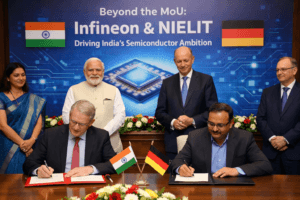
Beyond the MoU: How the Infineon-NIELIT Pact Signals a Maturity in India’s Semiconductor Ambition
The signing of a Memorandum of Understanding (MoU) is often a routine affair in the world of international business and diplomacy. Photo ops, handshakes, and a neatly framed document. But the partnership inked between German semiconductor behemoth Infineon and India’s National Institute of Electronics & Information Technology (NIELIT) in Ahmedabad this January, under the gaze of Prime Minister Narendra Modi and German Chancellor Friedrich Merz, is anything but routine. It represents a critical, under-the-hood evolution in India’s audacious quest to become a global semiconductor player. This isn’t just about building fabs; it’s about building the human foundation without which the most advanced factories are merely sterile shells.
The Missing Link in the Semiconductor Chain
For years, India’s semiconductor narrative has been dominated by headlines about multi-billion-dollar fabrication plant (fab) proposals and production-linked incentive (PLI) schemes. While securing large-scale manufacturing is vital, a persistent question has lingered: Who will operate, manage, and innovate within these temples of technology? The semiconductor industry is uniquely knowledge-intensive, requiring a deep, practical understanding of physics, chemistry, electronics, and systems engineering that cannot be mastered through theory alone.
This is where the Infineon-NIELIT partnership strikes at the heart of the ecosystem’s most pressing gap: specialized, industry-aligned talent. The collaboration focuses explicitly on semiconductor assembly, test, and packaging (ATP) – a segment often called the “back-end” but which is responsible for up to 50% of a chip’s final cost and performance. By concentrating here, Infineon and NIELIT are addressing a need that is both immediate and strategic.
Why This Partnership is Different: A Symbiosis of Scale and Expertise
What makes this MoU particularly potent is the complementary strengths each entity brings to the table.
- NIELIT: The Unparalleled Distribution Network: NIELIT is not just another elite engineering institute. It is a massive, decentralized skilling infrastructure with a presence in over 800 locations across India. Its mandate has always been vocational and skills-based, bridging the gap between academia and industry. It possesses the “last-mile” connectivity to reach talent in Tier 2 and Tier 3 cities, democratizing access to high-tech education.
- Infineon: The Global Practicum: Infineon brings world-class, real-world expertise. Their contribution isn’t just a generic curriculum; it includes “train-the-trainer” programs, expert seminars, and crucially, equipment donation for hands-on training. This is the golden key. Learning semiconductor packaging on actual machinery, even if it’s a generation behind the cutting edge, is infinitely more valuable than simulated software modules. It builds muscle memory, troubleshooting skills, and an intuitive grasp of processes that no textbook can provide.
This synergy moves beyond the traditional corporate CSR model. It’s a strategic investment in Infineon’s own future supply chain and innovation pipeline. As CEO Jochen Hanebeck noted, Infineon sees India not just as a market, but as a “strategic innovation and R&D hub.” By cultivating talent familiar with Infineon’s processes and quality standards, the company is essentially future-proofing its operations in a region poised for explosive growth in electronics manufacturing.
The “Viksit Bharat 2047” Workshop: From Vision to Pragmatics
The significance of this partnership was underscored by the two-day workshop held just prior to the MoU signing, titled “Semiconductors – A Key Enabler for Viksit Bharat 2047: From Vision to Reality.” This title itself is telling. The era of vague vision statements is giving way to focused, pragmatic roadmaps.
The workshop brought together experts, officials, and leaders to exchange knowledge on building a globally competitive ecosystem. The keyword is “competitive.” India is no longer just talking about self-reliance (atmanirbharta) in isolation; it’s calibrating its ambitions to compete on the global stage. This requires talent that doesn’t just meet local standards but is employable by and can innovate for global giants like Infineon.
Infineon’s Deepening India Footprint: A Testament to Long-Term Faith
The NIELIT partnership is not a one-off for Infineon. It’s a piece of a growing mosaic of commitment to India:
- The Global Capability Centre (GCC) in GIFT City, Gujarat: Opened in 2025 and already employing over 150, this center focuses on high-value R&D and global operations support.
- The Upcoming Bengaluru Campus: Slated for completion this year, it will serve as a major innovation hub.
- 25+ Years of Presence: This long history provides Infineon with a nuanced understanding of India’s challenges and opportunities, making its current investments informed and strategic.
These moves signal a mature, two-way relationship. India gains advanced technology, training, and integration into global value chains. Infineon gains access to a vast talent pool, a growing market for its power and IoT solutions (especially in e-mobility and renewables), and a strategic hedge in a geopolitically complex world.
The Road Ahead: Challenges and the Human-Centric Path
Of course, challenges remain. Scaling high-quality, practical training across a country as vast as India is a herculean task. Consistency of training quality across all NIELIT centers will be paramount. Furthermore, this ATP focus must eventually be complemented by equally robust programs in chip design, fabrication processes, and EDA tools to create a full-stack talent pipeline.
However, the Infineon-NIELIT model offers a compelling blueprint. It demonstrates that successful ecosystem building is not a top-down, government-led or a purely corporate-driven exercise. It is a collaborative, human-centric endeavor that leverages public infrastructure for distribution and private-sector expertise for relevance.
In conclusion, while the cameras captured leaders shaking hands in Ahmedabad, the real story is unfolding in the future labs of NIELIT centers across India. There, a generation of engineers and technicians will get their hands on the tools that power the modern world. This partnership goes beyond skilling; it’s about instilling a culture of precision, quality, and innovation at the grassroots level. It acknowledges that India’s semiconductor destiny won’t be written only in boardrooms or cleanrooms, but in the classrooms and workshops where its future workforce is being forged today. This is how visions like “Viksit Bharat 2047” move from political slogans to tangible, silicon-based reality.
You must be logged in to post a comment.