
Beyond the Monumental: How India’s Small Architectural Studios Are Redefining Impact Through Intimacy and Resilience
Across India, a transformative movement led by small architectural studios is redefining influence by prioritizing intimate engagement over monumental scale, proving that true impact lies not in a building’s size but in its resilient and responsive relationship to context. These practices reject the notion of architecture as a static, authored object, instead embracing it as an adaptive process that is deeply rooted in local climate, materials, and social fabric. By operating with climatic intelligence, material storytelling, and a focus on endurance, they create work that values continuity over completion, offering a globally relevant model where architectural agency is measured by cultural relevance, community integration, and sustainable resilience rather than mere spectacle.
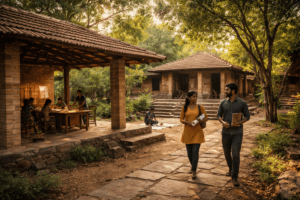
Beyond the Monumental: How India’s Small Architectural Studios Are Redefining Impact Through Intimacy and Resilience
In a world captivated by skylines punctuated by soaring towers and iconic cultural complexes stamped with celebrity architects’ names, a quiet revolution is unfolding. Across the diverse tapestry of India—from its bustling urban centers to its tranquil rural landscapes—a new generation of small architectural studios is challenging a fundamental premise: that architectural significance is synonymous with scale. These practices, often comprising just a handful of passionate designers, are proving that the most profound architectural agency isn’t found in the footprint of a building, but in the depth of its connection to place, people, and time.
This movement represents a fundamental recalibration of ambition. For decades, architectural influence has been measured in square footage, budget billions, and global recognizability. Yet, as India grapples with rapid urbanization, climate pressures, and rich cultural patrimony, a different kind of intelligence is emerging—one that privileges resilience over resolution, continuity over completion, and endurance over spectacle.
The Power of Intimacy: A Different Kind of Practice
Unlike large corporate firms handling dozens of projects simultaneously, these compact studios operate with a distinct advantage: intimacy. This manifests in three critical ways.
First, intimacy with context. Without the layers of detachment that can plague larger organizations, principals and designers are often directly embedded in the sites they work with. They spend time understanding not just the topography and climate, but the social rhythms, material legacies, and unspoken cultural codes. A project in Rajasthan isn’t just about sun control; it’s a dialogue with centuries-old traditions of stepwells and courtyards. A home in Kerala engages with the memory of its landscape, using laterite and timber not as stylistic nods but as logical, climatic, and cultural continuities.
Second, intimacy with process. These studios often treat architecture not as the delivery of a finished, static object, but as the careful orchestration of an adaptive process. Their designs frequently embrace incremental growth, allowing buildings to evolve with families or communities. A home might be designed with a “spine” of services, leaving room for future expansion. A public space might be conceived with simple, robust frameworks that communities can appropriate and personalize over time. This approach rejects the architect-as-author model in favor of the architect-as-facilitator, creating platforms for future life, not frozen moments of perfection.
Third, intimacy with resources. Constrained budgets and local material sourcing are not seen as limitations, but as creative catalysts. This forces a material honesty and innovation that lavish budgets can obscure. The use of reclaimed brick, locally-fired tiles, region-specific stone, and skilled but often diminishing local craftsmanship becomes a core part of the design narrative. The architecture that results doesn’t shout; it converses. It feels “of” its place because it is literally made from it.
The Ethos of Endurance: Core Principles in Action
The work of these studios, though diverse in aesthetic output, converges on a shared ethos. This can be distilled into several guiding principles:
- Climatic Intelligence as a Default, Not a Feature: In an era of climate crisis, sustainability isn’t an add-on certification pursued for marketing points. It is the foundational logic of the design. Passive cooling, strategic cross-ventilation, water harvesting, and solar orientation are woven into the DNA of the form. The building itself becomes a low-energy climate moderator, providing comfort through its very morphology rather than through expensive, high-maintenance mechanical systems.
- The Social Layer as Integral Program: Architecture is understood as a vessel for social interaction. Corridors widen into casual meeting spaces, thresholds between street and home become shaded, semi-public verandas, and institutional designs prioritize connective, human-scaled courtyards over imposing facades. The design asks not just “what does it look like?” but “how will it bring people together?” and “how will it age with the community?”
- Material Storytelling: Every brick, piece of timber, or slab of concrete is chosen for its performance, provenance, and narrative. The weathering of materials—the patina on copper, the moss on stone—is anticipated and celebrated as part of the building’s life. This creates structures that feel grounded and authentic, avoiding the placeless, polished sameness of globalized construction.
- The Beauty of the Imperfect and the Adaptable: There is a welcoming of the imperfect hand of the artisan, the slight irregularity of a handmade tile, the adaptive reuse of an existing structural fragment. This stands in stark contrast to the pursuit of flawless, factory-perfect finishes. The architecture is allowed to be a living record of its own making and subsequent use.
The Ripple Effect: Why This Model Matters Globally
The significance of this shift in India extends far beyond its borders. In a global architectural discourse often dominated by Western perspectives and solutions, these studios offer a potent alternative model of practice that is highly relevant for a resource-constrained, climate-vulnerable world.
They demonstrate that impact is not a function of size but of relevance. A thoughtfully designed, low-cost school that transforms education in a village, or a sensitive home extension that revitalizes a family’s life in a dense city lane, carries immense societal weight. This work rebuilds the public’s trust in architecture as a profession that serves, listens, and builds wisely.
Furthermore, these studios are preserving crucial tacit knowledge—of local materials, of construction techniques adapted to specific microclimates, of spatial arrangements that foster community. In an age of homogenization, they are acting as vital cultural curators, translating traditional wisdom into a contemporary language.
The Path Forward: Challenges and Visions
Of course, operating as a small practice is not idyllic. These studios face immense challenges: navigating complex regulations, managing client expectations often seduced by glossy “global” imagery, and achieving financial sustainability without compromising their ethos. Their success hinges on educated clients who value design as a long-term investment in quality of life, not just as a square-footage asset.
Yet, their continued rise, documented and celebrated by platforms focusing on nuanced regional work, signals a growing appetite for this kind of architecture. It suggests a future where the measure of a great architect might not be the height of their tower, but the depth of their engagement; not the boldness of their form, but the resilience of their creation.
The message from India’s small studios is ultimately one of profound optimism. It tells us that in an era of grand challenges, the most powerful architectural ideas might be humble, rooted, and deeply humane. They remind us that before architecture is about form, it is about life—and the best framework for life is often built with care, context, and quiet intelligence, one thoughtful project at a time.
You must be logged in to post a comment.