
Beyond the Monsoon: How India’s Weather Forecasts Became a Lifeline in the Era of Extremes
The provided information details significant advancements in India’s weather forecasting capabilities, highlighting improved accuracy in predicting cyclones, monsoons, heat waves, and thunderstorms through technologies like Doppler Weather Radars and multi-model ensemble forecasting systems. These enhancements have yielded tangible socio-economic benefits, including reduced loss of life through early warnings for disasters, better agricultural planning with block-level forecasts, and enhanced safety for fishermen via marine alerts. The India Meteorological Department (IMD) has strengthened last-mile connectivity by disseminating information through mobile apps and partnering with rural ministries to provide Gram Panchayat-level forecasts, while also developing climate hazard atlases to support long-term resilience planning for disaster management authorities and vulnerable communities.
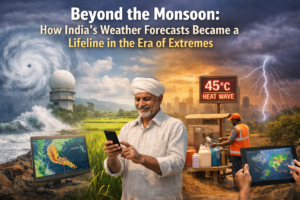
Beyond the Monsoon: How India’s Weather Forecasts Became a Lifeline in the Era of Extremes
For generations, the Indian farmer has looked to the sky with a mixture of hope and anxiety. The arrival of the monsoon was a matter of life and livelihood, but its timing and intensity were largely a mystery until the clouds actually burst. Today, that dynamic has fundamentally changed. The India Meteorological Department (IMD) is no longer just an observer of the weather; it has transformed into a sophisticated early warning machine, a sentinel standing guard over a nation increasingly on the frontlines of climate change.
A recent statement in Parliament by the Ministry of Earth Sciences paints a picture of staggering progress. It’s a story told in knots and kilometers—the precision of a cyclone track, the accuracy of a heat wave warning. But beyond the data points lies a more profound narrative: one of saved lives, protected livelihoods, and a nation building its resilience against a volatile climate. This is the story of how India learned to predict the unpredictable.
The Cyclone Edge: From Certain Devastation to Calculated Evacuation
Just a few decades ago, a severe cyclone making landfall meant a catastrophic toll on human life. The 1999 Odisha cyclone, which claimed over 10,000 lives, was a brutal turning point. It galvanized a national resolve to master the science of cyclone forecasting.
The latest figures from 2025 demonstrate just how far India has come. The report highlights that the annual average track forecast error—the difference between where a cyclone was predicted to go and where it actually went—now stands at a remarkably precise 80 km for a 24-hour lead period. This allows disaster management teams to pinpoint vulnerable areas with high confidence.
However, a closer look at the data reveals the immense challenge of climate change. While the intensity forecast errors have drastically improved (dropping from 9.8 knots to just 3.9 knots for a 72-hour lead period compared to the previous five-year average), the track forecast errors have slightly increased. The report notes the 72-hour track error for 2025 was 204 km, compared to a five-year average of 154 km.
This isn’t a step backward; it’s a reflection of a new reality. Climatologists suggest that a warming atmosphere is introducing more variability into steering winds, making cyclone paths more erratic. The fact that forecasters can still predict these wobbling giants with a high degree of accuracy is a testament to the advanced modeling systems now in place, such as the high-resolution Doppler Weather Radars (DWRs) that now dot the coastline. There are now 48 such DWRs operational across the country, acting as the nation’s electronic eyes peering into the heart of brewing storms. The result is a landfall forecast error that, while larger than the previous five-year average at longer lead times, is still precise enough to enable the mass evacuations that now keep cyclone death tolls in the dozens rather than the thousands.
The Monsoon, Demystified: A Farmer’s Digital Ally
If cyclones are the acute crises, the monsoon is the chronic, life-sustaining pulse of the nation. For years, a forecast was a simple, hopeful percentage. Today, it is a granular, multi-layered dataset designed for action.
The report underscores the IMD’s “seamless forecasting strategy,” a term that might sound technical but has a very practical meaning on the ground. It means a farmer in a remote village can now access a nowcast valid for the next six hours to decide if today is safe for harvesting. They can check a five-day forecast for their specific block to plan pesticide spraying, and they can even look at an extended range forecast for the next four weeks to get a sense of when the next active monsoon spell might arrive.
The numbers speak for themselves. The seasonal forecast for the 2025 Southwest Monsoon predicted 105% of the Long Period Average (LPA), while the actual rainfall was 108%—a remarkably accurate call that allowed the agriculture ministry, reservoir managers, and farmers to plan with confidence. For five consecutive years (2021-2025), the IMD’s all-India monsoon forecast has been spot-on, within the ±4% model error. This consistency builds trust, and trust is the currency of effective disaster management.
This precision is now being delivered to the most granular level possible. The recent collaboration with the Ministry of Panchayati Raj to launch Gram Panchayat-level weather forecasts is a game-changer. By putting this data on platforms like the e-Gramswaraj portal and the Mausamgram app, the forecast is no longer an abstract concept for a district. It is a localized tool for a village council. A Krishi Sakhi (agriculture friend) or Pashu Sakhi (livestock friend) can now access hyper-local data on temperature, humidity, and wind, translating it into actionable advice for a community of women farmers. This is the last-mile connectivity that turns data into resilience.
Fighting the ‘Silent Killer’: The Heat Wave Offensive
Unlike the dramatic visuals of a cyclone, a heat wave is a silent killer. It claims its victims quietly, often the most vulnerable: the elderly, the outdoor laborer, the urban poor. Combating heat waves requires a different kind of warfare—one of public awareness and pre-emptive action.
The report card for 2025 shows that India is winning this war on the forecasting front. The Probability of Detection (PoD) for a heat wave one day in advance was an astounding 98%. This means that when a heat wave is coming, the IMD almost never misses it. This early warning is the trigger for the Heat Action Plans (HAPs) now operational in 23 states.
These plans are a symphony of coordinated action. A forecast of a severe heat wave doesn’t just sit on a website. It triggers alerts to disaster management authorities. It leads to municipal bodies opening water stations and adjusting school timings. It prompts health departments to prepare for a surge in heat-related illnesses. The IMD’s “hot weather hazard analysis map,” which layers temperature data with wind patterns and humidity, helps city administrators identify the most vulnerable “heat islands”—densely packed urban neighborhoods where the impact will be most severe.
The skill does drop for longer lead times (a 5-day forecast was accurate 46% of the time in 2025), which highlights the challenge of predicting the precise evolution of a large-scale weather system. Yet, the continuous refinement of these forecasts, backed by the newly developed Climate Hazard & Vulnerability Atlas of India, means that states can move from a reactive, crisis-driven response to a proactive, planned one. They now know their hotspots and can preposition resources weeks before the mercury starts to soar.
Taming the Tempest: Thunderstorms and the New Nowcasting Era
Perhaps the most challenging weather event to forecast is the thunderstorm—a highly localized, rapidly developing beast. A storm that can produce a deadly lightning strike or a sudden, destructive squall can form in less than an hour. The traditional 24-hour forecast is often too broad to be useful.
This is where the science of “nowcasting” has taken a quantum leap. By synthesizing data from DWRs, satellites, and automatic weather stations, forecasters can now issue warnings valid for the next three to six hours. The results for the 2025 storm season are striking. The Probability of Detection for a three-hourly thunderstorm nowcast soared to 0.92, a massive improvement from 0.83 in 2022. For a 24-hour lead time, the PoD stood at a highly respectable 0.89.
This has a direct, life-saving impact. A 0.92 PoD means that on nine out of ten occasions, a village or urban ward will receive a specific warning before a severe thunderstorm or lightning strike hits. This warning, blasted through apps like Damini (specifically designed for lightning) and Mausam, gives people those precious few minutes to seek shelter. It’s the difference between a farmer being caught in an open field and being safely indoors.
The Big Picture: An Infrastructure of Resilience
What emerges from this parliamentary update is a vision of a weather service that has evolved from a data provider to a decision support system. The improvements are not just about scientific prowess; they are about building a national infrastructure for climate resilience.
The development of the web-based Climate Hazard & Vulnerability Atlas is a cornerstone of this effort. By mapping the thirteen most hazardous meteorological events—from cold waves to cyclones—it provides a foundational document for every planner in the country. When a state highway authority plans a new road, they can consult this atlas to understand its vulnerability to extreme rainfall. When an urban local body designs a drainage system, they can use the data to anticipate not just historical rainfall patterns, but future, more intense events.
The socio-economic benefits cited in the report are not mere jargon. They are the reality of a fishing community that stays ashore because of a marine alert and lives to fish another day. They are the reality of a farmer in a water-stressed district who, guided by a seasonal forecast, chooses a less water-intensive crop and avoids a total loss. They are the reality of a municipal worker in a heatwave-affected city who is provided with shaded休息 breaks and free water, preventing a fatal case of heat stroke.
By leveraging every conceivable communication channel—from the high-tech API-based data sharing to the grassroots reach of Panchayat-level forecasts, from the Mausam App to WhatsApp groups and social media platforms—the IMD is ensuring that its life-saving information flows freely and fast.
The path forward, as acknowledged by the state-level stakeholder workshops, is one of continuous refinement. The dialogue with users from agriculture, health, urban planning, and disaster management ensures that the forecasts remain relevant and actionable. In an era where climate change is making every weather event a potential emergency, India’s improved forecasting system is not just a scientific achievement; it is a testament to the power of foresight, a shield for the vulnerable, and a cornerstone of the nation’s journey toward a safer, more resilient future.
You must be logged in to post a comment.