
Beyond the “Moderate” Label: Decoding Delhi’s Persistent Smog and What It Truly Means for You
Despite Delhi’s average Air Quality Index (AQI) showing a marginal improvement to the ‘moderate’ category (196), this headline figure is deceptive, masking a persistent and severe public health reality. The city remains a patchwork of pollution, with numerous districts like Mundka and ITO still entrenched in the ‘poor’ to ‘very poor’ range, while stagnant, foggy weather conditions act as a lid, trapping dangerous pollutants and creating a visible smog that belies the “moderate” classification. This slight meteorological respite does not signify clean air, as levels remain hazardous by global standards, posing ongoing risks especially to vulnerable populations, and underscores that without sustained, systemic action, any improvement is fragile and geographically uneven, leaving the capital in a state of entrenched environmental crisis.
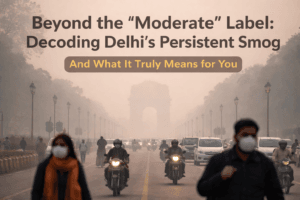
Beyond the “Moderate” Label: Decoding Delhi’s Persistent Smog and What It Truly Means for You
While the Central Pollution Control Board (CPCB) data shows Delhi’s average Air Quality Index (AQI) dipping into the ‘moderate’ zone (196), a closer look reveals a more complex and concerning picture. This marginal improvement, reported on a recent Sunday morning, offers a fragile respite but hardly signals a clean bill of health for the capital’s lungs. The reality on the ground—and in the air—is one of stark contrasts, persistent pollutants, and a weather pattern that offers little hope for substantial dispersion.
The Deceptive Comfort of a Number
The shift from ‘poor’ (227 on Saturday) to ‘moderate’ (196) is psychologically significant. According to the standard AQI classification, ‘moderate’ air suggests acceptable quality, albeit with a note that “there may be a moderate health concern for a very small number of people who are unusually sensitive to air pollution.” This official descriptor, however, can breed complacency.
For a city emerging from prolonged periods of ‘severe’ and ‘very poor’ air, ‘moderate’ feels like a victory. But health experts consistently warn that India’s air pollution crisis is such that even ‘moderate’ levels, as per the scale, carry significant risks. The World Health Organization’s (WHO) updated guidelines for key pollutants like PM2.5 are far stricter than India’s National Ambient Air Quality Standards. Therefore, an AQI of 196, while an improvement, still represents a concentration of pollutants many times higher than what is considered truly safe for long-term human health. It’s a relative improvement in a context of extreme pollution, not an absolute state of good health.
A Tale of Two Cities: The Stark Intra-City Divide
The aggregate number masks a severe disparity across Delhi’s neighborhoods. This is where the real story lies. While areas like Sri Aurobindo Marg (AQI 126) and IGI Airport (131) breathe comparatively cleaner air, other regions remain deeply engulfed in pollution.
The Pollution Hotspots: Mundka (AQI 266), Pusa (257), Narela and Rohini (both 247) top the list of the worst-affected. These areas, often characterized by higher industrial activity, dense residential clusters with mixed commercial use, and major traffic corridors, consistently record AQI levels deep in the ‘poor’ category (201-300). For residents here, the city-wide ‘moderate’ tag is a statistical abstraction. Their daily reality is one of visible smog, palpable throat irritation, and heightened health risks. Iconic central locations like ITO (223) and Chandni Chowk (232) also remain in the ‘poor’ zone, indicating that heavy vehicular traffic and commercial density continue to be major, unmitigated drivers of localized pollution.
The Cleaner Pockets: The areas with the best air, like Lodhi Road, Major Dhyan Chand Stadium, and diplomatic enclaves, benefit from greater green cover, less through-traffic, and generally more open space. This geographical inequity highlights that air pollution is not a uniform blanket but a patchwork influenced intensely by hyper-local factors—land use, traffic patterns, tree cover, and construction activity.
The Weather Culprit: Trapping the Haze
The India Meteorological Department’s (IMD) prediction of continued foggy conditions is critical to understanding why the smog lingers despite nominal improvement. This time of year is characterized by low wind speeds, low temperatures, and high relative humidity. These meteorological conditions act like a lid on the city.
Cool, dense air near the surface (inversion layer) traps pollutants, preventing their vertical dispersion. The fog further adds moisture to these particles, creating the familiar, visibility-reducing smog. With “stable and dry atmospheric conditions” prevailing, as noted in the forecast, there is no strong wind or rain system on the horizon to scavenge the accumulated pollutants. The air is stagnant, allowing emissions from vehicles, local industries, and even residual dust to concentrate. The forecast stable temperatures (max 23°C, min 10°C) reinforce this scenario of atmospheric inertia.
A Broader Subcontinent Pattern: Tamil Nadu’s Fog and Heat
The weather narrative extends beyond Delhi, offering a glimpse into a wider winter pattern across the subcontinent. Tamil Nadu’s forecast of rising day temperatures coupled with persistent morning fog in interior and hill districts like Nilgiris, Salem, and Vellore is instructive.
This pattern—dry, stable continental winds, absence of rain-bearing systems, ground-level moisture condensing into fog—is similar in nature to Delhi’s, albeit with different intensity and outcomes. It leads to a gradual rise in day temperatures and pollution entrapment in basins and valleys. For Chennai, it translates to “hot and humid” days. This underscores that the winter air quality and fog challenge is not Delhi-centric but a widespread phenomenon influenced by large-scale anticyclonic patterns over the region, limiting wind flow and cloud formation.
The Human and Health Impact: Reading Between the AQI Lines
For the citizen, what does this “moderate-but-smoggy” reality translate to?
- For Vulnerable Groups: The elderly, children, and those with pre-existing respiratory or cardiovascular conditions must remain cautious. ‘Moderate’ air can still exacerbate asthma, trigger bronchitis, and strain the heart.
- For the General Public: Prolonged exposure, even at these levels, can lead to persistent coughing, throat irritation, and breathlessness during physical activity. The visible smog is a reminder that PM2.5 particles—small enough to enter the bloodstream—are still present in high concentrations.
- Psychological Toll: The persistent gray haze, even on a supposedly ‘better’ day, contributes to a sense of environmental despair and reduces sunlight exposure, potentially affecting mood and vitamin D synthesis.
Navigating the Haze: Practical Steps Forward
While systemic solutions require sustained policy action, individuals can take informed steps:
- Hyper-Local Awareness: Don’t rely on the city-wide AQI. Check real-time data for your specific locality using reliable apps. If your neighborhood is in the ‘poor’ zone, act accordingly.
- Timing Matters: Pollution peaks during morning and late evening hours. Postpone outdoor exercises like jogging or cycling to late morning when dispersion might be slightly better.
- Protect the Vulnerable: Ensure children and older family members minimize exposure during high-concentration hours. Consider using N95/99 masks during essential commutes, especially in high-traffic zones.
- Create Clean Air Spaces: Use air purifiers with HEPA filters at home, especially in bedrooms. Keep windows closed during peak pollution hours but ventilate when the AQI is relatively lower.
- Collective Advocacy: Support and demand stronger local action—strict enforcement on dust control at construction sites, regulation of open burning, and improved public transportation to reduce vehicular load.
Conclusion: A Fragile Respite, Not a Solution
The slight dip in Delhi’s AQI to ‘moderate’ is a welcome directional change, but it is a fragile respite trapped under a lid of fog and stagnant air. It underscores the fine line the city walks between ‘poor’ and ‘moderate’ during winter, a line easily crossed with a slight change in wind speed or a minor increase in emissions. The simultaneous poor air in numerous districts and the persistent smog are potent reminders that the battle for clean air is far from won. True improvement will require not just favorable weather, but a relentless, year-round assault on the sources of pollution. Until then, the citizen’s task remains one of informed vigilance, understanding that in the complex algebra of urban air quality, the average often hides the critical, and ‘moderate’ is not the destination, but merely a signpost on a very long road.
You must be logged in to post a comment.