
Beyond the Missiles: How America’s War With Iran Is Reshaping Lives and Alliances Across the Middle East
The joint US-Israeli strikes that killed Iran’s Supreme Leader Ayatollah Ali Khamenei have triggered a region-wide upheaval, as Iran retaliated by targeting multiple Gulf states—including the UAE, Saudi Arabia, and Qatar—despite their explicit neutrality, thereby squandering years of diplomatic rapprochement and leaving traditional mediators like Qatar and Oman questioning the value of engagement. While Israel sees a historic opportunity for regime change echoing the ancient Purim story, Hezbollah faces an existential dilemma over whether to honor its ideological commitment to Iran or prioritize its survival in Lebanon, as Iraqi militias show signs of fragmentation and potential disarmament. Turkey braces for refugee flows and energy disruptions while attempting to mediate, and Palestinians find themselves further marginalized as the world’s attention shifts. The conflict has fundamentally shattered the post-1979 regional order, forcing Gulf states toward “calculated militarization” rather than diplomacy, and leaving a precarious path forward where Iranian civilians ultimately bear the weight of whatever comes next.
Beyond the Missiles: How America’s War With Iran Is Reshaping Lives and Alliances Across the Middle East
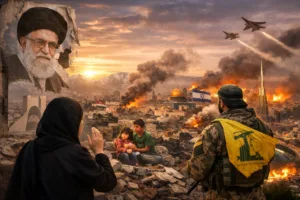
The banner of Ayatollah Ali Khamenei hung over Tehran’s Valiasr Street for decades—a permanent fixture in the landscape, as immutable as the Alborz mountains that frame the city’s northern edge. On March 1, 2026, that banner became a relic. The Supreme Leader was dead, killed by the very strikes the United States and Israel had code-named Operation Roaring Lion, and across the Middle East, a region already marinated in conflict began convulsing in entirely new ways.
What unfolded in the seventy-two hours that followed wasn’t merely a military escalation. It was the shattering of a status quo that had defined Middle Eastern politics since 1979. And as the Atlantic Council’s regional experts made clear in their rapid-fire assessments, the consequences are landing unevenly—sometimes paradoxically—across a region where nothing is ever simple.
The Tehran Street Where History Turned
“The funeral procession hasn’t even been organized yet, but already the rumors are spreading,” a Tehran-based journalist told me via encrypted message, asking for anonymity to speak freely. “On my street, people are either terrified or euphoric. There’s no middle ground. The pro-regime families have pulled their children inside. The others? They’re watching from their windows, waiting to see what comes next.”
This is the human reality beneath the strategic analysis: families who have known only Islamic Republican rule suddenly confronting the possibility that the entire structure of their lives could collapse. The Iranian negotiators who approached talks with US envoys Steve Witkoff and Jared Kushner as a “familiar dance,” as Atlantic Council expert Shalom Lipner described it, fundamentally misread their interlocutor. Donald Trump, after promising protesters on January 13 that “help is on its way,” had run out of patience with what his administration termed “games, tricks, and stall tactics.”
That miscalculation proved fatal. Israeli media reported that the Israel Air Force “eliminated 30 high-level officials in [the first] 30 seconds.” Among them, a man whose face had gazed down on Tehran for nearly four decades.
The Gulf: Trust Is the First Casualty
In Doha, Khalid Al-Jaber of the Middle East Council on Global Affairs put it bluntly: “Iran has made a serious strategic miscalculation.” The Gulf Cooperation Council states had done everything right, by their own calculation. They’d stated unequivocally that they wouldn’t allow their territory, airspace, or military bases to be used for operations against Tehran. They’d chosen restraint. They’d chosen diplomacy.
Then the missiles came anyway.
Saudi Arabia. Qatar. The United Arab Emirates. Bahrain. Kuwait. Jordan. One after another, Gulf states found themselves in the crosshairs despite having done nothing to provoke Iranian retaliation. “Targeting countries that backed de-escalation weakens those initiatives,” Al-Jaber observed. But the damage runs deeper than politics.
In Dubai’s Palm Jumeirah—that surreal archipelago of luxury villas shaped like a palm tree—falling debris from intercepted missiles shattered the illusion of safety that the UAE had so carefully constructed. A man died in Abu Dhabi. Hotels and airports, the lifeblood of Gulf economies built on tourism and investment, suddenly looked like targets.
“These states knew this could not happen in a turbulent region,” noted Aziz Alghashian from Riyadh. “Given US reluctance to provide security guarantees for Arab Gulf states, Gulf-Iran rapprochement was necessary.” That rapprochement had been “laborious and taxing,” he explained—”akin to a psychologist dealing with a traumatized patient with violent outbursts.” But there was genuine conviction behind it.
Now that conviction lies shattered alongside the windows of Dubai skyscrapers. The mediators who invested years in building channels—Qatar, Oman—find themselves questioning whether their efforts merely made them easier targets. Israeli strikes on Doha in September 2025. Strikes on Oman just this Sunday. “Mediation—particularly involving Iran and Israel—has become unappealing,” Alghashian concluded.
For Sheikh Mohamed bin Zayed Al Nahyan, the UAE’s president, the calculus is particularly painful. As Eric Alter explained from Abu Dhabi, the confrontation is “forcing the UAE much closer to the US and Israeli position than it wants to be.” Trade with Iran had grown. Diplomatic ties had been renewed. Both sides had worked to prevent escalation. “The recent strikes are undoing these advances.”
Lebanon’s Hezbollah: The Silence That Speaks Volumes
In Beirut’s southern suburbs, where portraits of “martyrs” line the streets and Hezbollah’s green flag flies from countless balconies, the response to Khamenei’s death has been notably muted.
“There was no knee-jerk military retaliation,” observed Nicholas Blanford, who has covered Hezbollah for decades. Even the mourning statements from Hezbollah leader Sheikh Naim Qassem contained “no threats of revenge.” For an organization that built its identity around loyalty to Iran’s Supreme Leader, this silence is deafening.
But the context matters. Hezbollah is still reeling from its own losses—most painfully the death in September 2024 of Hassan Nasrallah, a leader whose emotional connection with Lebanese Shias dwarfed anything they felt for a distant ayatollah in Tehran. “Khamenei’s death alone may not require an overt military response,” Blanford argued, “given that such a response could end up destroying the organization.”
Hezbollah faces what Blanford rightly calls “the biggest dilemma of its forty-five-year existence.” Attack Israel on Iranian instructions, and the Israeli response would be overwhelming—not just against Hezbollah itself, but against Lebanese infrastructure. Beirut airport. Power stations. Bridges. “In the aftermath, no Lebanese, including Shias, will thank Hezbollah for dragging Lebanon into another ruinous war for the sake of a country lying more than five hundred miles to the east.”
Yet if Hezbollah ignores an Iranian instruction to attack, the ideological and material linkage that binds the party to Iran’s clerical leadership risks rupture. Qassem appears to be a pragmatist, restructuring Hezbollah with an eye on survival in Lebanon’s domestic context. But Blanford notes that “there appears to be some dissatisfaction among military elements within the Islamic Resistance toward the current political leadership.” Could some commanders act on their own? “While this scenario is unlikely, it cannot be ruled out.”
Iraq: Sovereignty Within Reach, But at What Cost?
For Iraq, the sudden weakening of Iranian power presents an opportunity that would have seemed unimaginable just weeks ago. “A weakened Iran or the fall of the regime provides a dramatic opportunity to alter the course of Iraq,” argued Victoria Taylor, director of the Atlantic Council’s Iraq Initiative.
Iraq and Iran have been “inextricably linked” through political coordination between elites, economic ties, and the continued presence of Iranian-backed militias. An Iran less focused on meddling in Iraqi affairs could allow the Iraqi state to “reestablish its sovereignty.” But Taylor offers a crucial caveat: “This will not necessarily mean that the Iraqi government will take decisions that align with US interests.”
Already, hardline militias like Kataib Hezbollah have threatened action. A Kataib Sayyid al-Shuhida-affiliated group attacked the US base in Erbil. But Taylor points to a fascinating development: “Under pressure from the United States, a number of prominent militias, such as Asa’ib ahl al-Haq, have already announced their readiness to disarm—demonstrating the extent to which certain militias have become focused on their interests in Iraq rather than acting as a tool of Iran.”
Meanwhile, Iraqi politics remains paralyzed by the process to select the next prime minister. Trump had publicly opposed Nouri al-Maliki’s third term, with US statements suggesting that Iran’s support for Maliki’s candidacy was “the overwhelming reason to oppose him.” With Khamenei dead and senior Iranian leaders eliminated, the gridlock might break. But Maliki, Taylor notes, “will remain a formidable force within Iraqi politics with or without Iranian backing.”
Turkey: The NATO Ally Walking a Tightrope
From Ankara, Defne Arslan of the Atlantic Council’s Turkey Program outlined a country bracing for impact on multiple fronts. Turkey shares a 330-mile border with Iran. It hosts over 3.5 million Syrian refugees already. “The prospect of hundreds of thousands of Iranians (and Afghans currently residing in Iran) fleeing toward the Turkish border is viewed as an existential threat to social stability.”
Then there’s the Kurdish factor. Ankara is “deeply concerned that a power vacuum in Tehran could embolden Kurdish separatist groups”—specifically PJAK, the Iranian wing of the PKK. A new autonomous Kurdish region in northwestern Iran would create “a new security vacuum similar to that in northern Syria,” where Turkish forces have repeatedly intervened.
As a NATO member hosting the Küreçik radar station and İncirlik Air Base, Turkey finds itself in a delicate position. It provides critical infrastructure for the Alliance but has historically refused to allow its territory to be used for offensive strikes against neighbors. The presidential office has already announced that Turkey is not allowing the bases to be utilized for the attacks.
Economically, the pressure is mounting. Iran provides approximately 15 percent of Turkey’s natural gas. Damage to the Tabriz-Ankara pipeline or a halt in exports would cause “immediate energy shortages, and spike heating and electricity prices during the remaining winter weeks.” With Turkey already battling roughly 31 percent inflation, a regional war driving up global oil prices could widen the current account deficit and put further downward pressure on the Lira.
Diplomatically, Turkey is positioning itself as a non-aligned mediator. Foreign Minister Hakan Fidan is reportedly leading a “diplomatic push” to secure a cease-fire. President Erdoğan spoke with Trump on Saturday. But Arslan notes that the escalation “makes such a role nearly impossible in the short term”—though Turkey will likely remain a back channel for any future de-escalation talks.
The Palestinians: Invisible Yet Again
Perhaps no population in the Middle East has more experience with being overlooked than the Palestinians. Gina Abercrombie-Winstanley, a former US ambassador who has monitored elections in the Gaza Strip, captures the bitter irony: “This current war represents further loss for Palestinians. They lose momentum for rebuilding their lives. They lose the world’s attention to their plight.”
After Hamas’s October 7, 2023 attack, Israel’s campaign in Gaza killed over seventy thousand Palestinians and destroyed the territory’s infrastructure. The war lasted more than two years. “From the perspective of Gazans, Iran and its proxies were the few actors who tried an armed response,” Abercrombie-Winstanley notes, “before meeting superior Israeli and US force and reaching cease-fires with Israel.”
Now, even that support may vanish. “Iran may no longer be the vocal supporter of Palestinian self-determination that it has been.”
Shortly after the attacks on Iran began, Israel closed all crossings into Gaza. While the Israeli government asserts that Gaza has provisions to last for an “extended period,” both the United Nations and Human Rights Watch flagged in mid-February that aid, medicine, and reconstruction materials were in short supply. The wounded and sick are trapped. With the world’s attention fixed on Iran, “improvements on any of these fronts is unlikely.”
Abercrombie-Winstanley quotes an old blues saying: “If they didn’t have bad luck, they wouldn’t have any at all.”
Israel: Purim’s Ancient Echoes
In Jerusalem, the coincidence of timing carries profound resonance. Purim, the festival commemorating Jewish deliverance from annihilation in fifth-century BCE Persia, begins later this week. Both Prime Minister Benjamin Netanyahu and IDF Chief of Staff Eyal Zamir have invoked the holiday as backdrop to the campaign against modern Iran’s Islamic regime.
“Now, as then, hope springs for a happy ending to the story,” writes Shalom Lipner, who served seven Israeli premiers in the Prime Minister’s Office.
But Lipner sounds a note of caution amid the triumphalism. “Ultimately, as US and Israeli principals have asserted repeatedly, it will fall to the Iranian public to step up and chart their own future.” Trump’s message on Saturday was direct: “When we are finished, take over your government. It will be yours to take.”
That process, however, “could prove tortuous as the regime struggles to retain control and uncertainly prevails concerning the existence of viable (non-Islamic Revolutionary Guard Corps-affiliated) candidates who might mobilize to seize the reins of power.”
The Regional Architecture: What Comes Next
Across the Middle East, a generation of assumptions has been upended. The Islamic Republic of Iran, which since 1979 has positioned itself as the vanguard of Shiite resistance and the indispensable patron of proxy forces from Beirut to Baghdad, suddenly looks vulnerable—perhaps mortally so.
But vulnerability doesn’t automatically translate into the liberal democracy that Western planners might envision. The path from here to there runs through potential chaos: power struggles within the regime, competing factions vying for control, the possibility of prolonged civil conflict. The Iranian public, whatever their feelings about the regime, will bear the heaviest costs.
For the Gulf states, the lesson is bitter but clear: diplomacy, however sincere, offers no protection against missiles. The region is “heading toward calculated militarization,” as Aziz Alghashian put it. Deterrence will be pursued through capabilities rather than alliances.
For Iraq, the opportunity to reclaim sovereignty comes with the immediate risk of becoming a battleground for militia-US confrontation. For Lebanon, Hezbollah’s dilemma could reshape the country’s fragile politics. For Turkey, the refugee and Kurdish questions loom larger than ever. For the Palestinians, invisibility deepens.
And for the millions of Iranians who woke up Sunday to a world without the Supreme Leader who had loomed over their entire lives, the future is suddenly terrifyingly open. The banner on Valiasr Street is gone. What replaces it—whether another hardliner, a reformist, or simply chaos—will determine not just Iran’s fate, but the fate of a region that has never known how to live without conflict.
The war that began with missiles and airstrikes is, in the end, a war about people: their fears, their hopes, their miscalculations, and their resilience. And as the experts made clear, its consequences will radiate outward for years to come, touching lives in ways we cannot yet fully comprehend.
You must be logged in to post a comment.