
Beyond the Mine: How an Indian JV is Turning Industrial Trash into Tech Treasure
The partnership between Simon India and CSIR-NML marks a strategic shift in India’s approach to critical minerals, aiming to commercialize technologies that extract rare earth elements from industrial waste rather than relying solely on primary mining. By bridging CSIR-NML’s metallurgical research expertise with Simon India’s engineering and scale-up capabilities, the collaboration seeks to move proven pilot-stage processes (TRL 6) to full industrial deployment—transforming environmental liabilities like red mud and slag into valuable domestic sources of rare earths. This initiative directly supports India’s recently approved ₹7,280 crore scheme to build rare earth magnet capacity, reducing import dependence for clean energy, electronics, and defense sectors. Beyond resource security, the five-year MoU establishes a structured framework for joint R&D, intellectual property development, and commercialization, offering a blueprint for how public-private partnerships can turn laboratory innovation into scalable, sustainable industrial solutions that strengthen India’s technological self-reliance.
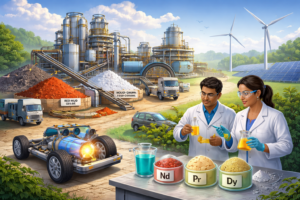
Beyond the Mine: How an Indian JV is Turning Industrial Trash into Tech Treasure
In the global race for technological supremacy, the quietest battles are often fought over the dirtiest materials. Rare Earth Elements (REEs)—the obscure group of 17 metals that power everything from electric vehicle motors to missile guidance systems—have become the new oil. For decades, the global supply chain for these critical minerals has been a geopolitical bottleneck, with China controlling the lion’s share of refining capacity.
However, a recent Memorandum of Understanding (MoU) signed between Simon India Limited (SIL) and the CSIR-National Metallurgical Laboratory (CSIR-NML) in Jamshedpur signals a strategic shift in how India intends to play this game. Instead of merely digging deeper into the earth, India is looking to mine its own mountains of industrial waste.
This partnership is not just another corporate handshake; it represents a crucial pivot toward “urban mining” and a sophisticated attempt to close the loop in India’s manufacturing ecosystem.
The Strategic Void: Why Rare Earths Matter
To understand the weight of this agreement, one must first grasp the fragility of the current critical minerals landscape. Rare earths are not necessarily “rare” in the earth’s crust, but they are notoriously difficult to extract and refine economically without causing severe environmental damage.
For India, the situation has been a paradox. While the country possesses significant mineral deposits—notably the monazite sands along its coasts—it lacks the commercial-scale refining infrastructure to convert these resources into usable metals. Historically, Indian industry has relied on imports to meet the demands of its burgeoning electronics and renewable energy sectors.
This dependency became a national security concern as global supply chains fractured. With the Indian government recently approving a massive ₹7,280 crore scheme to develop a 6,000 MTPA (Metric Tonnes Per Annum) rare earth magnet manufacturing capacity, the urgency for a domestic source of raw material has never been higher. Without feedstock, that manufacturing capacity remains a theoretical concept.
A Meeting of Minds: Lab Expertise Meets Industrial Muscle
The MoU between Simon India and CSIR-NML is a classic example of a “lab-to-land” approach, but with a modern industrial twist. It bridges two distinct competencies that rarely align seamlessly.
On one side stands CSIR-NML, a premier research institution with deep expertise in extractive metallurgy. Under the leadership of leaders like Sandip Ghosh Chowdhury, the lab has spent years developing advanced processes to leach, separate, and purify rare earths from complex matrices. Their work, currently standing at Technology Readiness Level 6 (TRL 6), has proven that the science works in controlled pilot environments.
On the other side is Simon India, an engineering, procurement, and construction (EPC) powerhouse. Athar Shahab, Chairman of Simon India, articulated the core challenge perfectly: “India’s journey towards technological self-reliance will depend on our ability to not just innovate, but to industrialize innovation.”
This distinction is critical. India’s research ecosystem is filled with brilliant patents that never leave the laboratory. The “valley of death”—the gap between a successful pilot project and a profitable, scalable industrial plant—has claimed countless promising technologies. Simon India’s role is to provide the engineering architecture—the Basic Design Engineering Package (BDEP) and Detailed Engineering (DEP)—that transforms a chemical process into a commercial asset.
The Goldmine in the Garbage
Perhaps the most compelling aspect of this collaboration is its feedstock: industrial waste.
For years, industrial waste has been viewed as an environmental liability. Red mud from alumina refineries, phosphogypsum from fertilizer plants, and slag from steel mills often accumulate in massive ponds, posing risks of groundwater contamination and land degradation.
However, these wastes are chemically complex and often contain trace concentrations of rare earths and other critical minerals. When primary mining is costly or geopolitically fraught, these secondary resources become economically viable.
The Simon India-CSIR-NML collaboration is essentially building the tools to perform alchemy. If successful, they will create a circular economy model where one industry’s pollution becomes another industry’s raw material. For India, which is simultaneously pushing for rapid industrialization and a clean energy transition, this is a sustainability double-win. It reduces the environmental burden of legacy waste while securing a domestic supply chain for strategic minerals.
Beyond Extraction: The Framework for the Future
The MoU, valid for five years, outlines a comprehensive roadmap that goes beyond mere extraction. It establishes a Joint Steering Committee to oversee the governance, ensuring that the partnership remains focused on commercialization rather than just academic curiosity.
Key pillars of this collaboration include:
- Joint R&D: Fine-tuning the chemistry to handle the variability of Indian industrial waste streams.
- Pilot-Scale Validation: De-risking the technology before committing to full-scale capital expenditure.
- IP Development: A structured framework for ownership, licensing, and commercialization of the resulting intellectual property.
This structured approach to intellectual property is vital. In the past, joint ventures between public sector research bodies and private firms often stumbled over IP disputes. By defining ownership pathways upfront, this MoU sets a precedent for how India can foster public-private partnerships (PPPs) in the high-stakes technology sector.
Implications for the Renewable Energy Sector
For readers following India’s renewable energy trajectory, this development is foundational. The government’s push for 500 GW of renewable energy capacity by 2030 hinges on massive deployment of wind turbines and electric vehicles (EVs).
Permanent magnets, which require neodymium, praseodymium, and dysprosium, are the heart of direct-drive wind turbines and EV motors. Currently, India imports nearly 100% of these rare earth magnets.
By securing a domestic extraction capability from waste, India insulates its green energy goals from geopolitical shocks. If a supply chain disruption occurs in the South China Sea, a wind farm in Gujarat or an EV plant in Tamil Nadu would not necessarily grind to a halt. They could theoretically rely on feedstock recovered from the waste of a steel plant in Jamshedpur.
The Road Ahead: Challenges and Opportunities
While the optimism surrounding the MoU is justified, the road to commercialization is fraught with challenges.
The first is economic viability. Recovering rare earths from waste is often more expensive than traditional mining due to the low concentrations and the chemical intensity of the separation process. The partnership will need to focus heavily on process optimization to ensure that the resulting rare earth oxides are cost-competitive with imported materials.
The second is technology absorption. Indian industry has historically been risk-averse, preferring to buy proven (often foreign) technology rather than betting on indigenous development. Simon India’s commitment to execute this project is a signal that the private sector is ready to take that risk, provided the technology proves robust during the pilot phase.
The third is waste aggregation. Industrial waste is not uniform. A successful technology for red mud from an alumina refinery might not work for phosphogypsum. The partnership will likely need to develop a portfolio of solutions tailored to different waste streams and establish logistics chains to aggregate waste from various industrial clusters to a central processing facility.
Conclusion: A Blueprint for Aatmanirbharta
The Simon India-CSIR-NML MoU is more than a news item about a corporate signing; it is a microcosm of India’s evolving approach to technological sovereignty. It acknowledges that true self-reliance (Aatmanirbharta) does not come from erecting tariff barriers but from solving the hard problems of engineering, chemistry, and scale.
By focusing on waste as a resource, the collaboration aligns with global ESG (Environmental, Social, and Governance) standards, potentially making Indian manufacturing more attractive to international investors who are increasingly scrutinizing supply chain sustainability.
As Athar Shahab noted, the ability to “industrialize innovation” will define India’s economic future. If this partnership succeeds in turning the toxic legacy of industrial waste into the high-purity metals required for the 21st century, it will not only strengthen India’s critical mineral capabilities but also serve as a blueprint for how the nation can solve its resource constraints through ingenuity rather than extraction.
For now, the eyes of the metallurgical and renewable energy sectors are fixed on Jamshedpur, waiting to see if this alchemy of science and engineering can truly turn industrial trash into national treasure.
You must be logged in to post a comment.