
Beyond the Metros: How Tier 2 & 3 Cities Are Powering India’s Next Economic Surge
India’s economic landscape is undergoing a significant decentralization, marked by a 25-67% year-on-year surge in corporate travel to Tier 2 and 3 cities like Indore, Coimbatore, and Visakhapatnam, far outpacing stagnant metro growth. This boom is fueled by concentrated investments in manufacturing, IT, and FMCG sectors seeking cost advantages and access to new consumer markets, supported by improved infrastructure and regional air connectivity. The trend has triggered a parallel hospitality and real estate boom, creating jobs and transforming these cities into primary economic growth engines, fundamentally reshaping the nation’s investment and development map beyond traditional metropolitan centers.
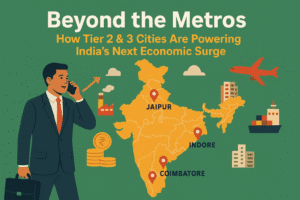
Beyond the Metros: How Tier 2 & 3 Cities Are Powering India’s Next Economic Surge
The map of India’s economic activity is being redrawn. While Mumbai, Delhi, and Bengaluru continue to dominate headlines, a quiet but powerful revolution is unfolding hundreds of kilometers away. Tier 2 and Tier 3 cities are experiencing an unprecedented boom in corporate travel, with growth rates skyrocketing between 25% and 67% year-on-year, dramatically outpacing the sluggish 2-3% growth in mature metropolitan centers. This surge in business travel is not an isolated trend but the most visible indicator of a profound economic decentralization, signaling a wave of investment, job creation, and infrastructural transformation that is reshaping the nation’s future.
This shift represents a fundamental restructuring of India’s corporate and investment landscape. It’s a story of strategic diversification, rising regional aspirations, and a recalibration of where growth and opportunity lie. For investors, entrepreneurs, and professionals, understanding this shift is key to unlocking the next decade of India’s growth story.
The Driving Forces: Why Companies Are Looking Beyond Metros
The corporate march into India’s heartland is driven by a compelling convergence of economic logic and strategic opportunity. The primary catalyst is concentrated sectoral investment, particularly in manufacturing, which contributes around 17% to GDP and is finding fertile ground in these emerging hubs. Companies are driven by the need to tap into new consumer markets, optimize supply chains, and leverage significant cost advantages in land, labor, and operations.
Complementing this is a powerful infrastructure push. Government initiatives like the Smart Cities Mission and the UDAN regional connectivity scheme are bridging the physical gap, making these cities more accessible and business-ready. Improved highways, new airports, and industrial corridors are transforming geography from a barrier into a bridge. Furthermore, there’s a tangible demographic and lifestyle shift. A growing young workforce, rising disposable incomes, and a desire for a better quality of life—marked by less congestion and lower living costs—are making these cities attractive not just for business, but for talent retention and long-term operations.
Sectoral Hotspots: Where the Investments Are Flowing
The corporate travel boom is a direct reflection of capital deployment. Different cities are emerging as specialized hubs, drawing focused investments and, consequently, a steady stream of business travelers.
| City | Key Investment Sectors | Major Players/Projects | Primary Driver for Corporate Travel |
| Vijayawada, AP | Automotive & Energy | Isuzu, Hero MotoCorp, AVERA Energy | Supplier audits, plant coordination, executive visits |
| Jaipur, Odisha | Steel & Heavy Manufacturing | Tata Steel (Kalinganagar expansion) | Project management, oversight of mega-expansions |
| Indore, MP | FMCG, IT, Pharma | Regional HQs of ITC, HUL; Super Corridor IT hub | Distribution network management, regional office ops |
| Coimbatore, TN | Automotive, IT, Textiles | TAFE, Tech Parks, “Manchester of South India” | Engineering coordination, client meetings, startup ecosystem |
| Visakhapatnam, AP | Pharmaceuticals, Port-led Industries | Attracting pharma with lower ops costs | R&D coordination, manufacturing ops, logistics |
Manufacturing & Heavy Industry form the bedrock of this shift. From the automotive clusters in Vijayawada and Lucknow (home to Tata Motors and Honda) to the monumental steel investments in Jaipur, Odisha—where Tata Steel’s expansion represents over ₹27,000 crore—these projects generate continuous travel for executive oversight, supplier audits, and technical coordination.
The IT and Technology Services sector is deliberately decentralizing. Cities like Coimbatore, Bhubaneswar, and Kochi are evolving into vibrant secondary IT hubs and homes for Global Capability Centers (GCCs). This creates sustained demand for travel related to client onboarding, project delivery, and inter-office training, moving beyond the traditional metro-centric model.
Furthermore, the FMCG and Pharmaceutical sectors are deepening their roots. With Tier 2 and 3 cities accounting for 36% of India’s FMCG consumption—a figure projected to reach 45%—cities like Indore have become critical regional command centers. Similarly, pharma companies are moving to Visakhapatnam and Chandigarh for cost efficiency, spurring travel for regulatory and manufacturing coordination.
The Infrastructure Boom: Building the Foundation for Growth
This economic activity cannot sustain itself without parallel development in hospitality and urban infrastructure. Recognizing this, a massive building boom is underway. The hospitality sector is leading the charge, with major brands expanding aggressively through mid-scale sub-brands tailored for these markets.
Indore exemplifies this transformation, with over ₹400 crore being invested to add nearly 1,500 hotel rooms by 2026, specifically targeting growing MICE (Meetings, Incentives, Conferences, Exhibitions) demand. This story is repeated across Jaipur, Lucknow, Coimbatore, and Bhubaneswar. The driving factors are clear: better air connectivity via the UDAN scheme, lower land costs, and a surge in blended business-leisure travel.
Beyond hotels, broader urban infrastructure and real estate are thriving. Driven by affordability and high growth potential, these cities are attracting significant institutional capital through Alternate Investment Funds (AIFs). Real estate here offers rental yields of 3.5-6%, often higher than saturated metros, and is seeing year-on-year price appreciation of 8-12% in leading cities like Indore and Coimbatore. This isn’t speculative growth; it’s underpinned by job creation from new IT parks, logistics hubs, and industrial zones.
Strategic Moves: How Travel and Business Services Are Adapting
The corporate travel industry itself is pivoting to capture this opportunity. Leading agencies are implementing focused regional strategies, recognizing that small and medium enterprises (SMEs)—which constitute 30% of the business travel market—are increasingly headquartered or operating in these non-metro areas.
- Yatra is targeting Tier 2 cities with a B2B corporate focus, adding dozens of new SME clients with substantial billing potential.
- MakeMyTrip and Thomas Cook are deploying multi-city strategies, tailoring their corporate travel solutions (like the myBiz platform) to specific regional markets across the south, north, east, and west of India.
This adaptation highlights a crucial insight: the future of corporate travel management lies in serving a geographically dispersed and diverse business ecosystem.
The Ripple Effect: Job Creation and Economic Transformation
Perhaps the most profound impact is on local employment and skills development. The hospitality boom alone is creating a wave of formal, skilled jobs. Companies like ELIVAAS are hiring over 80% of their workforce from Tier 2 and 3 cities, providing structured training to bring local talent up to global service standards. This creates sustainable career pathways, allowing young professionals to build futures without migrating to overcrowded metros.
This employment generation has a powerful multiplier effect. It boosts local disposable incomes, fuels demand for housing and retail, and fosters a virtuous cycle of economic development. The rise is not just in business travel but in high-spend, globally active travelers originating from these cities, reshaping both inbound and outbound travel markets.
Conclusion: A Fundamental Reshaping, Not a Temporary Trend
The soaring corporate travel statistics are a definitive signal. India’s economic geography is undergoing a fundamental and lasting reshuffle. Cities like Indore, Coimbatore, Lucknow, Visakhapatnam, and Jaipur are no longer secondary stops but are becoming primary growth engines.
For corporates, this means reevaluating location strategies for cost efficiency and market access. For real estate investors, it highlights markets with strong fundamentals, higher yields, and appreciation potential driven by real economic activity. For professionals and job seekers, it opens avenues for rewarding careers in vibrant, growing cities with an improving quality of life.
This decentralization is building a more resilient, inclusive, and distributed Indian economy. The momentum is clear, the investments are tangible, and the transformation is already in motion. The future of Indian business is being written as much in the bustling industrial estates of Tier 2 cities as in the glass towers of its megacities.
You must be logged in to post a comment.