
Beyond the Metal: How Visible Light is Rewriting the Rules of Sultam Synthesis
This feature explores a recent Organic Letters study that introduces a metal-free, visible-light-driven method for synthesizing benzosultams—a valuable scaffold in medicinal chemistry. Using the inexpensive organic dye eosin Y as a photocatalyst, the researchers generate sulfonyl radicals from simple sodium aryl sulfinates under mild, ambient conditions, triggering a cyclization with N-alkyl-N-propargyl arylsulfonamides to efficiently form exocyclic benzosultams. A subsequent mild base treatment smoothly isomerizes these products to their endocyclic forms, offering access to two distinct architectures from a single starting point. The approach stands out for its avoidance of precious metals and harsh conditions, its broad functional-group tolerance, and its alignment with green chemistry principles, illustrating how visible-light photoredox catalysis with organic dyes can serve as a powerful, sustainable alternative to traditional metal-catalyzed transformations.
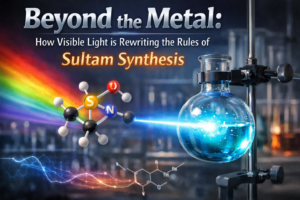
Beyond the Metal: How Visible Light is Rewriting the Rules of Sultam Synthesis
In the sprawling landscape of organic chemistry, the pursuit of efficiency often walks hand-in-hand with a hidden cost. For decades, the synthesis of complex molecular architectures has relied heavily on transition metal catalysts—powerful tools that, while effective, come with baggage: high cost, toxicity, and the generation of metallic waste that complicates purification. But a quiet revolution is underway, driven not by precious metals, but by the humble, renewable power of light.
A recent study published in Organic Letters (DOI: 10.1021/acs.orglett.6c00908) by the research team of Deb Das Dhabal and Dipankar Srimani offers a compelling glimpse into this sustainable future. Their work introduces a visible-light-enabled strategy for the synthesis of benzosultams, a class of compounds with significant relevance in medicinal chemistry, that elegantly sidesteps the traditional reliance on metals. This isn’t just another paper on photochemistry; it’s a blueprint for how we might rethink bond construction in the 21st century.
The Unsung Importance of the Sultam Scaffold
To appreciate the breakthrough, one must first understand the target. Benzosultams are the sulfonamide analogs of sultams—cyclic sulfonamides that serve as the backbone for a range of bioactive molecules. Unlike their more famous cousins, the sultones (cyclic sulfonate esters), sultams are prized for their metabolic stability and ability to act as constrained, non-planar scaffolds in drug design. They appear as key motifs in inhibitors targeting carbonic anhydrase, HIV integrase, and various proteases.
The challenge has always been their synthesis. Traditional methods often involve harsh conditions, pre-functionalized starting materials, or multi-step sequences that limit the diversity of final products. The approach described in this new Organic Letters article addresses these limitations head-on, offering a route that is not only efficient but also remarkably gentle.
Illuminating the Mechanism: A Radical Departure
The core innovation lies in the mechanism: a sulfonyl-radical-triggered cyclization. In plain terms, the researchers have devised a way to generate highly reactive sulfur-based radicals using the energy from a simple visible light source, rather than relying on traditional thermal or metal-mediated initiation.
Here’s how it works. The team starts with an N-alkyl-N-propargyl arylsulfonamide—a simple, easily prepared starting material. In a vial, under ambient conditions (room temperature, open to the air), they combine this with sodium aryl sulfinate. Then comes the key ingredient: Eosin Y, an inexpensive, commercially available organic dye.
When irradiated with visible light (likely from a standard blue LED setup, a common tool in modern photochemistry labs), the Eosin Y enters an excited state. It acts as a single-electron transfer (SET) photocatalyst, oxidizing the sodium sulfinate to generate a sulfonyl radical. This radical is highly electrophilic and doesn’t travel far. Instead, it adds to the nearby alkyne functionality (the propargyl group) in the same molecule, triggering a 5-exo-dig cyclization. The result is a rapid, one-pot construction of the exocyclic benzosultam framework.
What makes this mechanism so elegant is its simplicity. The entire process is metal-free. The photocatalyst is a dye, not a rare metal complex. The energy source is a light bulb, not a furnace. This aligns perfectly with the core tenets of green chemistry: waste prevention, safer solvents and auxiliaries, and the use of renewable feedstocks (in this case, light energy).
A Cascade of Advantages: From the Bench to the Clinic
The practical implications of this work extend far beyond the mechanistic novelty. By analyzing the experimental details and the scope outlined in the study (and its supporting information), several key advantages emerge that are highly attractive for synthetic chemists in both academia and industry.
- Mild Conditions and Functional Group TolerancePerhaps the most significant selling point is the mildness of the reaction. Running at room temperature in open air removes the need for inert atmospheres (like nitrogen or argon) that are standard in metal-catalyzed cross-couplings. This dramatically lowers the barrier to entry for routine synthesis. Furthermore, the researchers demonstrated the protocol across a “wide range of substrates,” showcasing tolerance for various functional groups—including halogens (F, Cl), methoxy, and nitro groups—that are often sensitive to traditional transition-metal conditions. This allows chemists to install handles for further diversification late in a synthetic route, a strategy highly valued in medicinal chemistry for exploring structure-activity relationships (SAR).
- The Eosin Y FactorThe choice of Eosin Y as the photocatalyst is a statement in itself. While the field of photoredox catalysis has exploded in recent years, it has often been dominated by iridium and ruthenium polypyridyl complexes. These are exceptional catalysts, but they are expensive and their heavy metal content raises toxicity concerns, particularly for pharmaceutical applications where residual metal limits are stringent. Eosin Y, by contrast, is an inexpensive organic dye—the same compound used in histology stains and even in some textile processes. It is readily removed from reaction mixtures and carries no heavy metal toxicity. This transition from precious metal to cheap dye is a paradigm shift toward more accessible and sustainable chemical synthesis.
- A Tale of Two Isomers: Exocyclic to EndocyclicAnother layer of sophistication in this work lies in the post-cyclization strategy. The initial product of the radical cyclization is the exocyclic isomer—where the double bond lies outside the ring system. However, the research team found that these products could be smoothly and efficiently isomerized to their more thermodynamically stable endocyclic forms using a mild base.
This two-step, one-pot concept is crucial. It allows the chemist to access two distinct molecular architectures from a single starting point. In drug discovery, the spatial orientation of atoms (the stereochemistry and electronic configuration) dictates how a molecule binds to a biological target. Having the ability to selectively generate either the exocyclic or endocyclic form of a benzosultam expands the chemical space available for screening without requiring a completely new synthetic route.
The Deeper Impact: A Toolkit for Sustainable Innovation
Beyond the specific synthesis of benzosultams, this research represents a broader trend that is reshaping organic chemistry. We are witnessing a shift in focus from “what can we make?” to “how can we make it better, safer, and cleaner?”
The visible-light activation strategy employed here is a perfect example of “radical chemistry under control.” Radical reactions were long considered the unruly cousins of ionic reactions—difficult to control, prone to side reactions, and often requiring harsh initiators like peroxides or tin hydrides (which are toxic). Photoredox catalysis has tamed these radicals, allowing them to be generated in a controlled, catalytic manner under mild conditions. This study is a testament to how this control can be applied to construct complex, saturated heterocycles that were previously challenging to access.
Furthermore, the accessibility of this method cannot be overstated. A university laboratory with a limited budget can easily acquire Eosin Y and an LED strip. They do not need a glovebox, high-pressure reactors, or expensive transition metals to contribute to high-impact synthesis. This democratization of advanced synthetic capability is vital for the global research community, enabling innovation even where resources are constrained.
Conclusion: A Brighter Path Forward
The work by Roy, Kar, Thamim, and colleagues is a fine example of how the intersection of physical organic chemistry (radical mechanisms) and applied synthesis can yield powerful results. By harnessing the energy of visible light with an organic dye, they have constructed a sustainable, practical, and versatile bridge to valuable benzosultam scaffolds.
For the synthetic chemist, this paper is more than a new method; it is an invitation. It invites us to question whether a metal is truly necessary for the transformation we want to achieve. It invites us to consider light not just as a source of heat or illumination, but as a precise reagent. And it offers a clear, well-documented pathway to synthesizing complex molecules with a smaller environmental footprint.
As the global scientific community continues to push for greener, more sustainable practices, strategies like this visible-light-enabled radical cyclization will undoubtedly move from being a novel approach to a standard tool in the synthetic toolbox. It is a clear demonstration that sometimes, the most powerful catalysts aren’t rare metals hidden deep in the earth, but the abundant, renewable light that shines all around us.
You must be logged in to post a comment.