
Beyond the Mercury Drop: Unpacking Srinagar’s Deep Freeze and the Harsh, Beautiful Reality of a Kashmiri Winter
A severe cold wave has engulfed the regions of Jammu & Kashmir and Ladakh, marked by Srinagar recording its season’s lowest temperature of -5.4°C. This chill, intensified by clear skies, is merely the precursor to a harsher reality, as surrounding areas like the tourist resort of Sonamarg and the South Kashmir district of Shopian have plunged to near -10°C, while the critical Zojila Pass connecting Ladakh faces a brutal -21°C.
The situation is set to worsen with the impending convergence of the La Niña climate pattern, which forecasts a colder and wetter winter, and the traditional 40-day peak winter period known as Chillai Kalan, promising a prolonged season of extreme cold and significant snowfall that will test the resilience of the local population and infrastructure.
Beyond the Mercury Drop: Unpacking Srinagar’s Deep Freeze and the Harsh, Beautiful Reality of a Kashmiri Winter
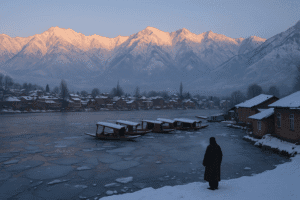
As the sun sets behind the snow-dusted peaks of the Pir Panjal range, a profound silence descends upon Srinagar. This is not the quiet of peace, but the deep, penetrating hush of extreme cold. The city, famed for its Dal Lake and Mughal gardens, has just recorded a stark meteorological milestone: minus 5.4 degrees Celsius, the season’s lowest temperature so far. This number, however, is merely the headline. The real story weaves through the frozen shikaras, the icy breath of a chai-walla by the Jhelum, and the scientific predictions pointing to a long, arduous winter ahead for the Kashmir Valley and Ladakh.
The Epicenter of the Chill: A Valley in the Grip of Sub-Zero
The recent cold wave is a blanket that has smothered the entire Union Territory of Jammu and Kashmir and the neighbouring region of Ladakh. While Srinagar’s -5.4°C serves as a key reference point, it’s almost mild compared to the brutal conditions in the surrounding areas. This temperature plunge, intensified by clear skies that allow daytime heat to escape rapidly into the atmosphere at night, has pushed the entire region firmly below the freezing point.
To truly understand the severity, one must look beyond the capital city. The real epicenters of cold are the higher altitudes and the famous tourist destinations, now transformed into pockets of intense frost:
- South Kashmir’s Bitter Core: The Larnoo area emerged as one of the coldest spots, recording a biting -8.1°C. Nearby, the Shopian district, known for its apple orchards, plunged to -8.5°C.
- Tourist Resorts Turned Iceboxes: The iconic tourist destinations are now experiencing their harshest avatar. Pahalgam, the starting point of the Amarnath Yatra, registered -8.4°C. The world-famous ski resort of Gulmarg in Baramulla district fell to -9°C, while Sonamarg lived up to its name (“Meadow of Gold”) by being the coldest recorded place in the Valley at a staggering -9.7°C.
- Ladakh: A Different Stratosphere of Cold: Further north, the high-altitude desert of Ladakh is battling a cold that is in a league of its own. Leh town recorded its season’s lowest at -13.2°C. However, the truly mind-numbing figure comes from the Zojila Pass, the vital but treacherous gateway connecting Ladakh to Kashmir, where the mercury collapsed to an almost unimaginable -21 degrees Celsius.
More Than Just a Cold Snap: The Human Impact Behind the Headlines
While the data paints a vivid picture, the true essence of this cold wave is felt on the streets and in the homes of the people.
- The Daily Grind in a Freezing World:Life defiantly goes on. Shopkeepers in Srinagar‘s old city huddle aroundkangris (traditional fire pots woven in wicker), their warm glow a small rebellion against the cold. The morning hustle is slower, breaths visible in the air as children, wrapped in layers of pherans (traditional long cloaks), make their way to school. For the region’s massive horticulture industry, particularly the apple growers, these temperatures are a double-edged sword. A sustained, deep freeze can help orchards by killing off pests, but a sudden, extreme dip can also damage dormant buds, threatening the next season’s yield.
- A Paradox for Tourism:For destinations like Gulmarg and Pahalgam, this cold is both a curse and a blessing. While the extreme temperatures can deter casual sightseers, they are manna from heaven for the winter sports industry. The severe cold ensures perfect powder snow, attracting avid skiers and adventure tourists from across the globe.It’s a high-stakes season where the economy hinges on the very harshness of the weather.
The Science of the Coming Storm: La Niña and the Legend of Chillai Kalan
The Kashmir Meteorological Department’s forecast provides a crucial, forward-looking context that elevates this news from a simple weather report to a story of impending natural drama. The key player identified is the La Niña effect.
- What is La Niña? It is a complex climate pattern characterized by cooler-than-average sea surface temperatures in the central and eastern Pacific Ocean. While distant, this phenomenon has a ripple effect on global wind and weather patterns. For the Indian subcontinent, a La Niña winter often translates to colder temperatures and above-average precipitation—meaning more rain and, crucially for Kashmir, more snowfall.
- The Convergence with Chillai Kalan: The La Niña effect is set to coincide with the most formidable period in the Kashmiri calendar: Chillai Kalan. Starting on December 21, this 40-day period is the heart of winter, renowned for its piercing cold, frequent snowfalls, and the freezing over of water bodies. The Met Department’s prediction suggests that La Nina will “multiply the impact” of this already harsh period, leading to a prolonged and severe winter.
The forecast outlines a rollercoaster for the coming weeks: a dry spell from December 10-11 will likely see temperatures dip further, followed by a potential respite in the form of snow from December 12-13. Another dry period from December 13-18 will again allow the cold to intensify, setting the stage for the grand entrance of Chillai Kalan.
A Dance with the Elements: What to Expect as Winter Deepens
The interplay between dry spells and precipitation is what defines a Kashmiri winter. Clear, cloudless skies lead to radiational cooling, causing the sharpest drops in minimum temperature. This is why Srinagar’s record low occurred during a dry period. The anticipated snowfall, while adding to the cold sensation, actually has an insulating effect. A thick snow cover can prevent the ground from losing more heat, potentially leading to a slight moderation in nighttime lows, even if the “feels like” temperature is colder.
For the people of Kashmir and Ladakh, this is not a crisis but a seasonal reality they are uniquely equipped to handle. The pheran and kangri, the well-insulated homes, and the slow, deliberate pace of life are all cultural adaptations to this environment. The real challenge lies in the infrastructural strain—potential power outages, blocked highways like the Srinagar-Jammu National Highway and the Zoji La, and the impact on daily commerce.
Conclusion: A Testament to Resilience and Nature’s Majesty
Srinagar’s -5.4°C is more than a data point; it is the opening note of a winter symphony that is about to become much more intense. It signals the beginning of a challenging, yet majestic, period in one of the world’s most beautiful landscapes. The convergence of a pronounced La Niña with the legendary Chillai Kalan promises a season of significant snow and severe cold, testing the resilience of the local population while simultaneously setting the stage for breathtaking snowy vistas and a thriving winter tourism season.
As the valley braces for what lies ahead, this deep freeze serves as a powerful reminder of humanity’s relationship with the environment—a dance of adaptation, respect, and enduring strength in the face of nature’s most formidable moods.
You must be logged in to post a comment.