
Beyond the Mercury Drop: Unpacking North India’s Deep Freeze and Its Human Toll
A severe cold wave gripped North India in January 2026, plunging temperatures to near-freezing or sub-zero levels across Rajasthan, Haryana, Punjab, and Delhi, with Gurugram and Fatehpur recording lows of 0.6°C and -0.4°C respectively. This historic freeze, marked by dense fog and ground frost, disrupted daily life, crippled transportation, and posed significant public health risks, especially for vulnerable populations. While the frost offered a paradoxical benefit to wheat crops through vernalization, it threatened to damage vegetable yields like potatoes and mustard, highlighting the complex agricultural impact. Beyond immediate disruption, the intense cold wave prompts urgent questions about urban preparedness for extreme weather, the adequacy of social safety nets, and the broader climate patterns potentially contributing to such volatile winter phenomena in the region.
Beyond the Mercury Drop: Unpacking North India’s Deep Freeze and Its Human Toll
As Temperatures Plunge to Historic Lows, What Does This Cold Wave Reveal About Climate, Agriculture, and Urban Resilience?
The winter sun, pale and distant, did little to melt the layer of ice that glazed the windshields of cars in Gurugram on Monday morning. In the nearby fields of Binola village, farmer Devi Ram watched as a crystalline sheet of frost settled over his crops—a sight both beautiful and menacing. “It felt like a white sheet had been spread over the land,” he said, his breath visible in the air. This was no ordinary winter morning. Across Rajasthan, Haryana, Punjab, and Delhi, temperatures plummeted to near-zero or sub-zero levels, turning daily life into a battle against the cold and raising urgent questions about preparedness, agriculture, and the changing face of winter in North India.
A Region in the Grip of Cold
The numbers tell a stark story. On January 12, 2026, Fatehpur in Rajasthan’s Sikar district recorded a biting -0.4°C, while Gurugram and Bathinda shivered at 0.6°C. Delhi’s minimum of 3.2°C was the coldest January day since 2023, and rural areas in the National Capital Region (NCR) reported visible ground frost—a phenomenon more associated with higher altitudes or latitudes. The India Meteorological Department (IMD) confirmed these were among the coldest nights of the season, with severe cold wave conditions expected to persist.
But these figures only scratch the surface. For residents like Vinod Kumar in Gurugram, this cold is visceral. “I do not recall the mercury dropping close to the sub-zero level in the past many years,” he remarked. Official records show Gurugram last touched 0°C in January 1971, but inconsistent historical data makes it hard to declare this an all-time low. What’s clear, however, is that this cold spell is exceptional in recent memory.
The Science Behind the Freeze
Meteorologists point to a combination of factors: clear skies, calm winds, and abundant moisture near the ground. These conditions allow for maximum radiative cooling—where heat escapes rapidly into the atmosphere—leading to sharp drops in nighttime temperatures. Additionally, dense fog blankets, which have been widespread across the Indo-Gangetic plains, trap cold air close to the surface, exacerbating the chill.
Dr. Surender Paul, Director of the Chandigarh Meteorological Department, notes that while severe cold is likely to abate after three days, cold wave conditions will linger. “Intense cold weather is likely to continue in Punjab and Haryana over the next three days,” he said. Beyond that, a western disturbance is predicted to affect the Himalayan region from January 15, possibly bringing light rain or snow to higher elevations but offering little respite to the plains.
Agricultural Impact: A Double-Edged Sword
For farmers, this cold wave is a mixed blessing. Devi Ram’s observation about frost benefiting wheat but harming vegetables is echoed by agricultural scientist Dr. Anand Kumar. “Rabi crops like wheat undergo vernalization—a process where exposure to cold stimulates flowering. Light frost can enhance this,” he explains. “However, for vegetable crops such as potatoes, peas, radishes, and mustard, sub-zero temperatures are destructive. Ice crystals form within plant tissues, causing cell damage and significant yield loss.”
Dr. Kumar advises light irrigation to protect crops—a technique that can moderate ground temperature—but many small farmers lack the resources or information to implement such measures quickly. In Rajasthan, where districts like Churu and Ganganagar recorded temperatures between 1.3°C and 1.5°C, the economic toll on vegetable growers could be severe. Meanwhile, the frost’s “white sheet” may offer photogenic scenes, but it masks underlying vulnerabilities in agrarian economies already stressed by climate variability.
Urban Life Grinds to a Halt
In cities, the cold wave disrupts everything from traffic to health. The Delhi-Gurugram expressway, depicted in a recent photo choked with traffic amid dense fog, symbolizes the commute nightmares that accompany such weather. Reduced visibility leads to accidents and delays, while icy roads—rare in this region—catch drivers off guard.
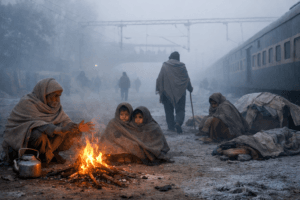
Public health officials warn of heightened risks, especially for homeless populations, the elderly, and children. Cold-related illnesses like hypothermia, bronchitis, and aggravated asthma are on the rise. Shelters in many cities, including Delhi and Gurugram, report overcrowding, underscoring the need for more robust cold-weather infrastructure. Unlike mountainous regions, plains cities are often ill-equipped for prolonged sub-zero conditions, from housing insulation to emergency response protocols.
Historical Context and Climate Questions
Is this cold wave a sign of a shifting climate? While isolated extreme cold events do not contradict global warming, some scientists suggest that Arctic warming and jet stream fluctuations could be contributing to more volatile winter patterns in mid-latitudes. A recent IIT-M study highlighted how aerosols aloft can thicken winter fog, prolonging cold conditions. This intersection of pollution and meteorology complicates the picture, making it not just a weather event but an environmental one.
Rajasthan’s case is particularly telling. Places like Lunkaransar (0.4°C) and Churu (1.3°C) are no strangers to cold, but the intensity and duration this year are noteworthy. The IMD has issued warnings for “cold wave to severe cold wave conditions” to continue, urging precautions for vulnerable groups. In Himachal Pradesh, a yellow alert for dense fog and cold waves underscores the regional scale of this phenomenon.
Voices from the Ground
Beyond data and warnings, it’s the human stories that capture the freeze’s essence. In Kashmir, residents found slight relief as temperatures rose a few degrees, though they remained below freezing. Srinagar recorded -2.4°C, and parts of Dal Lake froze over—a stunning but harsh reality. In Uttar Pradesh, cities like Lucknow and Prayagraj saw daytime temperatures hover between 13°C and 19°C, with calm winds amplifying the perceived cold.
For daily wage laborers, street vendors, and homeless individuals, the cold is not an inconvenience but a threat. Bonfires, a common sight on street corners, offer fleeting warmth but are no substitute for systemic support. “The government should open more night shelters and distribute blankets,” urged a social worker in Delhi, highlighting gaps in the social safety net during extreme weather.
Looking Ahead: Resilience in a Changing Climate
As North India braces for more cold days, the episode invites reflection on long-term resilience. Key areas for action include:
- Agricultural Adaptation: Extending weather-based advisories to farmers in real-time, promoting frost-resistant crop varieties, and improving access to protective irrigation.
- Urban Planning: Ensuring infrastructure can handle temperature extremes—from fog-resistant transportation systems to heated shelters for the homeless.
- Health Systems: Strengthening emergency services during cold waves and raising awareness about hypothermia and respiratory care.
- Environmental Management: Addressing the fog-cold wave nexus by reducing particulate pollution, which exacerbates fog formation.
The IMD’s forecast for January 13—4°C to 20°C in Delhi—suggests a slight reprieve but no real warmth. For now, North India remains wrapped in winter’s grip, a reminder of nature’s power and the need for thoughtful adaptation. As frost melts under a timid sun, it leaves behind questions not just about the cold, but about how we prepare for the next time it arrives.
You must be logged in to post a comment.