
Beyond the Mercury Drop: The Human Cost and Climate Paradox of North India’s Deep Freeze
A severe cold wave gripping North India in January 2026 has brought record-breaking chill, with Delhi experiencing its coldest January morning in three years at 3°C and Chandigarh its coldest night in nine years, underscoring a widespread crisis that extends beyond meteorology into daily human struggle.
This intense freeze, marked by temperatures falling 4-5 degrees below normal across Punjab, Haryana, Rajasthan, and Kashmir, has severely impacted vulnerable populations, disrupted agriculture and transport, and compounded public health risks as it coincided with dangerously poor air quality in urban centers. Paradoxically, such extreme cold events may be linked to broader climate change patterns, including a warming Arctic that destabilizes the jet stream and allows polar air to plunge southward, highlighting the complex reality of a warming world where weather extremes—including harsh winters—become more pronounced and demand greater systemic resilience and preparedness.
Beyond the Mercury Drop: The Human Cost and Climate Paradox of North India’s Deep Freeze
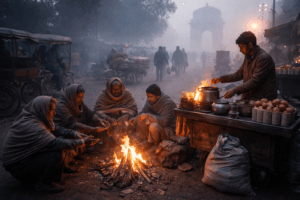
The scene across North India this past week was one of silent, frosty endurance. In the pre-dawn darkness of Tuesday, January 13th, 2026, as temperatures in Delhi plunged to a biting 3 degrees Celsius—the capital’s coldest January morning in three years—the true story unfolded not on weather charts, but on the streets. Huddled figures gathered around makeshift fires, their breath forming clouds in the frigid air. Street vendors, the invisible engine of the city’s economy, clutched cups of steaming tea, not for leisure, but for survival. This wasn’t just a meteorological event; it was a widespread test of resilience, a stark reminder of winter’s raw power, and a complex piece in the puzzle of our changing climate.
A Region in the Grip of Unrelenting Cold
The data from the India Meteorological Department (IMD) paints a picture of an intense and expansive cold wave. Delhi’s primary observatory at Safdarjung recorded a minimum of 3°C, a significant 4.4 degrees below the seasonal normal. This chill was not an isolated phenomenon but part of a sweeping freeze across northwestern and central India.
Chandigarh, the joint capital of Punjab and Haryana, shivered through its coldest night in nine years, with the mercury dropping to 2.8°C. In Punjab, Ballowal Saunkhri touched 0°C, while Bathinda and Ludhiana recorded lows of 1.6°C and 2.6°C respectively. Haryana felt the sting just as sharply, with Hisar at 1.5°C and Karnal at 2°C. Rajasthan saw freezing temperatures in Karauli (2°C), with Dausa and Ganganagar not far behind.
Further north, in the Kashmir Valley—already in the midst of Chilla-i-Kalan, the traditional 40-day period of harshest winter—the cold deepened. Srinagar recorded -4.9°C, while the tourist haven of Pahalgam plummeted to -6.2°C. The anticipation of a fresh western disturbance bringing snow offered only a paradoxical hope: the warming blanket of snowfall might follow an even sharper temperature drop.
The Invisible Threshold: When Cold Becomes a “Wave”
For the IMD, a “cold wave” is not merely subjective discomfort. It is a specific threshold declared when the minimum temperature departs from the normal by 4.5 to 6.4 degrees Celsius. A “severe cold wave” is when the departure exceeds 6.4 degrees. This week’s conditions, with widespread 4-5 degree departures, officially pushed vast swathes of population into a state of cold wave conditions. This formal designation is crucial, as it triggers administrative action—the opening of night shelters, distribution of blankets, and advisories for vulnerable populations.
The Human Dimension: Frost on the Fringes
The true weight of these numbers is borne by people. For the homeless population, a night at 3°C is a life-threatening ordeal. Government and NGO-run night shelters become critical havens. For daily wage laborers—construction workers, street vendors, rickshaw pullers—the cold wave means diminished earnings. Starting work in pitch-dark, freezing mornings impacts health and productivity. The iconic image of people warming hands over a chulha (small fire) made of scrap wood is less a cultural vignette and more a necessary strategy for basic thermoregulation.
Agriculture, the economic backbone of states like Punjab, Haryana, and Rajasthan, watches the skies with worry. While a moderate cold can benefit some Rabi crops like wheat, a prolonged and intense cold wave, especially if accompanied by frost, can damage crops, stunting growth and affecting yield. The fog that often accompanies these cold spells disrupts transportation, leading to flight delays, train cancellations, and dangerous highway conditions, creating a ripple effect on commerce and travel.
Compounding the crisis in urban centers like Delhi was the concurrent dive in air quality. The AQI settling at 337 (‘Very Poor’) creates a double jeopardy: cold air traps pollutants closer to the ground, and the inversion layer prevents their dispersal. For residents, this means breathing a toxic, icy mix that exacerbates respiratory illnesses, leading to heightened hospital admissions for asthma, bronchitis, and cardiovascular issues.
A Climate Paradox: Intense Cold in a Warming World
This severe cold wave inevitably invites the question: How does this align with global warming? This is where nuanced understanding is key. Climate change is not about the elimination of winter, but the disruption of global weather patterns.
- Arctic Oscillation and Jet Stream Meandering: A warming Arctic can weaken the polar jet stream, the river of high-altitude wind that confines frigid air to the poles. A weakened jet stream can become wavy, dipping southwards and allowing pools of Arctic air to spill into mid-latitude regions, including North India. This extreme cold event could be a manifestation of such a “wavy” jet stream pattern.
- Increased Variability: Climate scientists consistently warn that a warmer world is a world of greater weather extremes—more intense heatwaves, heavier rainfall events, and the potential for sharper, if less frequent, cold snaps. The overall trend remains one of warming, but the ride gets bumpier, with deeper troughs alongside higher peaks.
- Local Factors and the Western Disturbance Dance: The role of western disturbances—storms originating in the Mediterranean—is paramount for North Indian winters. The timing, strength, and path of these disturbances dictate precipitation and cold spells. The current conditions, with a weak system expected, point to a dominance of dry, north-westerly winds from the snow-clad Himalayas, which are inherently cold and devoid of moisture, leading to a sharp drop in minimum temperatures.
Looking Ahead: Preparedness in a New Normal
The January 2026 cold wave underscores the need for a multi-pronged approach to winter preparedness that goes beyond reactive measures.
- Hyperlocal Early Warning: IMD’s forecasts have become increasingly accurate. Disseminating these warnings at the district and even ward level, in clear, actionable terms, can save lives and livelihoods.
- Integrated Health Advisories: Public health messaging must combine cold wave and air quality alerts, advising on appropriate clothing, limiting outdoor exposure during peak cold and pollution hours, and recognizing symptoms of hypothermia and respiratory distress.
- Infrastructure Resilience: Ensuring robust, dignified, and accessible shelter facilities for the homeless is non-negotiable. For agriculture, promoting frost-resistant crop varieties and providing timely advisories on irrigation techniques to mitigate frost damage is essential.
- Long-Term Climate Adaptation: Understanding that such extreme cold events are part of the spectrum of climate disruption should inform long-term urban planning, agricultural practices, and public health infrastructure.
The biting chill that gripped North India is more than a seasonal headline. It is a vivid, tangible experience of how global atmospheric changes translate into local hardship. It reminds us that climate change’s narrative is not written solely in rising seas and melting glaciers, but also in the frozen breaths of street vendors on a Delhi morning, in the anxious glances of farmers in Punjab, and in the overloaded wards of city hospitals. As we warm our hands, the imperative is to also turn our minds to building systemic warmth—a society resilient to the growing extremes of the world we have shaped.
You must be logged in to post a comment.