
Beyond the Mercury: As Maharashtra Boils at 41°C, It’s Not Just the Heat, It’s the Humility
This news report details an intense early summer heatwave across Maharashtra on March 10, 2026, with the IMD issuing yellow alerts for 14 districts as temperatures in Vidarbha are expected to soar to a scorching 41°C, while coastal Mumbai and Konkan face the added burden of high humidity creating dangerously oppressive “steam bath” conditions. The feature article expands on this, arguing that beyond the stark statistics lies a deeply human story of resilience and struggle, exploring how the heat impacts daily wage laborers in Nagpur who must choose between their health and their income, farmers in Marathwada facing an unforgiving sky, and the physiological battle Mumbaikars wage against air so humid that sweat cannot cool the body. Ultimately, the piece reframes the “heat risk” not just as a meteorological event, but as a shared human experience that tests the body’s limits, exposes economic vulnerabilities, and calls for community care and adaptation in the face of a changing climate.
Beyond the Mercury: As Maharashtra Boils at 41°C, It’s Not Just the Heat, It’s the Humility
The numbers are stark, almost clinical. The India Meteorological Department (IMD) has flagged a “heat risk.” The mercury in Vidarbha is poised to touch a searing 41°C. Fourteen districts are under a yellow alert—a signal to “be aware.” In Mumbai, the forecast of 38°C is accompanied by a sinister, silent partner: humidity, promising to turn the city into a “steam bath.”
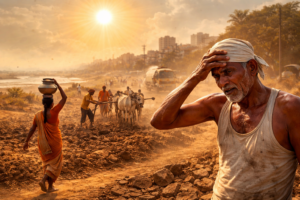
But to reduce this early summer surge to mere statistics is to miss the story entirely. The story of Maharashtra on a day like today isn’t really about the temperature reading on a thermometer. It’s about the tremor in the hand of a labourer in Nagpur as he wipes sweat from his brow before it stings his eyes. It’s about the ceaseless, energy-sapping whir of a fan that pushes around hot air in a Mumbai chawl. It’s about the farmer in Marathwada looking at a sky that is a brilliant, unforgiving blue, offering no solace of rain.
This isn’t just a weather update. It’s a portrait of a state bracing itself, of a million small battles against an adversary that is invisible, relentless, and deeply democratic in its discomfort.
The Vidarbha Crucible: Where the Earth Bakes
In the Vidarbha region, the forecast of 37°C to 41°C is more than just a high for the day. It’s the slow, creaking start of a furnace that will only get hotter in the months to come. In districts like Chandrapur, Amravati, and the divisional capital, Nagpur, the air shimmers. The black soil cracks, creating a parched mosaic across the farmland.
For the farmers here, this heat is a character in their lives, not just a climatic condition. Dr. Anjali Deshmukh, a community health worker based in Yavatmal, explains the human cost behind the yellow alert. “When we see 41°C, we don’t just think about heatstroke,” she says over the phone, her voice weary. “We think about the malis (gardeners) working in the sun, the women walking to the well for water that is now scarce, the children walking kilometres to school. It’s not a sudden spike for them; it’s a grinding reality. Their bodies are already at the limit by 10 a.m.”
The IMD’s yellow alert for districts like Wardha, Akola, and Amravati is a crucial early warning system. It’s a signal for local administrations to prepare. But on the ground, preparation is a luxury. For the daily wage earner, a day out of the sun is a day without food. The choice isn’t between comfort and discomfort; it’s between earning a wage and risking a heat-related illness. The true heat risk, therefore, isn’t just physiological; it’s deeply economic.
Mumbai’s Steam Bath: The Oppression of the Invisible
Shift focus 700 kilometres west to Mumbai, and the numbers tell a different kind of story. 34°C to 38°C might sound marginally cooler than Vidarbha, but those who have lived through a Mumbai summer know this is a deceptive metric. The IMD warns of “hot and humid conditions,” a phrase that fails to capture the sheer, visceral weight of the air.
“The temperature is just one part of the equation,” explains a retired meteorologist from the IMD’s Mumbai office, who wished to remain anonymous. “The ‘real feel’ or heat index is what matters here. With humidity levels soaring, the body’s primary cooling mechanism—sweating—becomes ineffective. The sweat doesn’t evaporate; it just coats your skin. It’s like the human body is trying to run a marathon in a sauna.”
This “steam bath” effect is what makes life in the Konkan coast so uniquely challenging. In the city’s densely packed neighbourhoods—the chawls of Dadar, the narrow bylanes of Girgaon, the towering vertical slums of Byculla—the heat is trapped. There is no respite. The sea breeze, Mumbai’s age-old summer saviour, is either weak or feels like the blast from a giant hair dryer. The humidity seeps into your bones, saps your will, and makes the simple act of breathing feel like a chore. The yellow alerts for Mumbai, Thane, and Raigad are a recognition that in these conditions, even the healthy can quickly succumb to heat exhaustion.
Pune and the Western Crescent: The Dry Deception
Inland, in the educational and cultural heart of Pune, the heat is of a different variety: dry and intense. With temperatures expected to hit 38°C, the sun here is a laser, focused and unforgiving. There’s little cloud cover to offer a reprieve. For the thousands of students, IT professionals, and auto-rickshaw drivers navigating the city, the day is a battle against the direct assault of the sun.
“It’s a dry heat, so you don’t feel that sticky sensation like in Mumbai,” says a health practitioner from a prominent Pune hospital. “And that’s what makes it dangerous. People underestimate it. They think because they aren’t sweating profusely, they aren’t losing fluids. But dehydration can set in just as fast, sometimes faster, leading to heat cramps and exhaustion before you even realise you’re in trouble.”
The sunny, cloudless skies over Satara, Sangli, and Kolhapur create a beautiful but brutal landscape. The ghats may look inviting, but the roads leading to them are ribbons of heat, testing the endurance of both man and machine.
A State on Alert: The Anatomy of a Yellow Warning
The issuance of a yellow alert across 14 districts, from the cotton fields of Jalgaon to the sugar belt of Ahmednagar (Ahilyanagar), is a significant act. It’s a sign that the meteorological machinery is working, that the data is being interpreted not just as numbers, but as a public health threat.
But what does a “yellow alert” mean for the average person? It is a call for heightened awareness. It is the government’s way of saying, “Today, the environment is not your friend. Plan accordingly.” It is a trigger for municipalities to ensure water tankers are running, hospitals have stocked up on ORS (Oral Rehydration Solution) and ice packs, and that cooling centres in public places are ready.
Yet, the most critical response isn’t institutional; it’s individual. It’s the auto driver in Nashik draping a wet cloth over his head. It’s the office worker in Mumbai choosing to take a later train to avoid the peak sun. It’s the parent in Latur ensuring their child carries a water bottle to school.
The Human Body Under Siege: A Physiological Perspective
To truly grasp the “heat risk,” one must understand what happens inside the body. Our internal thermostat is set to a precise 37°C. When the external environment approaches or exceeds that, the body has to work overtime to shed heat.
It diverts blood flow to the skin’s surface (that flushed look) and activates sweat glands. But when the air is both hot and humid, this system fails. As the retired IMD scientist noted, the sweat won’t evaporate. The body’s core temperature begins to rise.
First comes heat exhaustion: heavy sweating, weakness, cold and clammy skin, a weak pulse, and nausea. If left unchecked, this can rapidly escalate to heatstroke—a medical emergency where the body’s temperature soars past 40°C (104°F). The skin becomes hot and dry, the pulse races, and confusion or loss of consciousness can occur. Organs can begin to fail. The simplicity of the health advisory—”stay hydrated, avoid the sun”—belies the profound physiological drama unfolding under the skin.
Finding Solace and Strength in Adaptation
And yet, life goes on. Maharashtra is a state that has learned to live with extremes. In Pune, the evening tapri (tea stall) will still do brisk business, though the chai might be consumed a little slower. In Mumbai, the local trains will still be packed, the vendors on the bridges will still hawk their wares, and the sea-facing promenades will still be crowded after sunset. In the villages of Marathwada, life will retreat indoors, emerging only in the cool of the dawn and dusk.
This is the resilience of the human spirit. It’s the neighbour who offers a glass of cold buttermilk, the municipal worker who sprinkles water on the dusty road, the mother who forces another glass of water on her child before they go out to play.
The temperatures in Maharashtra today are a stark reminder of a changing climate, where “early summer surges” are becoming the new normal. But more than that, they are a lesson in humility. They remind us that for all our technological prowess—our weather satellites, our IMD alerts, our climate-controlled offices—we remain, at our core, creatures of this earth, subject to its moods and mercies.
As the sun climbs to its zenith over the Vidarbha plains and the humidity hangs heavy over the Arabian Sea, the message from the state is clear: look out for one another. The heat is more than just a number. It is a shared experience, a test of endurance, and a call to a deeper, more fundamental human connection. The yellow alert is a warning, but our response to it is a measure of our humanity.
You must be logged in to post a comment.