
Beyond the Megawatt: Decoding the TCS-OpenAI “Stargate” Pact and What It Really Means for India’s AI Future
The landmark partnership between OpenAI and Tata Consultancy Services (TCS) marks a pivotal moment for India’s role in the global AI economy, as it designates TCS’s new HyperVault data centre unit as the official Indian hub for the $500 billion Stargate initiative. Beyond the initial 100-megawatt infrastructure deal, the collaboration strategically positions India as a sovereign AI fortress by enabling OpenAI’s models to operate securely within the country’s borders, addressing critical data residency and compliance needs for regulated industries. The alliance also signals TCS’s proactive evolution from a traditional IT services provider to an AI-native powerhouse, leveraging OpenAI’s Codex platform to revolutionize its own software development while co-creating “Agentic AI” solutions that combine TCS’s deep domain expertise with cutting-edge models. Most significantly, the partnership’s commitment to providing 100,000 ChatGPT Edu licenses and skilling one million young Indians represents a massive human capital investment, seeding an entire generation with AI fluency and transforming India’s demographic dividend into a workforce ready for the future of work, all while TCS’s $7 billion infrastructure bet positions the Tata Group as a critical landlord to the artificial intelligence revolution in Asia.
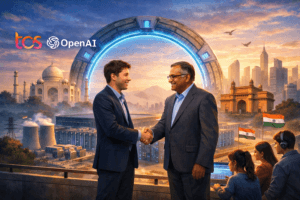
Beyond the Megawatt: Decoding the TCS-OpenAI “Stargate” Pact and What It Really Means for India’s AI Future
On the surface, it reads like a standard headline from the business pages: “OpenAI Becomes First Customer of TCS Data Centre Business.” But beneath the surface of this announcement lies a tectonic shift in the global artificial intelligence landscape. It’s a story not just about cables and cooling towers, but about data sovereignty, the decoupling of global tech, and India’s audacious ambition to transition from a back-office economy to an front-row innovator.
When OpenAI CEO Sam Altman sat down with Tata Sons Chairman N. Chandrasekaran at the India AI Impact Summit in New Delhi, they weren’t just signing a contract for 100 megawatts of server space. They were laying the foundation for a new kind of digital infrastructure that could define the next decade. This partnership, part of the colossal $500 billion Stargate initiative, is a multi-dimensional alliance that transforms India from a mere consumer of AI into a critical node in its global architecture .
Let’s move past the press release jargon and unpack what this “strategic partnership” actually means for businesses, developers, and the average Indian internet user.
- The “Stargate” Arrives in India: Not Just a Data Centre, But a Sovereign AI Fortress
To understand the magnitude of this deal, you have to understand what Stargate is. Conceived as a multi-year, multi-billion dollar project to build the physical backbone of artificial intelligence, Stargate was initially viewed as a predominantly US-centric project. By bringing it to India, OpenAI and TCS are acknowledging a fundamental truth of the AI era: data has a geography.
The initial 100MW capacity, scalable to a full gigawatt (1GW), is being developed under TCS’s new HyperVault unit . To put a 1GW data centre in perspective, it is a city-sized facility dedicated solely to computation. It requires its own power plants, its own cooling reservoirs, and its own security perimeters.
But the real insight here isn’t the wattage; it’s the wording of the mission. OpenAI explicitly stated that this infrastructure will allow its most advanced models to “operate securely within India” to meet “data residency, security and compliance requirements” .
Why does this matter to you? Imagine a future where critical government services, railway systems, or banking apps rely on AI. Would you want that data zipping across undersea cables to be processed in a data centre in another continent, subject to another country’s laws? Probably not. This deal allows for “inference at the edge” of the nation-state—meaning an AI model answering a query in Mumbai never has to leave Mumbai.
For Indian enterprises in regulated sectors like banking, insurance, and healthcare, this is a game-changer. It removes the latency lag (that millisecond delay that ruins user experience) and the legal ambiguity of cross-border data flows. OpenAI is effectively building a “Sovereign AI” fortress within the Tata Group’s walls .
- The Irony and the Evolution: TCS Embraces the “Disruptor”
There is a delicious irony in this partnership that Wall Street analysts were quick to note. For the last two years, the rise of Generative AI has been viewed as an existential threat to traditional IT services companies like TCS. The fear was simple: if CEOs can ask an AI to write code, why would they need to pay an army of software engineers in Hyderabad?
This deal signals the death of that lazy narrative. TCS isn’t waiting to be disrupted; it is embracing the disruptor.
By committing to use OpenAI’s Codex platform to standardize its own software development, TCS is making a massive bet on AI-augmented engineering . They are effectively saying, “We will build the future faster and cheaper using the very tools that were supposed to replace us.”
Furthermore, the partnership to co-develop “Agentic AI” solutions is where the real money lies . “Agentic AI” refers to systems that don’t just generate text, but take action—autonomously managing supply chains, handling customer service escalations, or optimizing inventory.
TCS possesses something OpenAI craves: domain expertise. OpenAI knows how to build models; TCS knows how an Indian bank’s ledger system works, how a mining company’s logistics operate, and what a retail chain’s pain points are. By combining these forces, they aren’t just selling software; they are selling “transformation as a service,” packaged with a massive AI infrastructure underneath it.
- The Human Upgrade: Skilling, EduLicences, and the “ChatGPT Generation”
Perhaps the most profound, yet understated, aspect of this announcement is the human element. The partnership includes the provision of over 100,000 ChatGPT Edu licences to Indian institutions and a commitment to skill “at least one million” young Indians .
This is where the article stops being about business and starts being about people.
India has the world’s largest youth population, but the “demographic dividend” is a double-edged sword. If unskilled, it becomes a demographic liability. By embedding ChatGPT into the curriculum at a massive scale, OpenAI and TCS are effectively seeding the next generation of the Indian workforce with a specific technological fluency.
What does this look like on the ground? It’s a engineering student in Pune learning to debug code with an AI co-pilot. It’s a rural entrepreneur using a local language model to apply for a government loan. It’s a call centre agent in Bengaluru being upskilled to handle complex, AI-assisted problem solving rather than reading from a script.
The Tata Group’s plan to roll out ChatGPT Enterprise to hundreds of thousands of its own employees will be one of the largest corporate AI training exercises in history . If successful, it will create a blueprint for how to manage the “future of work”—a blueprint that TCS can then sell to its global clients.
- The $7 Billion Vote of Confidence
Let’s talk about the money. TCS previously disclosed plans to invest up to $7 billion in its data centre unit . That is not pocket change. It is a declaration of war in the cloud wars.
For decades, the “Big Three” hyperscalers—Amazon (AWS), Google Cloud, and Microsoft Azure—dominated the infrastructure layer. They rented out computing power, and Indian companies built services on top of it. With HyperVault and the OpenAI deal, TCS is attempting to own a piece of the physical layer that the hyperscalers cannot touch.
This positions the Tata Group as a landlord to the AI revolution. Whether it’s OpenAI or (potentially in the future) other AI labs needing compute capacity in India, they will have to go through the infrastructure that Tata is building.
- A Turning Point for “AI in India”
Finally, this deal must be viewed against the backdrop of the Indian government’s recent policy moves. The 2026-2027 budget included provisions for foreign cloud service providers to operate tax-free for two decades . The message to the world is clear: “Build AI infrastructure here.”
By choosing Tata as its partner, OpenAI is aligning itself with a brand that is synonymous with trust in India. If you want to win in the Indian market, you don’t just need the best technology; you need the trust of the Indian consumer and the government. The Tata “salt-to-software” legacy provides that credibility.
Conclusion
The OpenAI-TCS deal is a megaphone announcement that India is open for AI business. It moves the conversation from “AI adoption” to “AI infrastructure.” It signals a shift from consuming AI models to co-creating them.
For the reader, the takeaway is simple: The AI you use in the coming years—whether it’s for booking a cab, filing taxes, or getting medical advice—will increasingly be powered by servers located in your own country, secured by local laws, and maintained by a local workforce.
The Stargate has opened in India, and the view from here looks distinctly desi.
You must be logged in to post a comment.