
Beyond the Mask: AIIMS Delhi’s Pioneering Face Transplant Programme Offers More Than a New Face
AIIMS Delhi has launched India’s first formal face transplant programme, planning to perform the country’s inaugural procedure within the year to offer a radical new option for patients with severe facial deformities—such as acid attack survivors and burn victims—who cannot be adequately helped by conventional reconstructive surgery. Unlike cosmetic procedures, these transplants aim to restore essential functions like breathing, speech, and facial expression, while also addressing the profound social isolation caused by disfigurement.
The initiative faces complex challenges, including meticulous patient selection, finding compatible deceased donors with matching skin tone and sex, navigating ethical and family consent issues, and managing the patient’s lifelong need for immunosuppressive drugs and psychological support. With a multidisciplinary team and international collaboration, the programme represents not just a surgical milestone but a deeply humane effort to restore identity, dignity, and the ability to re-engage with society for those who have lived behind a mask of trauma.
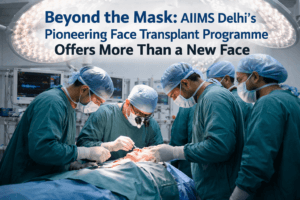
Beyond the Mask: AIIMS Delhi’s Pioneering Face Transplant Programme Offers More Than a New Face
In the labyrinthine corridors of the All India Institute of Medical Sciences (AIIMS) in New Delhi, a quiet revolution is underway. It’s a revolution not of politics or policy, but of healing and human identity. With the formal announcement of India’s first Face Transplant Programme, AIIMS has not just introduced a new surgical procedure; it has ignited a beacon of hope for thousands living behind a mask of severe disfigurement. The institute’s ambitious plan to perform the country’s first full or partial face transplant within the year signals a monumental leap in Indian medicine, positioning the nation at the forefront of one of the most complex and humane surgical endeavors known to science.
But to understand the magnitude of this moment, one must look beyond the headlines and surgical checklists. This is a story about the people who have been, until now, beyond the reach of modern medicine’s helping hand.
The Limits of Reconstruction: When 12 Surgeries Aren’t Enough
For decades, the gold standard for treating catastrophic facial injuries—from severe burns and acid attacks to gunshot wounds—has been reconstructive surgery. Pioneering surgeons in India have achieved remarkable results, rebuilding noses from forehead tissue, crafting lips from inner-arm skin, and restoring some degree of function through dozens of intricate procedures. AIIMS itself, as the article notes, performs over 8,000 such procedures annually.
Yet, reconstruction has its limits. It is often a piecemeal approach, a sculpting effort with borrowed materials. A patient might undergo 10 to 15 operations over several years, each one a grueling ordeal of surgery and recovery. While these procedures can close wounds and restore basic structure, they frequently fall short in recreating the dynamic, living tapestry of the human face. The ability to smile, to frown, to blink naturally, or to feel the warmth of a loved one’s kiss is often lost. The skin grafted from a thigh will never sweat, never grow facial hair, and will always look and feel like a patch.
It is for these patients—the ones for whom the scalpel has done all it can, yet life remains a prison of stares and whispers—that the face transplant programme exists. As Dr. Maneesh Singhal, Head of the Department of Plastic, Reconstructive and Burns Surgery at AIIMS, powerfully stated, this is not an experimental whim but “the need of the hour” for a carefully selected few.
The Anatomy of a Miracle: More Than Skin Deep
A face transplant is frequently misunderstood. It is not a simple swap of skin, nor is it a quest for superficial beauty. It is a composite tissue allotransplantation (CTA), meaning a multitude of different tissues—skin, muscles, nerves, blood vessels, and sometimes underlying bone—are transplanted together from a deceased donor. The goal is profoundly functional: to restore the very machinery of human expression and interaction.
Imagine a patient unable to close their eyes completely, leading to corneal dryness, ulceration, and the constant threat of blindness. A face transplant can restore eyelid function. Picture someone who breathes through a permanent hole in their throat because their nasal passages have collapsed. A transplant can rebuild the structural architecture that allows for normal respiration. Envision an acid attack survivor whose tight, scarred skin prevents them from opening their mouth to eat solid food or speak clearly. A new face can restore the pliability needed for these essential acts.
The surgery itself is a feat of staggering precision. The 14 to 16-hour procedure is a race against time, a microscopic ballet where surgeons must reconnect arteries no wider than a strand of spaghetti to ensure the new tissue survives. They must then perform the even more delicate task of coapting (surgically connecting) tiny nerves. The success of this step determines whether the patient will eventually be able to move their new face or feel a breeze on their cheek. It is a profound act of faith in the body’s ability to heal and regenerate.
The Invisible Hurdle: Finding the Perfect Donor
While the surgical team prepares, the greatest challenge often lies outside the operating room: finding the donor. Unlike a kidney or liver, which perform a hidden, internal function, a face is our most public organ. It is the canvas upon which we project our identity. This demands a level of compatibility that transcends simple blood typing and tissue matching.
As highlighted, the donor and recipient must be of the same sex and have a broadly similar skin tone. But the considerations go even deeper. The team must consider age, facial structure, and the thickness and texture of the skin. A mismatch could result in a face that looks perpetually foreign or, worse, doesn’t allow for natural movement.
This search requires a national network of awareness and consent. Within a narrow window following a tragedy—the declaration of brain death of a potential donor—transplant coordinators must approach grieving families with an almost unimaginable request: the donation of their loved one’s face. This requires immense sensitivity, education, and courage from all parties. It asks a family in mourning to see beyond their loss and envision the profound gift of identity they can bestow upon a stranger. This ethical and emotional complexity makes each potential transplant a unique and deeply human negotiation.
A Life Remade: The Long Road of Recovery
Receiving a new face is not the end of a journey, but the beginning of a new and equally challenging one. The psychological preparation begins long before the surgery. As Dr. Preethy K from AIIMS‘s Department of Psychiatry notes, rigorous screening and mandatory long-term counselling are cornerstones of the programme. A candidate must possess not only physical resilience but extraordinary psychological strength. They must grieve the loss of their old face, even if it was a source of pain, and prepare to accept a new one—a face that will always carry the echo of a stranger.
After the surgery, the patient looks in the mirror and sees someone new. The initial sight can be disorienting. Over months of rehabilitation and physical therapy, they must learn to use their new face, coaxing muscles to move and nerves to fire, often guided by a team of specialized therapists. They practice smiling, frowning, and raising their eyebrows in front of a mirror, relearning a language their body has forgotten.
This journey is shadowed by a lifelong medical commitment: immunosuppression. To prevent the body’s powerful immune system from recognizing the new face as foreign and destroying it, patients must take potent medications every day for the rest of their lives. These drugs, while life-saving, carry significant risks, including increased susceptibility to infections, kidney damage, and a higher chance of certain cancers. This is why the programme integrates nephrologists like Dr. Dipankar Bhowmick, whose team will vigilantly monitor the patient’s health for decades, balancing the gift of a new face with the constant need to protect the body that houses it.
A Global Milestone, An Indian Identity
The AIIMS programme is not being built in isolation. The collaboration with international experts like Dr. Indranil Sinha from Harvard-affiliated Brigham and Women’s Hospital is a testament to the global nature of medicine and a powerful vote of confidence in the Indian institution’s capabilities. It ensures that the team in Delhi learns from the cumulative experience of the few dozen face transplants performed worldwide, adapting global best practices to the Indian context.
This context is crucial. India has a unique and heartbreaking burden of facial trauma. It is home to thousands of acid attack survivors, many of them women, whose assailants sought to destroy not just their bodies but their place in the world. It treats countless victims of industrial accidents, devastating road traffic collisions, and, tragically, gunshot violence. For these individuals, the promise of a face transplant is not about vanity; it is about reclaiming a life.
When AIIMS performs its first transplant, it will be an Indian face, crafted by Indian hands, that looks back from the mirror. It will be a face that carries the resilience of a survivor, the skill of a homegrown surgical team, and the profound generosity of an Indian family who, in their darkest hour, chose to give the ultimate gift. This is what positions India among a select group of global leaders—not just by performing the surgery, but by embedding it within a deeply societal and compassionate framework.
Restoring the Right to Be Human
Ultimately, the AIIMS Face Transplant Programme is a testament to a fundamental belief: that every person has the right to look upon the world and have the world look back without flinching. It is about restoring the ability to perform the small, profoundly human acts that most of us take for granted—to smile at a child, to share a meal with family, to walk down a street without a veil.
For the patient who has endured years of isolation, the promise of a new face is the promise of re-entering the human community. It is the chance to have their expressions, their emotions, and their identity seen and understood once more. It is, in the truest sense, a restoration of dignity. As AIIMS Delhi prepares to cross this historic threshold, it offers not just a surgical solution, but a profound message of hope: that even in the face of devastating loss, identity can be reclaimed, expression can be restored, and the human spirit can find a new way to shine.
You must be logged in to post a comment.