
Beyond the Machines: Why Garment Technology Expo 2026 Is the Epicenter of Fashion’s Manufacturing Revolution
The 39th Garment Technology Expo (GTE) 2026, scheduled for March 20-23 at the India Expo Centre in Greater Noida, transcends its role as a traditional machinery trade show to become a pivotal convergence point for the future of fashion manufacturing, where automation, sustainability, and digital transformation take center stage. Co-located with the “Lace & Trims Show” and backed by the Ministry of Textiles, the event will showcase intelligent factory solutions, digital printing innovations, and sophisticated software for supply chain management, while also highlighting the growing importance of sustainable accessories and packaging. Beyond the exhibits, GTE 2026 serves as a critical platform for skill development, MSME modernization, and industry networking, reflecting India’s strategic push to evolve from a low-cost production hub into a high-tech, value-driven leader in the global apparel ecosystem.
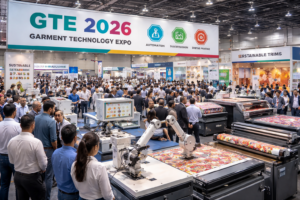
Beyond the Machines: Why Garment Technology Expo 2026 Is the Epicenter of Fashion’s Manufacturing Revolution
As the global fashion industry grapples with sustainability, supply chain resilience, and the digital leap, a four-day event in Greater Noida is poised to become the definitive blueprint for its future. The Garment Technology Expo (GTE) 2026 returns for its 39th edition from March 20 to 23 at the India Expo Centre & Mart, and it promises to be far more than a simple machinery showcase.
In the sprawling exhibition halls of Delhi-NCR, the future of how our clothes are made will be on full display. While the official announcement highlights the co-location with the “Lace & Trims Show” and participation from hundreds of exhibitors, the real story of GTE 2026 is about convergence. It’s where the clunky mechanics of the past meet the sleek software of tomorrow, and where Indian manufacturing asserts its place on the world stage.
This isn’t just a trade fair; it’s a live diagnostic of an industry in hyper-drive.
The New “Make in India” is High-Tech and Sustainable
For decades, the “Make in India” narrative in textiles was built on scale and labor arbitrage. Walking through GTE 2026, that story will feel antiquated. The buzzwords this year aren’t just “production capacity”; they are “automation,” “sustainability,” and “digital twinning.”
Attendees will witness a fundamental shift in the shop floor. The sewing machines of yesteryear are evolving into intelligent, data-generating workstations. The expo floor will be divided into thematic zones that tell a story of transformation:
- The Automated Factory Floor: Gone are the days of purely manual operations. This year’s expo will feature live demonstrations of robotic cutting systems that use AI to optimize fabric layouts, reducing waste by up to 15%. Automated spreading machines will handle delicate fabrics with a precision that human hands cannot match. For manufacturers grappling with rising labor costs and the need for consistent quality, these aren’t just gadgets; they are the key to survival and profitability.
- Digital Textile Printing Revolution: The co-location of the main expo with specialized machinery allows for a deep dive into digital textile technologies. The shift from analog to digital printing is one of the most significant revolutions in the sector. GTE 2026 will showcase the latest direct-to-garment (DTG) and direct-to-film (DTF) printers that are enabling “print on demand,” effectively killing the concept of dead stock. This technology allows a brand to print a design only after an order is placed, slashing inventory risk and water usage dramatically compared to traditional screen printing.
- The Invisible Hero: Software & Logistics: The press release mentions IT-enabled services and logistics, but these elements are the unsung heroes of modern garment manufacturing. Attendees can expect to see sophisticated ERP (Enterprise Resource Planning) solutions designed specifically for the textile industry. These platforms track a garment from fiber to finished good, managing supply chains that are increasingly complex. In a post-pandemic world where supply chain visibility is paramount, these software solutions are the new competitive advantage.
The “Lace & Trims Show”: Why Accessories Are the New Statement
A standout feature of GTE 2026 is the dedicated “Lace & Trims Show.” On the surface, it might seem like a niche addition—a corner for buttons and bows. In reality, it represents the growing sophistication of the Indian apparel market.
In the world of fast fashion and premiumization, the “trim” is what sells the garment. A plain t-shirt becomes a luxury item with the right label, the perfect button, or an intricate embroidered patch.
This dedicated show will highlight the innovation happening in this micro-sector. We’re talking about:
- Sustainable Fasteners: Buttons made from recycled ocean plastic, corozo nuts, or bio-resin.
- Smart Labels: RFID tags embedded in clothing labels for inventory tracking and anti-counterfeiting.
- Technical Elastics: High-performance elastics and threads that are integral to activewear and technical textiles.
- Packaging as Experience: Sustainable and aesthetically pleasing packaging solutions that enhance the unboxing experience for D2C brands.
For entrepreneurs and small brands, this section of the expo is a goldmine. It allows them to source high-value,差异化 components without the minimum order quantities typically required by large manufacturers, leveling the playing field.
A Government-Backed Mandate for Modernization
The fact that GTE 2026 enjoys the support of the Ministry of Textiles and approval from the Ministry of MSME is significant. It signals a policy-level recognition that the tiny karigars (artisans) and the giant mills need to upgrade.
The Indian textile sector is predominantly made up of Micro, Small, and Medium Enterprises (MSMEs). These units often struggle to access the latest technology due to cost and awareness barriers. The government’s backing of this expo acts as an endorsement, encouraging these smaller players to step out of their comfort zones.
At the expo, MSME owners aren’t just spectators; they are investors scouting for their next big purchase. Special seminars and buyer-seller meets are often organized to help these businesses understand financing options, such as the Credit Linked Capital Subsidy Scheme (CLCSS) for technology upgradation. The expo, therefore, becomes a catalyst for policy implementation, translating bureaucratic schemes into tangible machinery on the factory floor.
The Human Element: Skill Development and Networking
While the machines are the stars, the true value of GTE 2026 lies in human connection. Industry experts quoted in the announcement note the platform’s role in skill development. In an era of automation, the nature of jobs is changing. A machine operator now needs to be a machine troubleshooter.
Live demonstrations at the expo serve as informal training grounds. Students from textile institutes across Uttar Pradesh, Delhi, and neighboring states attend to see the theory of their textbooks come to life. For the seasoned professional, it’s a place to benchmark. How fast is my competitor’s new finisher? Is that German spreading machine really worth the investment?
The networking is unparalleled. Imagine a garment exporter from Tirupur discussing logistics software with a tech startup from Bengaluru, while a buyer from a European fashion house inspects trims from a Delhi-based manufacturer. These spontaneous interactions are the lifeblood of the industry, sparking collaborations that will define the next season’s fashion.
The Road Ahead: What GTE 2026 Tells Us About Fashion’s Future
As you walk the halls of the India Expo Mart from March 20 to 23, you’ll be witnessing the transition of garment manufacturing from a “cost center” to a “value creator.” The key takeaways from GTE 2026 will likely set the agenda for the next decade:
- Sustainability is Non-Negotiable: The machinery and processes on display will increasingly focus on water conservation, energy efficiency, and waste reduction.
- Speed to Market: Technologies enabling rapid sampling and short-run production will dominate, catering to the “see now, buy now” culture of modern retail.
- Resilience through Tech: The industry is investing in technology not just for efficiency, but to build buffers against future global disruptions.
For the entrepreneur looking to start a clothing line, the factory owner looking to modernize, or the student looking for a career, GTE 2026 is not just an event to visit—it’s a manual for the future. It is where the thread meets the circuit, and where the vision for a more efficient, beautiful, and responsible fashion industry is stitched together, one innovation at a time.
Event Essentials:
- What: 39th Garment Technology Expo (GTE) 2026, co-located with Lace & Trims Show
- Where: India Expo Centre & Mart, Greater Noida (Delhi-NCR)
- When: March 20 – 23, 2026
- Who Should Attend: Manufacturers, Exporters, Designers, Entrepreneurs, Students, and Textile Professionals.
You must be logged in to post a comment.