
Beyond the Lentil Trade: Why This Canada-India Business Boom Feels Different
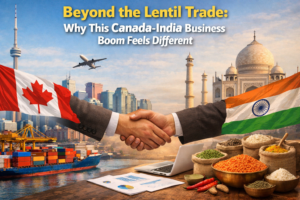
Beyond the Lentil Trade: Why This Canada-India Business Boom Feels Different
On a sweltering Tuesday afternoon in Gurugram—a sprawling satellite city of glass-and-steel office towers southwest of Delhi—Shweta Magar hands a customer a double-double latte and a warm paneer puff. Behind her, a mural depicts a Canadian canoe paddle leaning against a tent, a moose grazing in the distance. The lamp shades are shaped like maple leaves. Her uniform is a red-and-black lumberjack shirt.
This is not a scene from a Toronto tourist board advertisement. It is a Tim Hortons, one of 44 locations across India, and it represents something deceptively rare: a Canadian consumer brand that has actually planted its flag in the world’s fastest-growing major economy.
For years, the story of Canada-India trade has been a story of missed connections. It has been a tale of lentils and potash—bulk commodities loaded onto ships in Vancouver or Halifax, destined for processing plants in Gujarat or Punjab. It has been a story of diplomatic distance, political mistrust, and a persistent inability to translate a shared Commonwealth heritage into tangible commercial heft.
But standing in the cool air of the Gurugram Tim Hortons, surrounded by young Indian engineers tapping on laptops, you get the sense that the narrative might finally be shifting.
“The elevator pitch is very simple,” Prem Watsa, the Canadian billionaire and founder of Fairfax Financial, told me in a bustling Mumbai boardroom. “You have an economy that’s roughly US$4 trillion. You have a middle class of maybe 300 million people. Now imagine that becomes 600 million. That’s 300 million more people who want houses, cars, insurance, and credit cards. You are effectively creating a new United States every five to ten years.”
It is a seductive pitch. And for the first time in a generation, it is one that Ottawa and Canadian business leaders are taking seriously.
The Long View from the Seawall
To understand the scale of the opportunity, you have to start with the people. On a Saturday morning along Mumbai’s Bandra Bandstand—a promenade where joggers dodge selfie-taking tourists and the occasional Bollywood star—26-year-old Prathamesh Shirole is running in a pair of black Lululemon shorts.
He is surrounded by a sea of Nike and Adidas. There are no Lululemon stores in India yet, though the Vancouver-based company has plans to change that later this year. For now, Prathamesh relies on his sister, who lives in Mississauga, to ship his gear.
“It’s one of those ‘if you know, you know’ brands,” he says, barely breaking stride.
That sums up the Canadian presence in India: understated, niche, and reliant on a diaspora connection. But the country’s demographic reality is too powerful to ignore. India’s per capita income remains low—around $3,700 annually—but the absolute scale of the consuming class is staggering. Nearly 1.5 billion people live here, and roughly 300 million of them have enough disposable income to aspire to brands, experiences, and conveniences that barely existed in the country a decade ago.
John Hunter, the founder of Burlington, Ontario-based Hunter Amenities, saw this potential early. His company makes the tiny shampoo bottles and lotions found in hotel bathrooms around the world. In 2017, he acquired a factory in India, not just to produce for export, but to crack the domestic hospitality market.
“It’s still very untapped compared to China,” Hunter said over the phone from his Canadian office. “The hospitality market there is probably a tenth of China’s. But India will grow to be that. We are on the ground floor as the market matures.”
His Indian revenue is growing rapidly, and he is already scouting locations for a second factory.
The Patience of Pension Funds
But if Canadian consumer goods have been slow to arrive, Canadian capital has not. In fact, it has become one of the defining features of India’s infrastructure boom.
Drive on a toll road in Maharashtra, fly out of the gleaming new terminal at Bangalore’s airport, or flip on a light switch powered by a solar farm in Rajasthan, and there is a decent chance you are interacting with an asset owned, in part, by a Canadian pension fund.
The numbers are staggering. To date, Canadian asset managers—including the Canada Pension Plan Investment Board (CPPIB), the Caisse de dépôt et placement du Québec (CDPQ), Ontario Teachers’ Pension Plan (OTPP), and major players like Brookfield and Fairfax—have poured roughly $110 billion into the country.
Brookfield alone has set a target of $100 billion in assets under management in India by 2030, up from around $30 billion today. The company owns more than 55 million square feet of office and retail space across seven cities, over 250,000 telecom towers, a cross-country natural gas pipeline, and a massive portfolio of wind and solar projects.
“You compare it with other geographies, the first thing that hits you is scale,” Aditya Joshi, Brookfield’s country head for India, told me in the company’s Mumbai office. “There aren’t many countries where you can deploy dollars at scale and get returns that are globally competitive.”
What changed? According to Joshi, it was a series of deliberate policy moves by the government of Prime Minister Narendra Modi, in power since 2014. New Delhi liberalized foreign investment rules in sectors like insurance and telecommunications. It privatized roads and airports. It introduced a national digital ID system that revolutionized payments and financial inclusion.
“To grow India at 10 per cent nominal GDP, you need external capital,” Joshi explained. “So you make the ease of doing business better. You open up sectors. You build strong bilateral ties.”
Deepak Dara, who oversees roughly $6 billion in investments for OTPP in India, points to another crucial development: the maturation of Indian capital markets. A decade ago, foreign investors worried about how they would ever exit their positions. Today, with domestic savings flooding into mutual funds and a robust initial public offering (IPO) market, exiting is no longer the existential question it once was.
“Like any emerging market, the first question people would ask five or six years ago was: If you invest, how do you get out?” Dara said. “Now, that’s much easier.”
He also noted something striking: even at the height of the diplomatic crisis between Ottawa and New Delhi—after Canada accused India of involvement in the killing of Sikh activist Hardeep Singh Nijjar in British Columbia in 2023—the business climate for investors remained untouched.
“We didn’t feel it at all from a government-to-business perspective,” Dara said. “In fact, they leaned in. The message was clear: capital is welcome here.”
The Tech Bridge
While infrastructure gets the headlines, a quieter revolution is taking place in the technology sector. This is not the call-centre India of the 1990s. It is a country producing world-class engineers, data scientists, and product managers.
OpenText Corp., one of Canada’s largest software companies, has roughly 6,500 employees in Bangalore and Hyderabad. That is about a third of its global workforce and more than half of its engineering staff.
Muhi Majzoub, OpenText’s executive vice-president of product and engineering, describes a seamless global operation. Teams in India pass code to colleagues in North America at the end of their day, effectively creating a 24-hour development cycle.
“When we get a call from a customer in North America, we’re not waking up an engineer in the middle of the night in Hyderabad,” Majzoub said. “If the call is from Asia-Pacific, our colleagues in India step in. It’s about coverage, efficiency, and talent.”
For many multinationals, India has become less about cheap labour and more about high-quality intellectual capacity. These global capability centres (GCCs) are now a cornerstone of the corporate strategy for firms around the world.
The Uranium Breakthrough
Perhaps no single deal symbolized the new thaw in Canada-India relations more than the one signed on Monday at Hyderabad House, the opulent former palace of the Nizam of Hyderabad, now used for high-level diplomatic engagements.
Tim Gitzel, the CEO of Saskatoon-based Cameco Corp., stood alongside Prime Minister Mark Carney and Prime Minister Narendra Modi as they announced a $2.6-billion uranium supply deal.
For Gitzel, it was the end of a long drought. Cameco had supplied uranium to Indian nuclear reactors from 2015 to 2020, but the agreement was not renewed as diplomatic relations soured. The killing of Nijjar, and the subsequent expulsion of diplomats, froze any hope of a new deal.
“We do the business-to-business,” Gitzel said in an interview in New Delhi, “but we didn’t get an agreement between 2020 and 2025 because the relations between the countries didn’t allow it.”
The change in Ottawa’s leadership last year helped. But what really accelerated the rapprochement, according to multiple sources, was the unpredictable behaviour of the United States.
When President Donald Trump slapped a 50-per-cent tariff on Indian goods last summer—reportedly angered by Modi’s refusal to credit him for de-escalating a military standoff with Pakistan—it shocked New Delhi out of any complacency about relying too heavily on Washington.
“That was a wake-up call,” said Pramit Pal Chaudhuri, head of South Asia for the Eurasia Group. “India suddenly realized it needed to diversify its partnerships.”
The result has been a flurry of trade activity. Stalled negotiations with the European Union, stuck in limbo for 16 years, suddenly accelerated. Last month, the EU and India signed what European Commission President Ursula von der Leyen called the “mother of all deals.”
Canada, meanwhile, resumed trade talks that had first been launched in 2010. The goal, as Carney stated during his visit, is to double two-way trade to $70 billion by 2030 and sign a comprehensive economic partnership agreement by the end of this year.
The Geopolitical X-Factor
Carney’s pitch to Indian business leaders in Mumbai was calibrated to the current global moment. In a world upended by the U.S.-Iran war—which has disrupted shipping in the Strait of Hormuz, through which nearly half of India’s oil imports typically pass—Canada is positioning itself as the stable, reliable alternative.
“We are a secure supplier of energy and critical minerals,” Carney told a room full of Indian executives. With the expansion of the LNG Canada project in Kitimat, British Columbia, vast quantities of Canadian liquefied natural gas will soon hit Asian markets. Canada already ships several million barrels of crude oil to India each month, though the logistics are complicated by the fact that B.C.’s ports cannot currently accommodate the Very Large Crude Carriers needed for efficient trans-Pacific transport.
Still, the message resonates. India is under pressure from the U.S. to reduce its purchases of Russian oil, and the instability in the Middle East makes diversification an urgent priority.
Sriram Hariharan Iyer, an Indian banker who spent more than a decade in Toronto as the country head for ICICI Bank, has heard similar promises before. But he believes the current convergence of factors is different.
“To be honest, it’s déjà vu,” he admitted. “I’ve heard the same things again and again: ‘We can make this relationship grow; we have what you want.’ But somehow, I think this time could be different.”
His reasoning is simple: the United States is no longer a guaranteed partner for either country. Canada needs to diversify away from its overwhelming dependence on the American market. India needs to hedge against a capricious Washington and an unstable Middle East.
“That’s where Canada can differentiate itself,” Iyer said. “While I’m selling a commodity, I’m a stable country that will ensure the supplies are there.”
The Laggard Problem
Yet for all the optimism, Canada remains at the back of the pack. Australia, New Zealand, Britain, and the European Union have all signed or advanced trade deals with India while Ottawa dithered.
“That puts our companies at a disadvantage,” Maninder Sidhu, Canada’s Minister of International Trade, acknowledged in an interview in New Delhi. “Other countries have an early-mover advantage. That’s the energy that drives me to move this as fast as possible.”
Alison Nankivell, CEO of Export Development Canada (EDC), points to another structural weakness: the absence of Canadian “anchor” companies that can build entire value chains.
“What we really struggle with, compared to other nations, is that we have a lot of lower, mid-market companies quietly doing things in localized ways,” she said in Mumbai. “But we don’t have these large anchor companies—the Apples of the world—who build an entire ecosystem around their ambition and pull in their suppliers.”
In recent years, India’s electronics manufacturing sector has been transformed by the likes of Foxconn and Samsung, building massive factories as alternatives to China. Canadian companies, with a few exceptions, have been spectators to this transformation.
A New Chapter?
On the streets of Gurugram, the Tim Hortons is doing brisk business. The customers are mostly young, mostly professionals, and mostly curious about the Canadian theme. They order lattes and paneer puffs, snap photos of the moose mural, and return to their desks.
It is a small sign of a larger shift. For decades, the Canada-India relationship was defined by what it was not: not as deep as the U.S. ties, not as urgent as the China relationship, not as culturally entangled as the U.K. link.
But the world has changed. The old certainties are gone. And in their place, there is a tentative, pragmatic recognition in both Ottawa and New Delhi that they need each other more than they once thought.
Whether that recognition translates into the kind of trade growth that Carney envisions—$70 billion by 2030, a doubling of the current figure—depends on whether Canadian businesses, from miners to tech firms to coffee chains, can match the patience and scale of the country’s pension funds.
As the sun sets over the Mumbai seawall, the joggers keep running. Some of them are wearing Lululemon. More will be soon. The question is whether the brands, the capital, and the political will can finally catch up to the potential.
You must be logged in to post a comment.