
Beyond the Lecture: Academic Freedom on Trial in the Robinson Case
Texas State University faces a federal lawsuit from philosophy professor Idris Robinson, who alleges the school is illegally firing him in retaliation for a 2024 off-campus lecture on the Israeli-Palestinian conflict. Robinson’s suit claims administrators acted with “haste and servility” after an out-of-state activist’s social media post called for his termination, placing him on leave the next day despite positive performance reviews. The case raises fundamental questions about academic freedom and whether public university professors can be dismissed for extramural speech on matters of public concern—especially when the alleged trigger is external political pressure rather than evidence of interference with university duties.
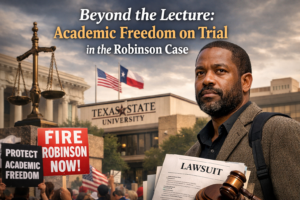
Beyond the Lecture: Academic Freedom on Trial in the Robinson Case
In the summer of 2024, Idris Robinson, a tenure-track philosophy professor at Texas State University, delivered a presentation at a public library in Asheville, North Carolina. Titled “Strategic Lessons from the Palestinian Resistance,” the talk was intended as an academic exploration of a complex geopolitical conflict. Nearly two years later, that lecture has become the center of a federal lawsuit that threatens not only Robinson’s career but also sets a precarious precedent for the boundaries of academic freedom in America’s public universities.
Robinson’s lawsuit, filed on March 24 in the U.S. District Court for the Western District of Texas, alleges that Texas State University is planning to “illegally” terminate his employment effective May 31. The suit names the university’s top leadership—including President Kelly Damphousse, Provost Pranesh Aswath, and other senior administrators—as defendants, accusing them of retaliating against Robinson for exercising his First Amendment right to speak as a private citizen on matters of public concern.
At its core, the case forces a fundamental question: When a professor speaks off-campus, on their own time, about a topic of public significance, does their right to free speech end where administrative discomfort begins?
The events that led to the lawsuit began quietly enough. Robinson’s presentation in North Carolina was a scholarly engagement, typical of the kind of intellectual exchange universities ostensibly exist to foster. According to the complaint, a physical altercation broke out among attendees at the event, but Robinson was not involved. In the months following the lecture, Robinson’s performance evaluations from Texas State leadership remained positive, suggesting that the university had no immediate concerns about his conduct or his position.
That changed abruptly on June 5, 2025, when David Moritz—a pro-Israel activist who had livestreamed the Asheville event—posted on Instagram calling for Texas State to fire Robinson. Moritz’s post accused the professor of inciting a “mob attack,” a characterization that Robinson’s legal team disputes. The very next day, June 6, the university placed Robinson on leave, citing “multiple complaints” connected to the nearly year-old event.
The timing, Robinson’s lawsuit argues, is no coincidence. “Once they received this out-of-state instruction from someone with no connection to TXST,” the complaint states, “Defendants quickly reacted with haste and servility.” The language reflects a growing concern among faculty and civil liberties advocates: that a single activist with a social media following can effectively force a public university to discipline or dismiss a professor whose views fall outside acceptable political boundaries.
Robinson appealed the decision to terminate him on June 28, 2025. The university upheld the firing on September 17. Now, with his termination set to take effect in just over two months, Robinson is seeking injunctive relief to block the firing and to restore his position, arguing that the university’s actions violate both his First Amendment rights and the university system’s own governing rules.
The lawsuit points specifically to the Texas State University System Rules and Regulations, which explicitly protect faculty members’ engagement in political activities “as long as such political activities do not interfere with the discharge of the duties and responsibilities that a member of the faculty owes to the System or a Component or otherwise involve the System or a Component in partisan politics.” According to the complaint, Texas State never produced any evidence that Robinson’s off-campus lecture interfered with his university duties in any way.
A Pattern of Pressure
For those who have been watching higher education in Texas, the Robinson case feels uncomfortably familiar. It follows closely on the heels of another high-profile termination at the same institution. Last year, Texas State fired professor Thomas Alter after comments he made during an off-duty speaking engagement at a conference on socialism. In both instances, faculty members found themselves facing professional consequences for expressing political views outside the classroom—views that administrators deemed controversial enough to warrant dismissal.
The pattern suggests a broader chilling effect. When professors see colleagues terminated for off-campus speech, the message is clear: intellectual risk-taking, even in venues completely separate from the university, can cost you your career. The implications extend far beyond the specific ideological content of Robinson’s lecture. If public universities can fire faculty for legal, off-campus speech simply because external activists object, the very concept of academic freedom becomes hollow.
Academic freedom has long been understood as the principle that faculty members must be free to teach, research, and speak on matters of public concern without fear of institutional retaliation. The American Association of University Professors (AAUP), which has defended academic freedom for over a century, maintains that professors are entitled to freedom in the classroom, in research, and in their extramural utterances—speech delivered outside the university context. The AAUP’s foundational 1940 Statement of Principles on Academic Freedom and Tenure explicitly recognizes that faculty members, as citizens, should be free to speak without institutional censorship or discipline.
What makes the Robinson case particularly troubling to First Amendment advocates is the apparent mechanism of his termination. The university, according to the lawsuit, did not act based on a complaint from a student, a colleague, or even an internal review of his conduct. Instead, the triggering event was a social media post from an activist with no affiliation to Texas State, calling for his firing more than a year after the lecture occurred.
The Slippery Slope of Extramural Speech
One of the more nuanced aspects of this case involves the distinction between a professor’s official duties and their private citizenship. Universities have broad latitude to regulate what professors say in the classroom—courts have generally held that institutions can control curriculum and pedagogical methods. But the First Amendment’s protections for public employees are strongest when employees speak as private citizens on matters of public concern, outside the scope of their official duties.
Robinson’s lawsuit hinges on this distinction. The Asheville lecture was not a Texas State University event. Robinson was not representing the university. He was not on university time, using university resources, or teaching a university course. He was, in the lawsuit’s framing, acting as a private citizen engaging in political and intellectual discourse—exactly the kind of activity the First Amendment was designed to protect.
The legal standard governing such cases comes from the Supreme Court’s decision in Garcetti v. Ceballos (2006), which held that public employees do not have First Amendment protection for speech made pursuant to their official duties. But the Court also made clear that when public employees speak as citizens on matters of public concern, they retain constitutional protection. The question in Robinson’s case will likely center on whether his off-campus lecture constituted speech as a private citizen—the lawsuit argues it plainly does—and whether the university’s interest in maintaining efficiency and discipline outweighed his free speech rights.
Beyond One Professor’s Job
While the lawsuit seeks to protect Robinson’s position at Texas State, the implications extend far beyond one professor’s employment. Public universities across the country are increasingly caught in the crossfire of cultural and political battles, with faculty speech becoming a flashpoint for controversy. Administrators, facing pressure from donors, legislators, and organized activist groups, sometimes find it easier to discipline controversial faculty members than to defend the principles of academic freedom.
The Robinson case also highlights the role of social media in modern academic controversies. A single viral post can transform a year-old event into a fresh crisis, forcing administrators to respond to online outrage rather than to any genuine threat to university operations. The speed with which Texas State acted—placing Robinson on leave the day after Moritz’s Instagram post—suggests that the university prioritized external perception over due process or a careful consideration of Robinson’s First Amendment rights.
There is also a question of equal treatment. Universities that discipline faculty for controversial speech about one geopolitical issue must ask themselves whether they would apply the same standard to speech about other contentious topics. If a professor can be fired for a lecture on Palestinian resistance, could a professor be fired for a lecture supporting Israeli military policy? If a professor can be terminated for speaking at a socialist conference, could a professor be terminated for speaking at a conservative think tank? The inconsistency reveals the danger of allowing political content to determine employment outcomes.
The Broader Stakes for Higher Education
For Texas State University, the lawsuit presents a reputational challenge. The institution is being accused not merely of a procedural error, but of acting with “haste and servility” in response to outside pressure. Such allegations, if proven, could damage the university’s standing among faculty, students, and academic peers. Tenure and academic freedom are the bedrock of faculty recruitment and retention; if Texas State develops a reputation as an institution where controversial speech leads to termination, attracting and retaining top scholars may become more difficult.
For faculty across Texas and beyond, the case serves as a warning. If public universities can fire professors for off-campus political speech, the traditional protections of academic tenure become meaningless. The tenure system was designed precisely to protect faculty from retaliation for unpopular views—to ensure that universities remain places where difficult ideas can be explored without fear. When that protection erodes, the university’s core mission suffers.
The Robinson case also comes at a time when Texas lawmakers have shown increasing interest in regulating what professors can say in the classroom. Recent legislative sessions have seen proposals aimed at restricting how faculty can teach about race, history, and other controversial subjects. While those proposals have focused primarily on classroom instruction, the Robinson case suggests that the regulatory impulse may extend beyond the classroom to faculty speech in any setting.
What Comes Next
With Robinson’s scheduled termination date of May 31 fast approaching, the federal court will need to decide whether to grant injunctive relief—essentially blocking the firing while the case proceeds. Such injunctions are not granted lightly; courts generally require plaintiffs to show a likelihood of success on the merits, that they will suffer irreparable harm without the injunction, and that the balance of equities favors relief.
Robinson’s legal team will likely argue that the loss of a tenured or tenure-track position constitutes irreparable harm that cannot be fully remedied by money damages later. They will also argue that the First Amendment violation is clear: a public employee cannot be terminated for off-campus speech on a matter of public concern absent evidence that the speech actually interfered with university operations—evidence the lawsuit claims does not exist.
For the university’s leadership, the case presents a choice. They can continue to defend the termination, arguing that the Asheville lecture somehow crossed a line that justified removal. Or they can reconsider their position, acknowledging that the response to an external activist’s social media post may have been an overreaction that violated the professor’s constitutional rights.
The Human Element
Amid the legal arguments about First Amendment doctrine and university policy, it is worth remembering what is at stake for Idris Robinson as an individual. A tenure-track philosophy professor, Robinson has invested years in building his academic career. Termination would not only mean the loss of his job but potentially the end of his ability to work in higher education—a field where dismissals for cause can follow a scholar for the rest of their professional life.
The lawsuit describes a professor who received positive performance reviews from university leadership in the months after the Asheville lecture, who continued to fulfill his duties without incident, and who was terminated only after an external activist called for his firing. If those allegations are accurate, they paint a picture of a university that sacrificed one of its own faculty members to appease critics outside the institution.
The case also raises questions about the role of public universities in democratic society. Universities exist in part to serve as forums for the exchange of ideas—including difficult, controversial, and politically charged ideas. When administrators discipline faculty for expressing such ideas off-campus, they send a message that controversy is not merely uncomfortable but professionally dangerous. The long-term consequence is self-censorship: faculty members who avoid controversial topics altogether, not because they lack intellectual interest, but because they fear for their jobs.
Conclusion
The lawsuit filed by Idris Robinson against Texas State University is, on its face, about one professor’s employment. But its implications stretch across the landscape of American higher education. At a time when universities face increasing pressure from political activists, donors, and legislators, the case tests whether the First Amendment still protects faculty who engage in controversial speech outside the classroom.
The speed with which Texas State moved to place Robinson on leave—within one day of an activist’s social media post—suggests a troubling dynamic in which external pressure drives administrative action more than internal principles of academic freedom. If public universities cannot resist the impulse to terminate faculty for off-campus political speech, then the traditional protections of academic tenure may no longer provide the security they were designed to guarantee.
As the case proceeds through federal court, the eyes of academic freedom advocates, civil liberties organizations, and faculty members across the country will be watching. The outcome will either reaffirm that public university professors retain their First Amendment rights when they speak as private citizens on matters of public concern—or it will signal that those rights can be revoked whenever an activist with a social media account demands it.
For now, Idris Robinson waits for a court to decide whether he will be allowed to keep the job he has held, the career he has built, and the constitutional right to speak his mind without losing his livelihood. The answer will tell us much about the state of academic freedom in America today.
You must be logged in to post a comment.