
Beyond the Landfill: Can India’s New Waste Rules Finally Break the Cycle of Neglect?
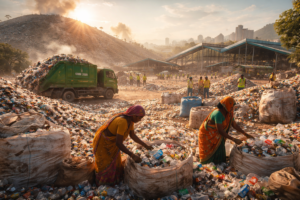
Beyond the Landfill: Can India’s New Waste Rules Finally Break the Cycle of Neglect?
For anyone who has driven past the towering, festering slopes of the Ghazipur landfill in Delhi or caught a whiff of the smoke from the Deonar dumping ground in Mumbai, the crisis is not a statistic—it is a visceral assault on the senses. These mountains of refuse are more than just eyesores; they are monuments to a system that has, for decades, prioritized the illusion of removal over the reality of management. For too long, the philosophy of Indian urban governance has been simple: collect waste from the rich neighborhoods, transport it to the poor neighborhoods, and dump it. Out of sight, out of mind.
However, a recent shift in the legislative landscape suggests that the government is finally attempting to change this calculus. With the promulgation of the Solid Waste Management Rules, 2026, and the Construction and Demolition Waste Management Rules, 2025, the Ministry of Environment, Forest and Climate Change (MoEF) has rolled out what appears to be a new blueprint for urban sanitation. But as the subcontinent grapples with generating over 62 million tonnes of waste annually—a figure poised to triple by the decade’s end—the question remains: Are these new rules a genuine turning point, or merely a sophisticated update to a rulebook that no one on the ground has the capacity or will to enforce?
The Great Divergence: Policy vs. Pavement
To understand the significance of these new regulations, one must first appreciate the depth of the failure they aim to rectify. The legal framework governing waste has historically been reactive. The seminal moment in Indian environmental jurisprudence regarding waste came in the form of Almitra H. Patel v. Union of India, a case filed in the shadow of the 1994 Surat plague. For nearly two decades, the Supreme Court wrestled with the inability of municipalities to manage their own filth. The court floated ideas that were radical for the time—privatization of garbage collection, the appointment of magistrates to fine litterers—but ultimately, the case was transferred to the National Green Tribunal (NGT) in a tacit admission that the judiciary alone could not engineer cleanliness.
That case highlighted a core structural paradox: India has never lacked for policies on paper. What it has lacked is the granular capacity to execute them. The new SWM Rules, 2026, attempt to address this by acting as “delegated legislation”—instruments that carry the weight of law, backed by the Environment Protection Act, 1986. But the success of these rules will not be measured by the language of their clauses, but by their ability to solve the three structural fractures that have historically crippled waste management: fiscal anemia, jurisdictional ambiguity, and the informal economy paradox.
The Fiscal Fault Line
The first and most daunting hurdle is money. The romantic notion of a “clean city” is expensive. It requires high-density compaction vehicles, material recovery facilities, scientific landfills, and, most importantly, skilled manpower. However, the reality of urban local bodies (ULBs) in India is one of fiscal dependency. Barring a few anomalies—such as the Brihanmumbai Municipal Corporation (BMC), which operates with a budget that rivals that of small states—most municipal corporations are effectively insolvent. They rely almost entirely on state and central grants, having failed to levy realistic user fees or property taxes that reflect the cost of the services they provide.
The fee a citizen pays for waste collection is often nominal, but so is the service. This creates a vicious cycle: citizens refuse to pay for a service they deem inadequate, and corporations refuse to improve the service because they lack the revenue. The new rules push for “user fees” and “polluter pays” principles, but unless there is a radical overhaul in the financial autonomy of ULBs, these remain aspirational. We are asking cash-strapped municipalities to not only collect waste but also to treat it, process it, and, in the case of construction debris, recycle it. Without a dedicated, ring-fenced funding mechanism—perhaps modeled on the success of the National Highways Authority of India (NHAI) for infrastructure—the financial burden will remain insurmountable.
Construction Debris: The Invisible Giant
Perhaps the most innovative—and potentially impactful—aspect of the new policy regime is the focus on Construction and Demolition (C&D) waste. The narrative around urban pollution often focuses on plastic bags and domestic garbage, ignoring the silent giant: the massive volumes of high-density debris generated by India’s construction boom.
Consider the lifecycle of a building in a modern Indian city. An existing structure is demolished. The resulting mixture—concrete, bricks, wood, metals, sand, and hazardous materials like asbestos—is usually hauled away in the dead of night by unregulated contractors, often dumped illegally on riverbanks or vacant lots. This debris does not just sit there; it leaches into groundwater, releases particulate matter into the air, and creates unstable, dangerous mounds that attract further illegal dumping.
The C&D Rules, 2025, aim to flip this narrative. By mandating the segregation and processing of this waste, the government is attempting to create a circular economy within the construction sector. The vision is compelling: the homogeneous high-density mixture from demolition becomes a cheap, raw input for new construction. If successful, this would not only mitigate the environmental hazard but also reduce the cost of construction materials, creating a rare win-win scenario.
However, the devil lies in the logistics. The construction sector in India is notoriously fragmented, dominated by thousands of small contractors who operate on razor-thin margins. For a small developer building a three-story apartment, the cheapest option will always be to pay a local truck driver to “disappear” the debris. Enforcing the C&D rules will require a supply chain revolution—creating designated processing facilities in every urban center (of which there are currently too few) and, more importantly, creating a market for recycled aggregates. If the government does not mandate the use of recycled materials in public infrastructure projects (roads, flyovers, government housing), the demand side of this equation will collapse, and the rules will remain a dead letter.
The Invisible Workforce
Any discussion of waste management in India is incomplete without acknowledging the human element that has kept the system afloat despite its official failures: the informal waste picker. For generations, a vast, invisible workforce of ragpickers has sorted through toxic heaps to extract recyclables, sustaining a multi-billion dollar recycling industry without any legal protection or social security.
The new rules represent a paradigm shift by attempting to formalize this sector. By emphasizing “integration of informal workers” and “waste segregation at source,” the legislation implicitly recognizes what environmentalists have argued for years: that you cannot solve waste without empowering the people who currently manage it.
Yet, the transition from informality to formality is fraught with danger. In cities where privatization has been attempted without proper planning, the arrival of high-tech garbage trucks and corporate contracts has often resulted in the displacement of these workers, stripping them of their livelihood without providing alternative employment. For the SWM Rules, 2026, to be truly progressive, they must move beyond lip service. They need to establish clear frameworks for the inclusion of Self-Help Groups (SHGs) and cooperative societies of waste pickers into the municipal value chain. If the rules merely replace manual sorting with mechanized sorting without providing a safety net, they will solve the problem of “visual pollution” but exacerbate the problem of urban poverty.
Unintended Consequences and the Need for Judicial Synergy
There is also a danger of legislative overreach creating new forms of friction. The rules grant significant powers to local authorities and pollution control boards to levy penalties and enforce compliance. While necessary, there is a fine line between robust enforcement and regulatory tyranny. If the penalties for improper segregation are set too high for low-income households or small businesses, the rules risk becoming instruments of harassment rather than tools of reform.
Furthermore, the judicial landscape remains a wild card. The Supreme Court, in cases like Almitra Patel, has historically shown impatience with bureaucratic lethargy. The NGT, which currently monitors state-wise compliance, often takes a strict liability approach, imposing heavy fines on state governments for non-compliance. While this “coercive correction” has yielded results in some areas, it has also led to a culture of “appeasement compliance”—where states file affidavits and pay fines to keep the court at bay, without addressing the underlying infrastructural deficits.
For the 2025 and 2026 rules to succeed, the judiciary must perhaps adopt a different posture—one of partnership rather than punishment. The courts could serve as a catalyst, pushing for the creation of independent regulatory authorities for waste at the state level, similar to electricity or water regulators, which can set tariffs, ensure quality of service, and adjudicate disputes without the need for constant judicial intervention.
Conclusion: A Hope, Not Yet a Promise
As Srijan Tripathi noted in his analysis of these laws, the new waste rules are “ambitious instruments.” They represent a significant departure from the fragmented, reactive policies of the past. For the first time, there is a cohesive attempt to treat solid waste and construction debris not just as a public health nuisance, but as a resource management challenge.
But ambition must be matched by architecture. The success of these rules will not be found in the press releases of the MoEF, but in the dusty municipal offices of Gorakhpur or the bustling construction sites of Bengaluru. It will be measured by whether the towering landfills begin to shrink, whether the air near demolition sites becomes breathable, and whether the woman who used to pick through garbage with bare hands now wears a uniform, holds an ID card, and has a bank account.
The laws provide the “how” on paper. But the real work lies in the “who”—who will fund it, who will enforce it, and who will ensure that the most vulnerable are not left behind. India has the policy framework to build clean cities. Now, it must find the political will, the administrative capacity, and the financial resources to turn that framework into concrete reality. Until then, these new rules remain a hope—a well-drafted, intellectually sound hope—but not yet a promise fulfilled.
You must be logged in to post a comment.