
Beyond the Label: The High-Stakes Smuggling of Amul Ghee and What It Reveals About Global Trade’s Shadow Economy
Amul, India’s premier dairy cooperative, has raised an alarm over the illicit smuggling of its cow ghee into the United States, alleging that unauthorized importers are deliberately misdeclaring India-market tins as “vegetable oil” or “puja oil” to evade the high 40% duty levied on dairy fats. This fraudulent labeling not only constitutes customs fraud, undermining legitimate exporters who bear the full cost of compliance, but also creates significant consumer safety risks by allowing products to bypass FDA scrutiny. The practice exposes everyone in the supply chain—importers, distributors, and retailers—to severe legal penalties, including fines and imprisonment, while exploiting cultural sensitivities and damaging brand integrity. Ultimately, this incident highlights critical vulnerabilities in global trade, where tariff disparities and complex supply chains can incentivize a shadow economy that jeopardizes revenue, safety, and fair competition.
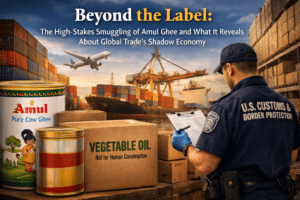
Beyond the Label: The High-Stakes Smuggling of Amul Ghee and What It Reveals About Global Trade’s Shadow Economy
In a bustling Indian grocery store in New Jersey or a specialty shop in California, a familiar golden tin sits on a shelf. It’s Amul Pure Cow Ghee, a taste of home for the diaspora. Yet, according to the dairy giant itself, that very product might be more than just a culinary comfort—it could be a piece of contraband, central to a sophisticated fraud that exploits loopholes in international trade, consumer trust, and food safety laws. Amul’s recent allegations of its India-market ghee being illegally imported into the United States, mislabelled as vegetable or puja oil, is not merely a corporate grievance. It is a window into the complex, often murky world of global food trade, where cultural longing, economic calculation, and regulatory arbitrage collide.
The Anatomy of a Customs Deception
At its core, this is a story about tariffs and trickery. Ghee, classified under US customs law as “anhydrous milk fat,” attracts a steep import duty of nearly 40%. This is a significant cost burden for importers. Vegetable oils, by contrast, face a duty of around 5-8%, even with recent additional tariffs. This stark discrepancy creates a powerful financial incentive for fraud.
The alleged scheme is brazen in its simplicity. Unauthorized importers, according to Amul, procure standard retail packs of Amul Cow Ghee meant for the Indian market—complete with FSSAI and Legal Metrology markings—and ship them to the US. The critical deception occurs at customs declaration. Instead of declaring the contents truthfully, the shipments are allegedly labelled as “vegetable cooking oil,” “puja oil” (ritual oil), “diya oil,” or even boldly marked “not for human consumption.” These classifications are strategic. “Puja oil” might invite less scrutiny, playing into cultural understandings, while “not for human consumption” absurdly attempts to sidestep food regulations entirely for a quintessential food product.
This misdeclaration is far from a victimless paperwork fudge. As Amul sharply notes, it constitutes fraud against US Customs and Border Protection (CBP) and the Food and Drug Administration (FDA). It is a direct theft of revenue and a deliberate bypassing of food safety gateways designed to protect consumers.
The Ripple Effects: Beyond Lost Revenue
While the immediate loss of customs duty is a clear hit to the US treasury, the implications of this practice ripple outwards, touching multiple facets of commerce and safety.
- Undermining Legitimate Business and Brand Integrity: Amul, and other compliant exporters, invest heavily in creating separate product lines for the US market. These packs feature FDA-compliant nutritional labels, importer details, and meet all US packaging requirements. This is a costly, necessary process of doing ethical international business. The smugglers, by undercutting them with cheaper, illicit imports, create an unfair playing field. They devalue the brand’s integrity, as consumers unknowingly purchase non-compliant products, and potentially damage Amul’s hard-earned reputation if any issues arise from these unregulated channels.
- Consumer Safety in the Shadows: This is perhaps the most alarming aspect. Products imported outside official food channels evade the safety net of regulatory oversight. The FDA’s oversight ensures that food imports meet US standards for contaminants, hygiene, and labeling. A tin of ghee slipping through as “puja oil” undergoes no such checks. There is no verifiable chain of custody. Was it stored at correct temperatures during its long journey? Is its composition exactly as stated? The consumer, believing they have purchased a genuine, safe product, is left vulnerable. The “not for human consumption” label, if discovered later, could even be used to absolve sellers of liability, leaving the consumer with no recourse.
- The Exploitation of Cultural and Religious Sentiment: The alleged use of labels like “puja oil” is particularly cynical. It exploits the respectful hesitation authorities might have in deeply examining items designated for religious use. This turns cultural sensitivity into a smuggling tool, potentially jeopardizing legitimate imports of actual religious items by inviting undue scrutiny across the board.
Legal Peril: A Web of Liability
Amul’s warning that liability extends beyond the importer is a crucial piece of the puzzle. Under US law, particularly the Federal Food, Drug, and Cosmetic Act and customs fraud statutes, the legal net can be cast wide.
- Importers face severe penalties: heavy fines (often multiples of the evaded duty), seizure and destruction of goods, and imprisonment.
- Retailers who knowingly sell these misbranded, illegally imported products can be held accountable for introducing adulterated or misbranded food into interstate commerce. This can lead to injunctions, fines, and criminal charges.
- Distributors and Individuals in the supply chain who are aware of the fraud could be considered conspirators.
This creates a stark choice for every business in the chain: ensure rigorous sourcing and documentation, or risk catastrophic legal and financial consequences.
Amul’s Dilemma: Brand Guardian in a Global Gray Market
Amul’s proactive stance is telling. They are not just disavowing the practice; they are actively coordinating with authorities in both India and the US. This highlights a modern challenge for globally recognized ethnic brands. Their product is so loved, so in-demand, that a black market emerges. They must now act as enforcement advocates, protecting their brand from their own customers’ desire for it. It’s a delicate balance—condemning the fraud without alienating the diaspora community that cherishes the product.
The Bigger Picture: A Symptom of a Fragmented System
This incident is a microcosm of larger issues in globalization. Disparate tariff regimes between product categories create irresistible arbitrage opportunities. The immense price sensitivity of certain ethnic food markets, combined with the deep emotional connection to the product, fuels demand for cheaper, non-compliant goods. Furthermore, the complexity of international supply chains and varying enforcement capacities make detection difficult.
It calls for a multi-pronged response:
- Enhanced Cross-Border Intelligence Sharing: As Amul is doing, companies and authorities in exporting and importing countries must collaborate to track suspicious shipping patterns.
- Consumer Awareness: The end buyer holds power. Diaspora consumers should be wary of products that lack proper US labeling, seem suspiciously cheap, or are sold through informal channels. The presence of only FSSAI markings on a pack in a US store is a red flag.
- Technology-Enabled Traceability: Blockchain and secure QR code systems, where a consumer can scan and verify a product’s legitimate journey from factory to shelf, could be a powerful tool against such fraud.
Conclusion: More Than Just Ghee
The tale of the mislabelled Amul ghee tin is ultimately a parable about integrity in our interconnected world. It asks us who bears responsibility for ethical trade: Is it only the regulators, or do retailers, consumers, and the brands themselves share the burden? It reminds us that the journey of a food product from a village in Gujarat to a kitchen in Texas is fraught with legal, economic, and ethical checkpoints. Bypassing them isn’t a clever hack; it’s a fraud that compromises safety, equity, and trust. In an era where “know your source” is a growing mantra for everything from coffee to clothing, this scandal underscores that the demand for transparency and accountability must extend to the most familiar, comforting items on our shelves. The promise of globalization fails when the rules of safe and fair trade are dissolved in the pursuit of profit, or even just in the well-intentioned desire for a taste of home.
You must be logged in to post a comment.