
Beyond the Lab: Why the UK and India Are Betting Big on Being the World’s AI Adopters
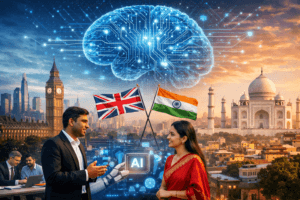
Beyond the Lab: Why the UK and India Are Betting Big on Being the World’s AI Adopters
The global artificial intelligence race is often framed as a battle between the builders: the US with its Silicon Valley giants and China with its state-backed champions. But according to a prominent UK minister, the true prize of the 21st century economy may not go to the inventor of the next large language model, but to the nation that most effectively integrates AI into the fabric of its society and economy.
In a significant statement ahead of the AI Impact Summit in New Delhi, UK Minister for AI and Online Safety, Kanishka Narayan, laid out a compelling vision for a new kind of AI leadership. His core message? While the world’s premier AI laboratories may be concentrated in the US and China, the United Kingdom and India possess a unique and powerful combination of assets that positions them to become the “best places in the world for the adoption of AI.”
This isn’t just diplomatic pleasantry; it’s a strategic repositioning that acknowledges a critical inflection point in the technology’s lifecycle. The era of pure AI discovery is giving way to an era of application. For countries like India and the UK, which are not currently home to the “Big Tech” AI giants, this shift represents an exceptional economic and social opportunity—one they are now racing to seize together.
The Strategic Pivot: From Invention to Integration
Minister Narayan’s distinction between AI invention and AI adoption is the crux of his message. For years, the narrative has been dominated by the race to build bigger models, consume more data, and achieve artificial general intelligence (AGI). This is a capital-intensive, highly specialized game with high barriers to entry.
Adoption, however, is a different beast. It’s about taking these powerful tools and embedding them into existing industries, solving real-world problems, boosting productivity, and creating new markets. It’s less about the creation of the engine and more about building the best cars, roads, and driving schools to put that engine to work.
Narayan’s argument is that both the UK and India are uniquely primed to excel in this phase. His three-pillar strategy during his visit to Bengaluru and Delhi—focusing on sectoral adoption, next-gen R&D, and responsible governance—provides a clear blueprint for this bilateral ambition.
Pillar 1: Adoption as the Engine of Growth
The minister specifically highlighted two sectors where the India-UK synergy is most potent: services and healthcare/life sciences.
- Services: India’s global dominance in the services sector, particularly in IT and business process outsourcing, is well-documented. The rise of generative AI presents both a challenge and an opportunity. The challenge is the potential automation of routine tasks. The opportunity, as Narayan frames it, is for India to lead the world in creating AI-augmented services. Instead of simply providing back-office support, Indian firms can pioneer new models of customer interaction, data analytics, and business strategy, using AI as a force multiplier. The UK, as one of the world’s largest services economies and a global hub for finance, law, and consulting, presents the perfect proving ground. A partnership here isn’t just about trade; it’s about co-creating the future of the service industry itself.
- Healthcare and Life Sciences: This is arguably the most exciting frontier for the India-UK partnership. Narayan points to the incredible synergy: India offers a massive, diverse population and a large-scale, innovative, and increasingly digitized healthcare sector. This provides an unparalleled dataset for training AI models on epidemiology, drug discovery, diagnostics, and personalized medicine. The UK, on the other hand, offers a world-leading life sciences sector, anchored by the single-payer behemoth of the National Health Service (NHS). The NHS’s 70 years of anonymized patient data is a goldmine for researchers. By combining India’s scale and innovative drive with the UK’s deep research capability and unique data resources, the two countries could accelerate breakthroughs in treating diseases, managing public health, and developing new drugs and therapies at a fraction of the current cost and time.
This vision of adoption moves beyond simple technology transfer. It’s about creating a joint innovation ecosystem where solutions are developed in tandem, tested in two very different but complementary environments, and then scaled for the world.
Pillar 2: The Next Wave of Collaborative R&D
While the focus is on adoption, Narayan is careful not to neglect the importance of continued research. However, he frames this as a collaborative, targeted effort. He mentions a focus on “frontier AI and semiconductors”—areas where the UK has specific research strengths.
The UK is home to world-class universities (Oxford, Cambridge, Imperial College London) and a thriving “Silicon Fen” that punches above its weight in AI research. India, with its vast pool of STEM graduates and its own burgeoning deep-tech startup scene in cities like Bengaluru, is a natural partner.
The idea is to create a virtuous cycle. Real-world problems identified during the adoption phase in healthcare or services can feed back into the R&D pipeline, guiding academic research toward practical, high-impact challenges. This ensures that the science being done is not just theoretical but is directly relevant to the needs of the two economies. By pooling their intellectual capital, the UK and India can carve out a significant niche in the next generation of AI innovation, even without a “Big Tech” giant in their backyard.
Pillar 3: The “Responsible AI” Advantage
Perhaps the most profound point Narayan makes is about values. He argues that both India and the UK, as democracies grounded in similar legal and ethical traditions, have a shared interest—and a competitive advantage—in shaping the future of “responsible AI.”
In a world increasingly wary of unbridled tech power, algorithmic bias, and the erosion of privacy, the ability to build trustworthy AI systems is becoming a major differentiator. The EU is forging ahead with heavy-handed, compliance-driven regulation (the EU AI Act). The US and China are taking more laissez-faire or state-centric approaches, respectively.
Narayan envisions a third way: a collaborative, values-based approach between the UK and India. This isn’t about creating bureaucratic hurdles, but about developing shared standards for assurance, governance, and responsible use. The goal is to build AI that is not only powerful but also fair, transparent, and accountable.
By co-developing these standards, the UK and India can create a trusted “seal of approval” for AI products and services. For any company looking to do business in these two large, influential markets, building to these shared standards would become a necessity. This effectively allows them to set the global norm for what “good AI” looks like, turning a regulatory and ethical stance into a powerful economic moat. As the minister put it, it’s about making sure “AI works for everyone.”
The Living Bridge: People, Policy, and Partnership
Underpinning this entire vision is the unique “living bridge” between the UK and India. Minister Narayan himself is a perfect embodiment of it—a Bihar-born, Wales-based MP of Indian heritage. He speaks of a connection that transcends any single trade deal or political cycle.
“The thing that persists through those periods of negotiation is the living bridge that remains,” he noted, referring to the recently concluded Free Trade Agreement (FTA). This bridge is built on people-to-people ties, shared history, a common language, and a cultural affinity that makes collaboration instinctive.
This human connection is being reinforced by practical policy. Narayan highlighted the UK’s Global Talent Visa, describing it as a “concierge service” designed to attract the best minds in tech. For Indian AI researchers, engineers, and entrepreneurs, this offers a fast-tracked, less bureaucratic route to living and working in the UK. The message is clear: “We are open to the very best in the world coming and building exceptional companies, exceptional research here.”
This openness is a deliberate contrast to a rising tide of protectionism elsewhere. In a global environment where some nations are “shutting their doors to opportunity,” the UK is positioning itself as a welcoming hub for global talent, with India as its most important source.
The minister backed this up with data, citing £24 billion in investment in UK AI companies and a further £28 billion in AI infrastructure spending. This isn’t just a pitch; it’s a demonstration of a thriving, mature ecosystem. For an Indian AI startup looking to expand into Western markets, the UK offers a familiar language, a robust legal system, a world-class financial centre, and a government that is actively courting their business. It’s the perfect launchpad.
A Future Forged in Collaboration
The AI Impact Summit in New Delhi serves as the perfect backdrop for this new chapter in the India-UK relationship. It moves the conversation from one of aid, or even just trade, to one of true strategic partnership.
The challenges are, of course, significant. Both countries must navigate the ethical minefields of AI, from job displacement to algorithmic bias. They must invest heavily in digital infrastructure and upskilling their workforces. And they must ensure that the benefits of AI adoption are distributed equitably across their societies, not just concentrated in a few tech hubs.
However, the vision laid out by Minister Narayan is compelling precisely because it is grounded in reality. It leverages the distinct, complementary strengths of two nations. India provides the scale, the entrepreneurial dynamism, and the real-world proving grounds. The UK provides deep research expertise, a sophisticated services economy, and a strategic gateway to global markets.
By choosing to focus on “adoption” rather than just “invention,” the UK and India are not conceding the AI race. They are redefining it. They are betting that the true winners will not be the ones who build the most powerful brain, but the ones who figure out how to use it to build a smarter, healthier, and more prosperous world. And in that race, they believe they have the best possible partner in each other.
You must be logged in to post a comment.