
Beyond the Lab Coat: Why India’s Scientific Future Depends on Its Women
At the National Science Day 2026 celebration, Union Minister Dr. Jitendra Singh reframed the role of women in science as powerful “catalysts” for India’s journey toward a developed nation, or ‘Viksit Bharat,’ emphasizing that true scientific progress requires inclusive participation and must be measured by its tangible impact on people’s lives rather than just global rankings. To operationalize this vision, the government launched several strategic initiatives, including the “Engage with Science” programme to provide young students, especially girls, with immersive lab exposure to spark early curiosity, alongside major infrastructure projects like the Hydrogen Valley Innovation Cluster and the ANRF-Venture Centre to bridge the gap between research and market-ready solutions. The event also underscored science’s role in cultural preservation through the transfer of a DST-supported nano-titania coating technology for protecting heritage stone monuments, collectively signaling a shift toward mission-driven, inclusive, and solution-oriented scientific advancement.
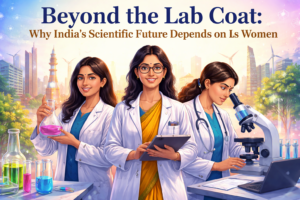
Beyond the Lab Coat: Why India’s Scientific Future Depends on Its Women
On the sweeping canvas of India’s ambition to become a developed nation—a ‘Viksit Bharat’—by its centenary of independence, the brushstrokes of progress are increasingly being made in laboratories, research institutions, and innovation hubs. But as the nation celebrated National Science Day on Thursday, a powerful and necessary re-calibration of this vision took centre stage. It was a declaration that the architect of this future cannot be a monolith; it must be a mosaic. And at the heart of this mosaic, as Union Minister Dr. Jitendra Singh asserted, are the women of India.
Addressing a gathering at the INSA Auditorium in New Delhi, Dr. Singh didn’t just acknowledge the role of women in science; he reframed it. He called them not merely participants or beneficiaries, but powerful “catalysts” in India’s transformative journey. This single word choice—catalyst—is significant. A catalyst is not a passive ingredient; it is an agent of acceleration and change, fundamentally altering the pace and nature of a reaction without being consumed by it. It is a fitting metaphor for the role women are poised to play, and are already playing, in reshaping India’s scientific destiny.
The event was more than a ceremonial celebration of the focal theme, “Women in Science: Catalyzing Viksit Bharat.” It served as a launchpad for a suite of ambitious initiatives, from nurturing young minds in Class 8 to building massive hydrogen innovation clusters. It underscored a crucial shift in policy thinking: that scientific growth is not an abstract pursuit of rankings, but a tangible, grassroots movement that must be inclusive, accessible, and solution-oriented.
The Multiplier Effect: From Mentorship to Leadership
The most profound insight from Dr. Singh’s address was his emphasis on a “multiplier effect.” For decades, the conversation around women in STEM has often been limited to statistics—the percentage of enrolment, the drop-off rates at higher levels, the underrepresentation in leadership. While these metrics are vital, they only tell part of the story. The Minister shifted the focus to a more dynamic and hopeful vision: the exponential impact of empowering a single girl child with scientific curiosity.
“When you empower a young student, particularly a girl, with structured exposure to a laboratory, you are not just teaching her a experiment,” Dr. Singh’s remarks suggested. “You are lighting a spark that will illuminate her family, her community, and eventually, the nation. She becomes a scientific ambassador in her own right.”
This philosophy is the bedrock of the newly launched “Engage with Science” Programme. Conceptualized by the National Council for Science & Technology Communication (NCSTC), this initiative is a masterstroke in long-term capacity building. It will bring students from Classes 8 and 9—a formative age where career paths often begin to crystallize—into 16 autonomous DST institutions for immersive, one-week residential programmes.
Imagine a young girl from a rural background, who has only ever read about the stars in a textbook, spending a week at an astronomy institute, peering through a telescope and interacting with women scientists who look like her and speak her language. Or a student from a tier-2 city getting hands-on experience in a materials science lab, understanding how the nano-coatings on her phone work. This isn’t just an educational trip; it’s a life-altering exposure that democratizes opportunity. By spanning seven thematic areas—from Biological Sciences and Medical Technology to Indigenous Knowledge Systems—the programme acknowledges that scientific temperament can be ignited through diverse pathways.
This initiative dovetails perfectly with the observed trends of growing representation. Dr. Singh pointed to the increasing number of women in research, leadership, and innovation-driven sectors. This isn’t by accident. It is the result of a deliberate policy shift from isolated achievements to building “enabling ecosystems.” When a girl sees a woman leading a prestigious lab or heading a department, the path ahead of her seems less like an arduous climb and more like a well-trodden road.
Building the Valleys and Villages of Innovation
While nurturing the next generation is about the long game, the initiatives launched on Thursday also addressed the immediate need to translate today’s research into tomorrow’s solutions. The announcement of the Hydrogen Valley Innovation Cluster is a prime example of this. As India races to meet its green energy commitments, creating a dedicated cluster for hydrogen technology signals a move beyond pilot projects to a cohesive, industrial-scale ecosystem. It brings together academia, industry, and startups to collaborate on the entire value chain of hydrogen—from production and storage to distribution and application.
Similarly, the launch of the ANRF–Venture Centre Outreach Initiative is a critical bridge between bright ideas and viable businesses. The Anusandhan National Research Foundation (ANRF) is designed to seed and scale research, and by linking it with a venture centre, the government is providing a clear pathway for young aspirants and seasoned researchers alike. It sends a clear message: a discovery in an Indian lab should not just be a paper in a foreign journal; it should be a product, a process, or a service that solves an Indian problem and competes on a global stage.
This philosophy of “solutions for the people” was beautifully illustrated by the transfer of a DST-supported nano titania technology to a private company, M/s Rebuild Technologies Services Pvt. Ltd. The technology—a copper-doped nano titania (Cu-TiO₂) coating—is a marvel of modern materials science with a surprisingly traditional application: conserving India’s heritage.
India’s ancient stone monuments, from the red sandstone of Delhi’s Qutub Complex to the marble of Rajasthan’s temples, are under constant assault from pollution, rain, and UV radiation. Conventional conservation methods can be invasive or aesthetically damaging. This new nano-coating, embedded in a Paraloid B-72 matrix, offers an elegant, high-tech solution. It enhances hydrophobicity (water repellence), resists UV degradation, and, crucially, maintains the stone’s original look. The fact that it was developed with DST support and is now being commercialized is a perfect example of science serving culture. It is a testament to how cutting-edge research in nanotechnology can be harnessed to protect the physical proof of our past for the citizens of Viksit Bharat.
A Vision Measured by Impact
Dr. Jitendra Singh’s overarching message was a powerful corrective to how we often measure a nation’s scientific prowess. “India’s scientific advancement must be measured not only by global rankings,” he stated, “but by its capacity to deliver solutions for its people.”
This is a profound shift in perspective. Rankings in scientific publications and citation indices are important, but they are internal metrics. The true test of a nation’s scientific health is its external impact. Does it have the technology to provide clean drinking water to its villages? Can it develop affordable healthcare diagnostics? Can it create sustainable agricultural practices? Can it, as with the nano-titania project, protect its cultural identity?
By this measure, the initiatives launched on National Science Day 2026 are not just policy announcements; they are a strategic roadmap.
- Inclusivity as a Strategy: The focus on women scientists is not just about social justice; it’s about harnessing the full intellectual capital of the nation. A problem tackled from diverse perspectives yields more robust and creative solutions.
- Nurturing the Root: Programmes like “Engage with Science” are about strengthening the roots of the scientific tree. They ensure that the pipeline of talent doesn’t run dry and that the scientists of 2047 are being inspired in the classrooms of 2026.
- Mission-Driven Research: Clusters like the Hydrogen Valley and initiatives like the ANRF Venture Centre ensure that research is aligned with national priorities—energy security, economic growth, and technological self-reliance.
- Science for Culture and Heritage: The technology transfer for heritage conservation shows that science is not just about the future; it is also the custodian of the past, using innovation to ensure that future generations can inherit their history intact.
The Road Ahead: From Commemoration to Perpetual Motion
As the event concluded, Dr. Singh urged that National Science Day should not be a mere commemorative event but a reaffirmation of India’s scientific resolve, translating into “year-round action.”
The vision of ‘Viksit Bharat’ is not a distant, static destination. It is a dynamic process of continuous betterment, resilience, and innovation. In this process, the role of a woman scientist is not confined to her laboratory. When she leads a research team, she dismantles stereotypes. When she mentors a young student, she builds the nation’s future. When her discovery leads to a market-ready product, she fuels the economy. When her innovation helps preserve a centuries-old monument, she connects the past to the future.
The story of Indian science on this National Science Day is no longer just about the discoveries we make. It is about who is making them and who they are for. It is a story of catalysis, where the energy and intellect of its women are accelerating the nation towards a future that is not just developed, but inclusive, resilient, and profoundly wise. The journey has begun, and the catalysts are already at work.
You must be logged in to post a comment.