
Beyond the Lab Coat: How India’s KVKs Are Cultivating a ‘Soil to Success’ Revolution in the East
A three-day HRD programme titled “From Soil to Success: Smart Agri-Horticultural Practices for Enhancing Farm Income – The Role of KVKs” was held in Kolkata, bringing together 22 scientists and extension officers from Krishi Vigyan Kendras (KVKs) across West Bengal to address the critical link between soil health and farmer prosperity. Organized by ICAR-ATARI, Kolkata and WBUAFS, the training emphasized that sustainable agricultural development begins with preserving the living ecosystem beneath our feet, moving beyond traditional yield-focused approaches. Through technical sessions on advanced soil testing, reclamation of problematic Gangetic alluvial soils, value addition in floriculture, and the effective interpretation of Soil Health Cards, participants were equipped to become catalysts for change in their communities. The programme underscored the pivotal role of KVKs in translating complex science into actionable farmer advice, promoting integrated farming systems, and fostering entrepreneurial ventures, all contributing to the national vision of a resilient and prosperous agricultural sector in Eastern India.
Beyond the Lab Coat: How India’s KVKs Are Cultivating a ‘Soil to Success’ Revolution in the East
Kolkata, March 2026: In the lush, deltaic plains of West Bengal, where the Ganges threads its way through a landscape of emerald paddy and golden mustard, a quiet revolution is taking root. It’s not about introducing a single miracle seed or a new tractor. It’s about something far more fundamental, and far more complex: the very ground beneath a farmer’s feet.
For three days in mid-March, the city of Kolkata became the epicentre of this agricultural transformation. The ICAR-Agricultural Technology Application Research Institute (ATARI) and the West Bengal University of Animal and Fishery Sciences (WBUAFS) joined forces to host a unique Human Resource Development (HRD) programme, aptly titled “From Soil to Success: Smart Agri-Horticultural Practices for Enhancing Farm Income – The Role of KVKs.”
But this was far more than a routine training session. It was a crucial meeting of minds, a strategic gathering designed to arm the frontline soldiers of Indian agriculture—the scientists and extension officers of the Krishi Vigyan Kendras (KVKs)—with the latest weapons in the fight for food security and farmer prosperity.
The Unseen Hero: Why Soil Health is National Health
To the uninitiated, soil is just dirt. To the 22 participants—a dedicated cohort of Heads, Subject Matter Specialists (SMS), Farm Managers, and Lab Technicians from five KVKs across Bengal—it is a living, breathing ecosystem, the nation’s most critical bank account. And right now, that account is dangerously overdrawn.
In his inaugural address, Dr. T.K. Datta, Vice Chancellor of WBUAFS, struck a chord that would resonate throughout the programme. He spoke not of yields and tonnage, but of sustainability and security. “We cannot talk about doubling farmer income,” he asserted, “if we are depleting the very asset that generates that income. The health of our soil is directly linked to the health of our rural economy and, ultimately, the health of our nation.”
His words framed the core challenge: How do we feed a growing population while reversing decades of damage caused by the overuse of chemical fertilisers and mono-cropping? The answer, the programme suggested, lies in a potent blend of ancient wisdom and cutting-edge science, delivered through the most effective network in the country—the KVK system.
The KVK: India’s Agri-Innovation Hub
The Krishi Vigyan Kendra is more than just an extension centre. It is a living laboratory, a teaching institute, and a farmer’s first point of contact for any agricultural problem. The participants in this HRD programme are the people who translate complex scientific papers into simple, actionable advice for millions of farmers.
Dr. Pradip Dey, Director of ICAR-ATARI, Kolkata, framed their mission within the grand vision of a developed India. “The foundation of a Viksit Bharat @2047,” he explained, “is a resilient and prosperous agricultural sector. And that resilience starts with healthy soils. KVKs are not just information disseminators; they are the catalysts for a behavioural change in our farming community.”
The programme was designed to supercharge these catalysts. It moved beyond textbook definitions to tackle the gritty, on-the-ground realities of Eastern Indian agriculture. The technical sessions were not abstract lectures; they were deep dives into the region’s most pressing soil-related crises.
Decoding the Dirt: From Soil Health Cards to Smart Solutions
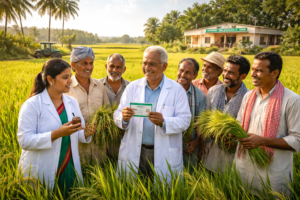
One of the most anticipated sessions focused on the government’s flagship Soil Health Card (SHC) Programme. For years, farmers have received these cards, but the gap between receiving a card and understanding its implications has been a chasm. The programme at ATARI aimed to bridge this gap.
Participants engaged in advanced workshops on soil testing techniques, moving beyond traditional NPK (Nitrogen, Phosphorus, Potassium) analysis to assess micronutrient deficiencies, organic carbon content, and biological activity. The goal was to empower KVK scientists to not just generate data, but to become master interpreters. They learned how to sit with a farmer, look at a Soil Health Card, and say, “Your land is telling us it’s low in zinc. Here’s how we fix that, and here’s how it will increase your yield of potatoes by 20%.”
This is where human insight meets hard science. It’s about transforming a piece of paper into a roadmap for profit.
Reclaiming the Land: The Challenge of Problematic Soils
A significant portion of the Gangetic alluvial zone, while fertile, is plagued by specific problems: salinity, acidity, and waterlogging. These “problematic soils” are a major barrier to success for marginal farmers. The HRD programme dedicated a crucial session to reclaiming these lands.
For a participant like a young SMS from a coastal KVK in South 24 Parganas, this session was transformative. Her farmers struggle with saltwater intrusion that turns their fields into white, barren patches. The session introduced advanced techniques like the use of gypsum for reclamation, the cultivation of salt-tolerant paddy varieties, and the strategic planting of bio-drainage species like Eucalyptus to lower the water table. She left the session not just with new knowledge, but with a tangible toolkit to offer hope to farmers who had nearly given up on their ancestral land.
Beyond the Field: The Floriculture Frontier
The “Agri-Horticultural” aspect of the programme brought a vibrant dimension to the discussions. A session on value addition and entrepreneurship in floriculture opened the participants’ eyes to the immense potential hidden in a flower.
In West Bengal, flowers like marigold, tuberose, and gladiolus are not just for worship or decoration; they are high-value cash crops. The session challenged the participants to think beyond the farm gate. Why should farmers only sell loose flowers at low mandi prices when they could be creating value-added products?
The discussion explored avenues like natural dye extraction from marigolds, the production of essential oils from tuberose, and the art of creating packaged garlands and floral arrangements for urban markets. The role of the KVK here shifts from agricultural advisor to business incubator, guiding farmers on forming Farmer Producer Organisations (FPOs), understanding quality control, and connecting with e-commerce platforms to sell their products directly to consumers in cities like Kolkata, Mumbai, and Delhi.
The Power of Collaboration: A Synergy of Strengths
A key takeaway from the three-day event was the power of institutional collaboration. The partnership between ICAR-ATARI, a national leader in technology application, and WBUAFS, a state university with deep roots in the region’s veterinary and fisheries sciences, created a holistic learning environment.
Dr. Keshab Chandra Dhara, Deputy Director (Farms) at WBUAFS and the programme’s coordinator, emphasized this synergy. “Agriculture is no longer just about crops,” he noted during his address. “A farmer’s livelihood is an integrated system. Soil health affects the fodder for their cattle, which affects the milk yield, which affects their income. By bringing together the expertise of our university and the reach of ATARI, we are fostering a systems approach to farming.”
This integrated vision was the highlight of the concluding interactive workshop on sustainable soil management. Participants broke into groups, not by their subject specialisation, but by the geographical challenges of their respective KVK districts. An SMS in plant protection from a district prone to flooding brainstormed with a farm manager from a dry, upland area. A lab technician shared tips on calibrating new soil-testing equipment with a fellow technician from across the state. The room buzzed with the energy of shared problem-solving.
Sowing the Seeds of a Viksit Bharat
As the programme drew to a close, the 22 participants weren’t just carrying back厚厚的 folders and presentation printouts. They were carrying a renewed sense of purpose. They had been reminded that their work in the laboratory, in the demonstration plot, and in the farmer’s field is the bedrock of India’s future.
The true success of the “From Soil to Success” programme won’t be measured in the number of sessions held or the attendance certificates distributed. It will be measured months and years from now, in a village in Birbhum, where a farmer decides to test his soil before planting. It will be seen in the coastal belt of the Sunderbans, where a patch of saline land is slowly turned productive with the help of a confident KVK scientist. It will be heard in the bustling markets of Kolkata, where a woman from an FPO sells a bouquet of marigolds that she grew, processed, and marketed herself.
The HRD programme at ICAR-ATARI, Kolkata, was a powerful reminder that the journey from soil to success is a long one. But with skilled hands, sharp minds, and a deep respect for the earth, India’s agricultural extension system is ensuring that its farmers—and the nation—get the best possible return on that most fundamental of investments: the soil beneath our feet.
You must be logged in to post a comment.