
Beyond the IPO: How Samsung’s AI and Finance Strategy Will Reshape Its Future in India
Beyond the IPO: How Samsung’s AI and Finance Strategy Will Reshape Its Future in India
Samsung Electronics’ decision to forgo an initial public offering (IPO) for its massive India business is more than a financial announcement—it is a clear declaration of its long-term strategic confidence. By publicly ruling out an India listing, the company is signaling a preference for internal, controlled growth over market-funded expansion. This choice, made even as South Korean peers like Hyundai Motor India and LG Electronics tap into public capital, reveals a corporation betting on its own operational strength and a deep-seated belief in India’s future.
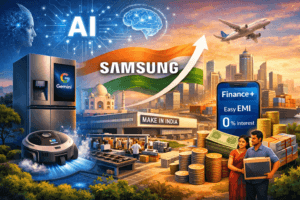
The alternative roadmap Samsung has laid out focuses on two powerful, interconnected engines: artificial intelligence (AI) as a product differentiator and consumer finance as a market enabler. This dual strategy is designed to secure Samsung’s dominance in a market that is both fiercely competitive and critical to its global ambitions.
The Strategic Choice: Why No IPO?
Samsung’s leadership has been unequivocal. When asked about a potential IPO, JB Park, President and CEO of Samsung Southwest Asia, stated, “No, we do not have any such plans as of now”. This decision is rooted in a philosophy of self-reliance and strategic control.
- Financing Through Internal Strength: Park emphasized that the company has “multiple options” for working capital, including institutional borrowings and corporate bonds, making a public listing unnecessary for its current growth objectives. An IPO would introduce shareholder pressures and quarterly expectations that could constrain long-term, patient investments in areas like manufacturing and R&D.
- A Contrast with Competitors: The move stands in stark contrast to the path taken by other major South Korean players in India. Hyundai Motor India and LG Electronics have both pursued public listings, using the raised capital to cement their local presence. Samsung’s choice to go it alone suggests a calculated bet that its existing resources and profitability are sufficient to win the market on its own terms.
The Dual Growth Engines: AI and Consumer Finance
With the IPO question settled, Samsung is channeling its energy and resources into two primary growth vectors. The table below outlines the core components of this strategy:
| Strategic Pillar | Primary Objective | Key Initiatives & Metrics |
| AI Integration | Differentiate products in a crowded market; drive premiumization. | Showcasing new AI appliances at CES 2026; integrating Google Gemini into refrigerators; over 10,000 R&D engineers in India. |
| Consumer Finance (Finance+) | Boost sales accessibility and penetration, especially in rural markets. | Over 40% of smartphones sold on EMI; expanding to TVs & washing machines; segment growing at 10% annually. |
| Manufacturing Depth | Move beyond assembly to high-value component manufacturing. | Applied for PLI scheme to make mobile displays; Noida factory is world’s largest smartphone plant. |
- Betting on AI to Command the Premium Market
AI is not just a feature for Samsung; it is positioned as the “cornerstone” of its future products. The company aims to move beyond gimmicks to deliver what Park calls “smarter, more personalised experiences that enhance everyday living”. This is a direct play to win and retain high-value customers.
- CES 2026 as a Launchpad: Samsung plans to unveil a suite of upgraded AI-powered appliances at the upcoming Consumer Electronics Show. Highlights include the Jet Bot Steam Ultra vacuum, AI-driven laundry combos, and the AI Refrigerator Family Hub which will, for the first time, integrate Google Gemini for enhanced food recognition and kitchen management.
- R&D Rooted in India: Crucially, this global AI ambition is powered significantly by Indian talent. Samsung employs over 10,000 engineers in India across three R&D centers and a design studio, making the country a pivotal hub for both local and global innovation.
- Using Finance to Fuel Mass-Market Growth
While AI targets the premium segment, Samsung’s consumer finance arm, Finance+, is the engine for volume growth. By offering interest-free EMIs, Samsung dramatically lowers the entry barrier for its products in a price-sensitive market.
- Proven Success and Expansion: With over 40% of its smartphones already sold through this scheme, Samsung is now expanding Finance+ to big-ticket home appliances like televisions and washing machines. This initiative is a “very big growth engine” for tapping into rural markets in north and northeast India.
- Building an Ecosystem: This strategy does more than drive sales; it builds a loyal customer ecosystem. Easy access to financing for a suite of products can tie consumers more closely to the Samsung brand for future upgrades and additional purchases.
Doubling Down on “Make in India”: From Assembly to Core Manufacturing
Samsung’s commitment to India is fundamentally anchored in manufacturing. Its facility in Noida is already the largest smartphone manufacturing plant in the world and a key export hub. However, the new strategy involves a significant evolution: moving up the value chain from assembling finished products to manufacturing critical components.
- The Display Manufacturing Gambit: Samsung has applied for incentives under India’s Production-Linked Incentive (PLI) scheme to manufacture mobile phone displays locally. Displays are among the most expensive and complex components in a smartphone. Local production would reduce dependency on imports, cut logistics costs, and deepen the local supply chain—a major strategic upgrade for India’s electronics ecosystem.
- A Complementary, Not Competing, Strategy: It’s important to note Samsung’s global manufacturing balancing act. The company has clarified it will not shift existing capacity from Vietnam, its largest global base, to India. Instead, India is being developed as a complementary growth center where new capacity is added to meet organic demand, particularly for exports. In fact, exports accounted for a remarkable 42% of Samsung’s India revenue in FY2025, which crossed $11 billion.
Navigating a Competitive Landscape
This aggressive strategy unfolds against intense competition, most notably from Apple, which has been gaining share in India’s premium segment. Park acknowledges this competition but remains confident, noting that the Android ecosystem Samsung leads still commands over 90% of the Indian smartphone market.
Samsung’s multi-pronged approach—premium AI features for the high-end, affordable finance for the mass market, and deeper local manufacturing for cost and supply chain efficiency—is designed to defend and grow its position across all fronts.
Conclusion: A Long-Term Vision of Sovereign Growth
Samsung’s rejection of the IPO path is a powerful statement. It reveals a company confident in its own financial and operational muscle, and deeply committed to playing a long game in India. By prioritizing AI innovation, financial inclusivity, and manufacturing depth, Samsung is not just seeking to sell more products; it is working to embed itself into the fabric of the Indian economy.
The goal is clear: to transform India from Samsung’s largest factory into one of its most critical technology and innovation hubs. This strategy requires patience and immense investment, but it promises a more durable and influential market position—one built on genuine value addition rather than financial engineering. In doing so, Samsung is betting that its own growth will be inextricably linked with the rise of the Indian consumer and the “Make in India” initiative itself.
You must be logged in to post a comment.