
Beyond the Hype: Why Sam Altman’s Stealth India Trip Signals a New AI Battleground
Sam Altman’s planned, low-key visit to India during the high-profile AI Impact Summit signifies a critical strategic pivot, where the real competition for AI dominance is moving behind the scenes. While the summit itself showcases global leaders like Sundar Pichai and Jensen Huang, Altman’s separate closed-door meetings and private event underscore a deeper battle to win over India’s enterprise market, influential policymakers, and vast developer community. This concerted push by OpenAI, Anthropic, and Nvidia highlights India’s unique role as both a massive consumer base and a crucial future hub for talent and AI development. However, the mission is fraught with challenges, from converting India’s vast ChatGPT user base into paying subscribers to navigating infrastructure constraints and complex regulations, making this visit a essential diplomatic and commercial maneuver in the high-stakes quest to secure India’s AI future.
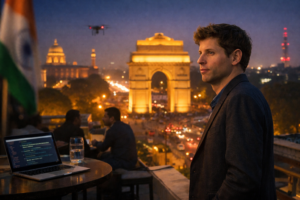
Beyond the Hype: Why Sam Altman’s Stealth India Trip Signals a New AI Battleground
While the official agenda of the India AI Impact Summit 2026 is set to glitter with keynotes from the industry’s biggest names, the most telling development might be happening in the shadows. Sam Altman’ planned, yet unannounced, visit to New Delhi in mid-February, complete with closed-door meetings and a private OpenAI event, is more than a routine corporate trip. It’s a strategic maneuver in the high-stakes contest for global AI dominance, and India has unequivocally become its newest and most critical frontier.
This convergence of Silicon Valley’s elite in Delhi isn’t merely a conference; it’s a diplomatic and commercial offensive. The simultaneous side-events by Anthropic in Bengaluru and Nvidia in New Delhi reveal a concerted push to woo India’s three pillars of tech influence: its vast enterprise market, its prolific developer community, and its decisive government policymakers. Altman’s presence, away from the summit’s main stage, suggests a focus on the nuanced, behind-the-scenes work of deal-making and relationship-building that will ultimately determine winners and losers.
The Quiet Diplomacy of a Tech Giant
Altman’s itinerary—meeting with tech executives, startup founders, and government officials—reveals OpenAI’s two-pronged challenge in India. First, it must transition ChatGPT from a viral phenomenon to a sustainable business. India is ChatGPT’s largest market by downloads and second-largest by users, yet converting this massive user base into paying subscribers has proven difficult. The introduction of the sub-$5 “ChatGPT Go” plan was a direct response to this, acknowledging the unique price sensitivity of the market.
Second, and more significantly, OpenAI is navigating India’s complex and evolving AI regulatory landscape. Hiring for legal roles focused on AI regulation in India is a clear sign of proactive engagement. Altman’s likely discussions with government figures won’t just be about sales; they’ll be about shaping the conversation around responsible AI, data sovereignty, and the infrastructure needed to support it. In a nation keenly aware of its digital sovereignty, gaining trust is as important as gaining market share.
India’s Unique Confluence of Factors
Why has India suddenly become the globe’s most sought-after AI audience? The reasons are singular and powerful:
- The Demographic & Talent Dividend: Beyond its billion-plus population, India possesses one of the world’s largest and most agile pools of software developers and engineers. For companies like Anthropic and OpenAI, this isn’t just a consumer base; it’s a future workforce and a hub for model refinement and development tailored to non-Western contexts.
- The Enterprise Laboratory: India’s diverse economy, from massive conglomerates like Reliance to a thriving startup ecosystem and a vast public sector, presents unparalleled testing grounds for AI applications in agriculture, healthcare, education, and logistics. Partnerships, like those between Google and Jio or Perplexity and Airtel, show the route to scale is through alliances with domestic giants.
- The Strategic Counterbalance: For U.S. AI firms, a strong presence in India serves a geopolitical purpose. It solidifies a strategic tech partnership with a key democratic counterweight in the Indo-Pacific, at a time when technological spheres of influence are being drawn. India’s push for domestic “smaller models” for local use cases is a gentle warning; it seeks collaboration, not dependence.
The Formidable Roadblocks: Infrastructure and Monetization
However, Altman’s mission is fraught with challenges that no closed-door meeting can easily solve. OpenAI’s exploration of India as an infrastructure expansion base runs directly into the nation’s physical constraints. The vision of massive, water-cooled data centers powering the next generation of AI faces the reality of uneven power grids, high energy costs, and water scarcity. While Google and Microsoft have announced multi-billion-dollar investments, the build-out will be slower and costlier than in other regions, potentially putting AI responsiveness and affordability at risk.
Furthermore, the monetization puzzle remains unsolved. The Indian market has famously trained global tech companies to prioritize volume over value. OpenAI’s tiered pricing is an experiment in cracking this code. Can it provide enough perceived value to move users from free to paid tiers in a market saturated with low-cost digital services? The answer will be a case study for the entire industry.
A Summit of Substance Over Spectacle
The India AI Impact Summit 2026, therefore, moves beyond symbolism. The Indian government’s hope to attract $100 billion in AI investment is ambitious, but the simultaneous courtship by every major AI player suggests it’s not entirely fanciful. The summit is a convening of power, but the real business will happen on the sidelines—in the meeting rooms where Altman and his peers negotiate partnerships, in the developer halls where Anthropic evangelizes its toolkit, and in the policy circles where the rules of the next decade are being softly debated.
Sam Altman’s quiet trip to Delhi is a acknowledgment of a new reality: the future of AI will not be written in Silicon Valley alone. It will be co-authored in hubs like New Delhi and Bengaluru, shaped by local needs, local constraints, and local ingenuity. For OpenAI, success in India is no longer optional; it’s existential. The race is on, and the starting pistol has already fired.
You must be logged in to post a comment.