
Beyond the Hype: Why FICER’s Smart City Networking Play at Convergence India 2026 is a Blueprint for the Subcontinent’s Digital Future
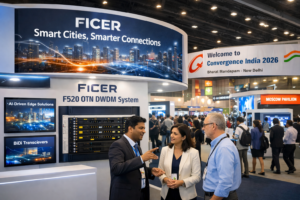
At the Convergence India Expo 2026, FICER is poised to address the critical yet often overlooked challenge of physical network infrastructure with its next‑generation F520 OTN DWDM system—a high‑density, modular platform designed to maximize existing fiber capacity and reduce the need for disruptive urban excavation. By leveraging advanced DCO transceivers and BiDi technology, the solution offers a cost‑efficient path to scaling bandwidth and reducing fiber congestion, which is essential for supporting the low‑latency demands of AI workloads and smart city applications. With a strong emphasis on automated network management and edge‑ready deployment, FICER’s showcase underscores that the foundation of India’s digital future lies not only in flashy new applications but in the resilient, scalable optical networks that make them possible.
Beyond the Hype: Why FICER’s Smart City Networking Play at Convergence India 2026 is a Blueprint for the Subcontinent’s Digital Future
As Bharat Mandapam in New Delhi prepares to host the 33rd Convergence India Expo in March 2026, the usual buzz of press releases and product teasers is reaching a fever pitch. Among the cacophony of announcements regarding AI startups and satellite spectrum battles, one particular news item from FICER demands a closer look—not because it is the flashiest, but because it speaks to the most pressing, unglamorous problem holding back India’s digital ambition: the physical infrastructure of connectivity.
While the average consumer marvels at 5G speeds on their smartphones, the engineers and policymakers attending the expo understand that the “digital India” dream is currently constrained by a very analog reality: congested fiber ducts, aging optical networks, and the exorbitant cost of digging up Indian streets to lay new cable. FICER’s upcoming showcase, centered on the F520 OTN DWDM System, is not merely a product launch; it is a strategic response to the tectonic shifts occurring in Indian urban planning and data consumption.
The Unspoken Crisis in the Cables
To understand why FICER’s timing is impeccable, one must look at the ground truth of India’s smart city mission. For the last decade, the government’s Smart Cities Mission has focused heavily on citizen services, surveillance, and command-and-control centers. However, the connective tissue—the optical fiber network—has struggled to keep pace with the exponential growth in data.
India is currently experiencing a data paradox. On one hand, the cost of data is among the cheapest globally, leading to unprecedented consumption. On the other hand, the physical infrastructure carrying this data is often a patchwork of legacy systems installed during the 2000s. As cities like Pune, Ahmedabad, and Bengaluru expand vertically and horizontally, the existing fiber infrastructure is suffering from severe “duct congestion.” In metropolitan areas, the underground conduits that house fiber optic cables are bursting at the seams.
This is where FICER’s approach, moving beyond simple bandwidth upgrades to focus on scalability and density, becomes critical. The F520 OTN DWDM (Optical Transport Network Dense Wavelength Division Multiplexing) system is designed to solve the spatial problem. Instead of laying new fiber—a process that involves navigating India’s complex right-of-way (RoW) regulations, municipal hurdles, and disruptive construction—DWDM technology allows network operators to maximize the capacity of existing fiber.
By utilizing advanced DCO (Digitally Coherent Optics) Series transceivers, the F520 effectively turns a single strand of fiber into a multi-lane highway. For a city like Mumbai, where digging a new trench costs lakhs per kilometer and often faces months of litigation, the ability to scale capacity without physical intervention is not just an efficiency gain; it is an economic survival mechanism for network providers.
AI’s Insatiable Appetite Meets Edge Reality
The press release touches upon “AI-driven data infrastructure,” a phrase that has become ubiquitous in 2026. However, the reality of AI infrastructure is far more granular than the massive server farms making headlines. The true bottleneck for Artificial Intelligence today is not just compute power—it is latency and data transport.
As India pushes toward AI-led governance and industry, data centers are proliferating across Tier-2 and Tier-3 cities. But the current architecture often forces data to travel vast distances to centralized processing hubs, creating latency that is unacceptable for real-time applications like autonomous traffic management (a key smart city component) or advanced manufacturing robotics.
FICER’s focus on high-density, modular platforms suggests a shift toward distributed networking. The F520’s modularity means that it can be deployed not just in core data centers but at the network edge. This allows for the creation of “edge nodes”—miniature data processing hubs located closer to the point of data generation (traffic cameras, smart meters, industrial IoT sensors).
By enabling these nodes to communicate via a robust DWDM backbone, FICER is effectively laying the groundwork for a network architecture that can handle the specific demands of AI inference. In practical terms, this means a traffic management system in Delhi that can analyze video feeds and adjust signals in real-time without sending terabytes of footage to a server in Noida first. The processing happens locally, the insights travel globally. This is the kind of “smarter connection” that moves beyond marketing jargon and into tangible urban efficiency.
The BiDi Revolution and the Economics of Fiber
Another subtle yet powerful highlight of the upcoming showcase is the inclusion of BiDi (Bidirectional) transceivers. To the layperson, a transceiver is a minor component; to a Chief Technology Officer (CTO) of a telecom operator, it is a line item that can make or break a quarter’s capital expenditure.
Traditional optical modules require two fibers to communicate: one to transmit, one to receive. BiDi technology uses wavelength division multiplexing to send and receive data over a single fiber strand. In the context of India’s smart city deployments, where every millimeter of duct space is precious and the cost of leasing dark fiber is astronomical, BiDi effectively doubles the capacity of the existing physical plant overnight.
This focus on cost-effective deployment is a deliberate nod to the financial realities of Indian telecom. The market is incredibly price-sensitive. For a long time, the adoption of cutting-edge optical networking in India lagged behind Western markets because the return on investment (ROI) for expensive hardware was difficult to justify in a market characterized by ARPU (Average Revenue Per User) pressures.
By highlighting solutions that reduce fiber congestion and improve efficiency without requiring massive new infrastructure builds, FICER is aligning its business strategy with the fiscal conservatism of its clients. It’s a recognition that in India, the “future-ready” network isn’t the one that uses the most exotic technology; it’s the one that offers the lowest total cost of ownership while handling the highest throughput.
The Convergence India Expo: A Barometer for ‘Viksit Bharat’
FICER’s choice of Convergence India Expo 2026 as the launchpad for this next-gen portfolio is significant. Now in its 33rd year, this expo has evolved from a simple telecom trade show into a barometer for the country’s technological trajectory. The 2026 edition, with its expected 50,000 attendees and participation from 25 countries, arrives at a pivotal moment.
The Indian government has been articulating its vision for “Viksit Bharat” (Developed India) by 2047. A cornerstone of this vision is the creation of industrial cities and smart municipalities that are not just digital by default, but digital by design. However, the gap between policy intent and on-ground execution is often wide.
Events like Convergence India serve as the bridge. They are where the theoretical architectures discussed in government white papers meet the physical hardware that engineers must install in manholes and data centers. For the 200 startups attending, the showcase of high-density optical networking offers a glimpse into the infrastructure they will rely on to scale their own AI and IoT solutions.
Moreover, the presence of international pavilions, such as the previously announced Moscow Pavilion showcasing robotics and cybersecurity, highlights that the battle for India’s digital infrastructure is a global one. In this competitive landscape, FICER is making a clear statement with its “Smart Cities, Smarter Connections” theme: that deep domain expertise in optical transport is the non-negotiable foundation upon which all other digital innovations—from fintech to AI—must be built.
The Human Element: Managing Complexity Through Automation
Perhaps the most valuable, albeit understated, aspect of the F520 system is its promise of automated network management. The shortage of skilled optical network engineers is a silent crisis in the industry. As networks become more complex with the introduction of multi-vendor environments and sprawling IoT ecosystems, the manual configuration of wavelengths and paths becomes a single point of failure.
Modern DWDM systems are increasingly incorporating software-defined networking (SDN) capabilities. The ability to automate the provisioning of wavelengths, to allow for self-healing networks that detect and bypass fiber cuts without human intervention, and to provide predictive analytics on network health is what separates a reliable utility from a fragile infrastructure.
For smart cities, where public safety and municipal services depend entirely on uptime, this automation is a lifeblood requirement. When a municipal corporation in Surat is managing a network of 10,000 IoT sensors for flood detection, it cannot rely on a manual ticketing system to restore connectivity. It needs an intelligent network that adapts in microseconds. By focusing on automation alongside hardware, FICER is addressing the human capital constraints that often slow down digital transformation in India.
Conclusion: Laying the Rails for the Express Train
As the delegates gather at Bharat Mandapam from March 23 to 25, 2026, the stalls will be filled with dazzling displays of AI avatars, cybersecurity firewalls, and futuristic robotics. But for the network architects, the city planners, and the infrastructure CEOs walking the floor, the most important conversations will be happening at the booths of companies like FICER.
The unveiling of the F520 OTN DWDM System is not just about selling hardware; it is about providing the scalability required to prevent India’s digital growth from hitting a physical wall. As the country accelerates towards a future where AI, smart cities, and digital governance are the norm, the networks must be able to handle an estimated 100x increase in data traffic over the next decade.
FICER’s pitch—focusing on density, automation, and cost-efficiency—resonates because it acknowledges that the smart cities of tomorrow are being built on the fiber infrastructure of today. By showing how to make that existing infrastructure “smarter” without requiring a complete rebuild, FICER is offering a pragmatic, yet futuristic, roadmap.
For those attending the expo, the message is clear: the future of connectivity in India won’t just be built on the brightest ideas, but on the most resilient, dense, and intelligent optical networks. And if FICER’s latest innovations deliver on their promise, they will be providing the quiet, reliable engine powering India’s sprint toward a truly connected era.
You must be logged in to post a comment.