
Beyond the Hype: What India’s First Vande Bharat Sleeper Train Truly Means for Overnight Travel
Beyond the Hype: What India’s First Vande Bharat Sleeper Train Truly Means for Overnight Travel
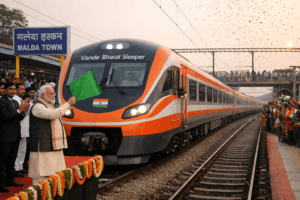
On a Saturday in Malda, West Bengal, a splash of orange and grey didn’t just mark the arrival of another train; it signalled a deliberate shift in how a nation of billions dreams of distance. When Prime Minister Narendra Modi flagged off India’s inaugural Vande Bharat Sleeper train on January 17, 2026, the ceremonial event transcended political spectacle, offering a tangible glimpse into the future of long-distance rail travel. This isn’t merely a faster train; it’s a recalibration of the overnight journey experience, connecting the cultural heart of Kolkata (Howrah) with the spiritual and economic gateway of the Northeast, Guwahati (Kamakhya).
The Launch: Symbolism and Substance
The choice of location was telling. Launching from Malda Town, a crucial hub in West Bengal, the event underscored a focus on enhancing connectivity to and within the Eastern and Northeastern regions. By flagging off both directions of the service—the Howrah-Guwahati and Guwahati-Howrah routes—the inauguration highlighted a vision of two-way, equitable connectivity. The inaugural specials (Train 02075 and 02076) operated on a special schedule, with the train symbolically commencing its journey from Malda Town towards Kamakhya, and from Kamakhya towards Howrah, setting the stage for regular commercial runs to follow.
This launch wasn’t an isolated event but part of a colossal railway modernization narrative. With ambitions to deploy 800 Vande Bharat trainsets by 2030, the sleeper variant answers the most critical question: How do you bring high-speed, hotel-like comfort to the long-distance, overnight routes that form the backbone of India’s passenger rail network?
Decoding the “Revolution”: More Than Just Six Hours Saved
Media headlines rightly trumpet a travel time reduced by up to six hours. The scheduled 14-hour 40-minute journey between Howrah and Guwahati is a significant compression. But the revolution lies in the details, in the silent upgrade of a hundred small experiences that constitute an Indian rail journey.
- The Sleeper Evolution: Moving beyond the chair-car format of existing Vande Bharats, this sleeper version addresses the core of Indian travel: the need for a horizontal bed over vast distances. Designed by BEML using ICF technology, the 16-coach train promises modern berths, enhanced sound insulation, and LED lighting designed for night travel. The promise of “regional cuisines” being served isn’t just a catering note; it’s an acknowledgment of the journey’s cultural passage, offering a taste of Bengal and Assam onboard, making the train a moving extension of the destinations it connects.
- The Passenger Calculus: For decades, travelers on this route faced a trade-off: the affordable but lengthy conventional train, or the expensive flight. The Vande Bharat Sleeper inserts a compelling middle ground—a premium rail experience that saves a full quarter of a day compared to older trains, at a price point likely still significantly below airfare. This isn’t just about moving people faster; it’s about making a comfortable, time-efficient journey accessible to a much larger segment of the population. It redefines value for money in rail travel.
- Strategic Connectivity: The stoppages read like a map of key economic and tourist nodes: New Jalpaiguri (for Darjeeling/Sikkim), New Alipurduar, New Bongaigaon, and more. This isn’t a point-to-point bullet train but an integrated corridor developer. It brings faster, modern travel to smaller hubs, potentially boosting tourism and local economies. The enhanced connection to Kamakhya, one of the Shakti Peethas, also underscores the importance of pilgrimage connectivity in India’s transport planning.
The Broader Canvas: India’s Rail Ambition and the Passenger’s Future
The Vande Bharat Sleeper’s debut is a single frame in a fast-moving film. Indian Railways’ stated goal of 4,500 Vande Bharat trainsets by 2047 paints a picture of a network fundamentally transformed. This sleeper variant is the key that unlocks the next phase: overhauling the Mail and Express overnight services, which carry the immense bulk of India’s long-distance travelers.
The challenges are implicit. Maintaining the high standards of cleanliness, service, and punctuality on such a complex network will be monumental. The fare structure, while inclusive compared to flights, must remain dynamic to ensure viability and accessibility. The integration of this new system with existing infrastructure—from platform upgrades to maintenance depots—is a continuous task.
A New Chapter in Railway Romance
For over a century, the Indian sleeper train has been more than transport; it’s a microcosm of society, a moving tableau of conversations, shared meals, and landscapes unfolding outside the window. The Vande Bharat Sleeper doesn’t seek to end that romance; it seeks to elevate its conditions. It replaces the symphony of clattering wheels and jerks with a quieter, more stable ride. It swaps harsh fluorescent tubes for gentle LEDs. It aims to exchange indifferent catering for a taste of the region.
The inaugural run from Malda Town to Kamakhya, and from Kamakhya to Howrah, was more than a logistical test. It was the first real-world draft of a new contract between Indian Railways and its passengers. A contract that promises that progress isn’t just about soaring bridges and record-breaking speeds, but about the quality of the night spent between two distant points on a map—about arriving not just faster, but more rested, and more connected to the journey itself.
As the orange and grey rakes settle into their regular service, the true measure of success will be in the stories of the passengers: the family visiting Guwahati for a reunion, the tourist heading to the hills of North Bengal, the business traveler navigating the Northeast. For them, the Vande Bharat Sleeper isn’t a headline; it’s their reality—a quieter, quicker, and more comfortable chapter in India’s endless, enduring love affair with the rails.
You must be logged in to post a comment.