
Beyond the Hype: The Geopolitical Forces That Finally Forged the EU-India Trade Deal
The recently concluded EU-India free trade agreement, hailed as a landmark deal, represents a fundamental shift in the purpose of trade pacts in today’s fractured world. Rather than being driven solely by classic economic liberalization, this agreement is a strategic geopolitical compact, forged after nearly two decades of talks and finally accelerated by shared vulnerabilities. For the EU, it is a central pillar of its strategy to diversify supply chains away from China and secure growth in Asia, while for India, it guarantees crucial market access and reinforces its strategic autonomy amidst global uncertainty. The deal carefully balances concessions—offering EU automakers and winemakers entry into India’s market and giving Indian textile and pharmaceutical producers preferential access to Europe—while protecting politically sensitive sectors like agriculture. Ultimately, it transcends traditional tariff reduction, serving as a tool for economic security, supply chain resilience, and a demonstration that major democracies are crafting new, pragmatic alliances in an era of great power rivalry.
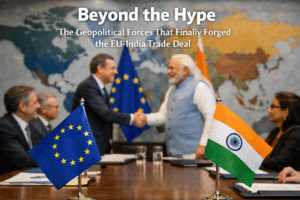
Beyond the Hype: The Geopolitical Forces That Finally Forged the EU-India Trade Deal
The recent announcement of the free trade agreement (FTA) between the European Union and India marks a defining moment in 21st-century global economics. Branded by European Commission President Ursula von der Leyen as the “mother of all deals,” this pact creates the world’s largest free trade zone, linking two economies that together represent nearly 25% of the world’s GDP and a quarter of its population. Yet, to view this historic accord purely through the lens of tariffs and market access is to miss its true significance. The agreement, concluded after nearly two decades of stalled negotiations, is a direct product of a fractured world order, driven more by urgent geopolitical recalibration than by conventional trade calculus.
This analysis moves beyond the headline figures to explore the powerful forces that finally sealed the deal, the tangible gains and concessions on both sides, and the substantial challenges that will determine whether this partnership can deliver on its transformative promise.
The Geopolitical Imperative: A Deal Forged in Crisis
For years, the EU-India FTA languished, bogged down in technical disputes over issues like patent protection and labor mobility. What changed was not a sudden resolution of these old conflicts, but the emergence of new, shared vulnerabilities that made an agreement a strategic necessity for both Brussels and New Delhi.
- Navigating a Volatile Washington: The return of a transactional U.S. foreign policy under President Donald Trump created profound uncertainty for both partners. The EU faced renewed tariff threats, compelling it to confront the limits of its reliance on the American market. For India, a long-time champion of a rules-based order, Washington’s “America First” agenda proved destabilizing. A decisive moment came in 2025 when India, facing punitive U.S. tariffs over its purchases of Russian oil, refused to endorse a White House narrative on regional security. This refusal accelerated India’s drive for strategic autonomy and diversified economic partnerships.
- The Shared Challenge of China: While neither side seeks full decoupling, both the EU and India share deep concerns about over-dependence on China. The EU runs a massive €304 billion trade deficit with China, highlighting a critical vulnerability in its supply chains. India, meanwhile, contends with China’s strategic partnership with Pakistan and unresolved border tensions. The FTA is thus a mutual hedge—a framework to build alternative manufacturing hubs, secure critical supply chains, and reduce unilateral dependencies.
As one analysis starkly framed it, the agreement was driven less by economics and more by the need for Brussels and New Delhi, as “mid-level powers,” to navigate an increasingly fragmented landscape together.
Inside the Deal: Winners, Losers, and Strategic Gains
The final agreement is a study in careful balance, with both sides securing key victories while protecting sensitive domestic sectors. The numbers are staggering: the deal aims to double EU exports to India by 2032, with annual duty savings projected at €4.7 billion.
Key Sectoral Impacts
| Sector | EU Gains | Indian Gains |
| Industrial Goods | Cars: Tariffs slashed from up to 110% to 10% over 5 years. Chemicals & Machinery: High duties (up to 22%) eliminated, mostly at entry into force or over 7-10 years. | Textiles & Apparel: Immediate zero-duty access to the EU market. |
| Agriculture & Food | Wine & Spirits: Tariffs up to 150% reduced to 30-40%. Olive Oil, Dairy, Processed Foods: Tariffs eliminated. | Protected its sensitive dairy sector; gained preferential access for agricultural exports like processed foods. |
| Services & Digital | Financial, Maritime, IT, Professional Services: Access to 144 subsectors; ambitious commitments on labor mobility. | Strong IP protection frameworks to integrate generic pharma into EU supply chains. |
| Strategic Sectors | Pharmaceuticals: Elimination of India’s 11% tariff on EU drugs over 5-10 years. | Anchored as a reliable partner in EU’s diversification from China, especially in garments and manufacturing. |
The agreement notably features significant exclusions to protect political sensitivities. The EU shielded its farmers by excluding beef, poultry, sugar, and rice, while India successfully protected its dairy industry. Furthermore, initial EU pushes for a sustainability chapter with hard enforcement mechanisms were replaced with cooperative frameworks, avoiding accusations of “green protectionism” from New Delhi.
Beyond Trade: The Security and Sustainability Corridors
The FTA is part of a broader strategic package. It was accompanied by a new security and defence partnership covering maritime security, cyber resilience, and defence-industrial collaboration. For India, this offers a pathway to reduce dependence on Russian arms and enhance coordination with European navies. For the EU, it solidifies India’s role within its Indo-Pacific strategy.
Equally significant is the green transition corridor. The deal aligns the European Green Deal with India’s target of 500 gigawatts of renewable capacity by 2030. Through existing frameworks like the EU-India Clean Energy and Climate Partnership, the focus is on joint leadership in green hydrogen, offshore wind, and solar energy. However, tensions remain, particularly around the EU’s Carbon Border Adjustment Mechanism (CBAM), which India views as a potential trade barrier.
The Road Ahead: Implementation and Inevitable Comparisons
The greatest challenge now shifts from negotiation to implementation. As one observer wryly noted, the European Commission excels at negotiating deals but often gets “bored by the prosaic job of implementation”. Several thorny issues, such as digital rules and steel access, were postponed. The persistence of India’s complex “Quality Control Orders” and sub-federal trade restrictions could also undermine market access in practice.
The deal’s conclusion also invites comparison with the UK-India FTA signed in 2025. A UK parliamentary committee recently noted that while their deal is a “significant achievement,” Indian exporters gained immediate full access to the UK market, whereas benefits for UK goods exporters will take time to materialize. The committee raised a crucial question: as India opens its market more broadly via the larger EU deal, how competitive will UK products remain?. This dynamic puts the UK at a potential disadvantage, highlighting the EU’s success in securing first-mover advantage in a critical market.
Conclusion: A New Template for Fractured Times
The EU-India agreement is far more than a traditional trade deal. It is a geopolitical compact born of necessity in an era of great power rivalry and economic uncertainty. It signals that in the face of a retreating U.S. and an assertive China, other major democracies are crafting new alliances to ensure their economic security and strategic autonomy.
The pact’s ultimate success will not be measured by tariff reductions alone, but by whether it can foster the deep supply chain integration, trusted technology partnerships, and collective resilience it promises. It offers a compelling model: pragmatic, balanced, and attuned to the political realities of both partners. In a world where the multilateral trading system is under strain, this “mother of all deals” demonstrates that cooperation, while more bespoke and interest-driven, is very much alive. The EU and India have placed a strategic bet on each other; the coming decade will reveal its true value.
You must be logged in to post a comment.