
Beyond the Hype: How India’s Sodium-Ion Battery Breakthrough Could Reshape Energy Security and Cut Tech Costs
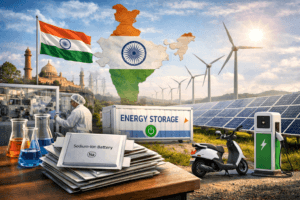
The recent Memorandum of Understanding (MoU) between the Department of Science and Technology’s ARCI and Voltasun Technologies represents a critical step in India’s strategic pursuit of energy security, aiming to transition indigenous sodium-ion battery technology from lab-scale validation to commercial readiness. This collaboration focuses on industrially testing pouch cells built around ARCI’s proprietary Sodium Vanadium Phosphate (NVP) cathode material, which offers a safer, potentially lower-cost, and more abundant alternative to lithium-ion batteries. If successfully validated, this technology could revolutionize India’s renewable energy storage landscape by providing a scalable solution for grid storage, reducing dependence on imported critical minerals, and creating a complementary storage ecosystem tailored for stationary applications and specific mobility niches.
Beyond the Hype: How India’s Sodium-Ion Battery Breakthrough Could Reshape Energy Security and Cut Tech Costs
In a quiet yet significant move that could have loud repercussions for India’s energy future, a government lab and a private company have joined hands to tackle one of modern technology’s biggest bottlenecks: the battery. On December 18, 2025, the International Advanced Research Centre for Powder Metallurgy and New Materials (ARCI) and Voltasun Technologies inked a Memorandum of Understanding (MoU). Their goal is not merely research, but the crucial industrial validation and eventual commercialisation of sodium-ion battery technology, built on a home-grown cathode material called Sodium Vanadium Phosphate (NVP).
At first glance, this might read like another piece of bureaucratic science news. But dig deeper, and it reveals a strategic pivot—a calculated bet on a technology that could democratise energy storage, reduce import dependence, and offer a safer, more sustainable pathway for India’s renewable energy and electric mobility ambitions.
The Lithium Problem and the Sodium Promise
To understand why this MoU matters, we must first confront the limitations of our current champion: lithium-ion batteries. Lithium has powered the portable electronics revolution and is spearheading the shift to electric vehicles (EVs). However, it comes with significant baggage. Geopolitically, lithium and cobalt resources are concentrated in a few countries, creating supply chain vulnerabilities and price volatility. Economically, as demand soars, costs remain a barrier for large-scale grid storage. Safety-wise, lithium-ion batteries carry risks of thermal runaway and fire.
Enter sodium, lithium’s abundant and inexpensive cousin on the periodic table. Found abundantly in seawater and salt deposits, sodium is virtually inexhaustible and geographically dispersed. Sodium-ion batteries (SIBs) theoretically promise lower costs, enhanced safety due to more stable chemistries, and better performance in extreme temperatures. The catch? Historically, they’ve lagged behind lithium-ion in a key metric: energy density (the amount of energy stored per unit weight). This made them less ideal for EVs where weight is crucial, but opened a massive window of opportunity for stationary storage—think solar farms, wind installations, and backup power systems.
ARCI’s Homegrown Innovation: The NVP Advantage
This is where ARCI’s work becomes pivotal. Under the ANRF-supported MAHA EV project, their scientists didn’t just work on a generic sodium-ion concept; they developed and patented a specific cathode material: Sodium Vanadium Phosphate (NVP). The cathode is the battery’s positive terminal, a critical component determining its performance, cost, and lifecycle.
NVP-based cathodes offer several compelling advantages:
- Structural Stability: The phosphate framework provides a robust crystal structure, allowing sodium ions to shuttle in and out with minimal degradation. This translates to a potentially longer cycle life—a critical factor for storage systems that charge and discharge daily for decades.
- Thermal Safety: Phosphate-based chemistries, familiar from the lithium iron phosphate (LFP) success story, are inherently more stable and less prone to oxygen release at high temperatures, reducing fire risk.
- Material Cost: Vanadium, while not as ubiquitous as sodium, is more readily available than cobalt and is already part of established industrial supply chains.
ARCI has already proven the concept at the lab scale, fabricating working pouch cells. The MoU with Voltasun is the essential, often treacherous, next step: moving from the controlled lab bench to the real world.
The Voltasun Partnership: Bridging the “Valley of Death”
In innovation parlance, the gap between laboratory proof-of-concept and a commercially viable product is known as the “valley of death.” Many promising technologies perish here, unable to demonstrate reliability under real-world stresses. The ARCI-Voltasun MoU is a structured blueprint to cross this valley.
The phased approach is telling:
- Phase I: ARCI supplies 80 pouch cells of 5 Ah capacity. This isn’t a token gesture. It’s a statistically significant batch for Voltasun to subject to rigorous testing—different charge-discharge cycles, temperature variations, and simulated load conditions. The feedback loop here is gold; it tells scientists what tweaks are needed in material synthesis or cell assembly for industrial readiness.
- Phase II: Two more batches of 80 cells each, governed by a separate agreement. This indicates an iterative, milestone-driven partnership. Success in initial validation unlocks the next phase, ensuring both parties are aligned and progressing.
Voltasun’s role is that of a crucible. They will stress-test these cells in conditions that mimic actual applications, perhaps in small-scale solar storage setups or as backup for telecom towers. This data is irreplaceable. It answers practical questions: How does the cell degrade after 1,000 cycles in the heat of Rajasthan or the humidity of Kerala? Can it handle the erratic charge cycles of a solar microgrid?
The Bigger Picture: Strategic Autonomy and a Greener Grid
The commercialisation of indigenous sodium-ion technology aligns perfectly with India’s macro-level goals.
- Energy Security at Scale: India’s ambitious targets for 500 GW of renewable energy by 2030 are hobbled by the intermittency of sun and wind. Large-scale, affordable battery storage is the missing link. Widespread sodium-ion batteries could be the solution, locking in renewable energy for use around the clock without relying on imported lithium-ion packs.
- Decentralising the Energy Future: The lower cost and safety profile of SIBs could make them ideal for rural and off-grid applications. They could power schools, health centres, and agricultural operations through local solar-plus-storage systems, advancing energy access and equity.
- Creating a New Manufacturing Ecosystem: Success here isn’t just about selling batteries. It’s about building an entire domestic supply chain—from processing raw materials to manufacturing cathode powder, cells, and battery management systems. This creates jobs, attracts investment, and positions India as a technology creator, not just a consumer, in the global energy storage race.
- A Complementary, Not Competitive, Technology: It’s crucial to note that sodium-ion isn’t envisioned as a wholesale replacement for lithium-ion, especially in passenger EVs where energy density is king. Instead, it’s a complementary technology poised to dominate the stationary storage market and potentially find use in lower-speed EVs, two-wheelers, and lead-acid battery replacement. This strategic niche-focus increases its chance of commercial success.
The Road Ahead: Cautious Optimism
While the promise is immense, the path is lined with challenges. The collaboration must prove that ARCI’s NVP cells can compete not just on safety and cost, but on the hard metrics of energy density, cycle life, and calendar life against established and evolving lithium-ion chemistries. Scaling material production from kilograms to tons while maintaining quality is another formidable engineering task.
Furthermore, the global race is on. China, Europe, and the US have active sodium-ion research and early commercialisation efforts. India’s advantage lies in its specific market needs—a high demand for affordable storage—and this focused public-private partnership model.
The ARCI-Voltasun MoU, therefore, is more than a formal agreement. It is a testbed for India’s scientific and industrial synergy. If successful, it won’t just commercialise a battery; it will energise a vision of an Atmanirbhar Bharat in clean technology, turning the nation’s abundant salt into the foundation of a more secure and sustainable power grid. The journey of these 160 pouch cells, from lab to field, will be one to watch closely, for it carries the charge of a potential energy revolution.
You must be logged in to post a comment.