
Beyond the Horsepower: How John Deere’s New 5130M Tractor is Planting the Seeds of a Data-Driven Indian Farm
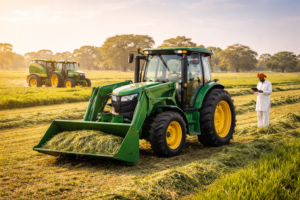
Beyond the Horsepower: How John Deere’s New 5130M Tractor is Planting the Seeds of a Data-Driven Indian Farm
The air at the John Deere Power & Technology Show in New Delhi last week hummed with more than just the promise of diesel engines. Amidst the gleaming green and yellow machinery, a quieter, more profound revolution was on display. While the unveiling of the new John Deere 5M Series 5130M tractor—a robust 130 HP machine—was the marquee event, the real story unfolding on the exhibition floor was about connectivity, data, and the reimagining of the Indian farmer as an agri-tech entrepreneur.
For over 27 years, John Deere has been a familiar sight in Indian fields, synonymous with reliability and farming muscle. But with the launch of the 5130M and a suite of supporting technologies under its “Power and Technology 7.0” initiative, the company is signalling a strategic pivot. It’s no longer just about selling a tractor; it’s about selling an ecosystem designed to optimize every pass through the field.
The 5130M: More Than Just Muscle
At first glance, the new 5130M is an impressive piece of engineering. Slotting into the critical 130 HP segment, it’s designed for the large-scale farmer and custom hiring service provider who demands power for heavy tillage and demanding farm operations. But its true innovation lies in its versatility.
For the first time in this segment in India, Deere is aggressively promoting the Front Hitch and Front PTO (Power Take-Off) application. This isn’t just a technical specification; it’s a productivity multiplier. Imagine a farmer who can now mount a front-mounted loader for silage making while simultaneously operating a rear-mounted mower. This “front and back” capability effectively turns one tractor into a dual-operational tool, slashing the time and fuel needed for complex tasks. It’s a feature that speaks directly to the need for greater operational efficiency in a country where narrow planting and harvesting windows can make or break a season.
Ramakant Garg, Director – Sales and Marketing at John Deere India, framed this evolution perfectly during his address. “Farm technologies and agronomy practices are linked,” he stated, “and the company aims to align them for future agricultural systems.” The 5130M, in this context, is the physical backbone upon which a digital layer of intelligence can be built.
The Digital Layer: Where the Real Revolution Begins
The most significant announcements at the show weren’t made of steel and rubber, but of silicon and code. The introduction of technologies like 5E AutoTrac™ and GreenSystem™ Link represents a major leap for precision agriculture in the Indian context.
5E AutoTrac™ is a straight-row vehicle guidance system that takes the guesswork—and the fatigue—out of driving a straight line. For the uninitiated, it might sound like a luxury, a “self-driving” feature for a tractor. But for a farmer, it’s a precision tool that delivers tangible ROI.
Consider the math of a typical Indian farm during sowing season. Without guidance, overlaps in seeding can waste 5-10% of expensive hybrid seeds, fertilizers, and pesticides. Missed patches lead to yield gaps that are impossible to fill later. AutoTrac ensures that every pass is millimeter-perfect, regardless of dust, darkness, or driver fatigue. This isn’t just about comfort; it’s about optimizing inputs at a time when their costs are volatile and profit margins are under pressure.
Then there is GreenSystem™ Link. This factory-fitted connectivity solution is the tractor’s voice to the cloud. It transforms the machine from an isolated tool into a connected node on the farm. It can telemeter data on machine health, fuel consumption, location, and implement performance back to the farmer or fleet manager.
This is where “human insight” meets digital transformation. For the first time, a farm owner in a city can have a real-time window into what’s happening on their land hundreds of kilometers away. For a custom hiring operator with a fleet of tractors, GreenSystem Link becomes a fleet management tool, allowing them to dispatch the nearest machine to a job, monitor fuel theft, and schedule predictive maintenance to prevent costly breakdowns during peak season.
The Indian Farmer: From Operator to Information Manager
The underlying narrative of the Power & Technology Show was a shift in identity. John Deere is betting that the Indian farmer is ready to be seen—and to see themselves—as an information manager.
Rajesh Sinha, Managing Director and Country Manager, John Deere India, touched upon this by emphasizing the company’s focus on “integrating precision agriculture and digital technologies with connected machines.” This isn’t a top-down, West-to-East technology dump. Deere’s long-standing R&D and engineering presence in India suggests that these solutions are being tailored for local realities: smaller field sizes (though consolidating), diverse cropping patterns, and the critical need for affordability.
The inclusion of radial tyres on the 5405 and 5075E models is a subtle but telling example of this localization. While not as flashy as GPS guidance, radial tyres offer lower rolling resistance, which translates to significant fuel savings—a direct benefit to the farmer’s bottom line. They also cause less soil compaction, a critical factor for long-term soil health, which Sinha explicitly mentioned as a company concern.
A Symbiotic Future: Policy, Academia, and the Private Sector
Mukul Varshney, Region 1 Government Affairs Director at John Deere, broadened the conversation beyond the farm gate. By linking the company’s efforts to the government’s ambitious sustainability goals for 2047, he painted a picture of a necessary public-private partnership.
“The government’s sustainability goals for 2047 create opportunities for technology adoption in agriculture,” Varshney noted. This is a crucial point. The challenges of the future—feeding a growing population with depleting water resources and shrinking arable land—cannot be solved by hardware alone.
It requires a systemic approach. Precision technologies like AutoTrac and GreenSystem Link are tools that enable precision conservation. They allow for:
- Variable Rate Application: Applying the right amount of fertilizer and water only where needed, reducing runoff and conserving resources.
- Reduced Input Waste: Aligning with the government’s goal of reducing chemical usage.
- Data for Policy: Aggregated, anonymized data from connected machines could, in the future, provide policymakers with unprecedented insights into crop health, sowing patterns, and regional productivity, enabling more effective and targeted agricultural policies.
Varshney’s mention of collaboration with academic and research institutions is the final piece of the puzzle. The true value of this new data will be unlocked when agricultural universities and extension services can help farmers interpret it, turning raw information into actionable agronomic advice.
The Road Ahead: Cultivating a New Mindset
The unveiling of the John Deere 5130M in New Delhi was more than a product launch. It was a declaration that the future of Indian agriculture is a hybrid future—one where the raw power of a 130 HP engine is guided by the invisible hand of data.
The challenges are real. The cost of entry for such technology can be prohibitive for marginal farmers. The digital literacy required to interpret telematics data is not yet universal. And the infrastructure for seamless connectivity in rural India is still a work in progress.
However, John Deere’s strategy appears to be a long-term play. By equipping its new tractors with factory-fitted connectivity and offering scalable guidance systems, it is future-proofing its customer base. The farmer who buys a 5130M today is not just buying a tractor; they are buying a platform that can be upgraded with new software and insights for years to come.
As the lights dimmed on the Power & Technology Show, the message was clear: the green tractors in India’s heartland are about to get a lot smarter. And in that intelligence lies the promise of a more productive, profitable, and sustainable future for the millions who feed the nation. The conversation has shifted from horsepower to brainpower, and John Deere is making sure it’s driving that conversation.
You must be logged in to post a comment.