
Beyond the Horizon: Why Finland’s Arctic Tech is Becoming India’s Himalayan Shield
The strategic partnership between India and Finland is evolving from diplomatic goodwill into a capability-driven alliance centered on space technology, particularly Finland’s Synthetic Aperture Radar (SAR) expertise, which offers all-weather, day-and-night surveillance critical for India’s Himalayan borders, maritime security, and disaster response. Companies like ICEYE exemplify this shift, moving from commercial startups to trusted defense collaborators, and the collaboration aims to go beyond simple procurement by emphasizing co-development, local manufacturing, and data sovereignty—aligning with India’s Aatmanirbhar Bharat goals. This emerging axis, bridging Helsinki’s Arctic engineering with India’s strategic needs, highlights how shared democratic values and technological depth are reshaping modern geopolitical alignments in an era where space-based capabilities have become foundational to national security.
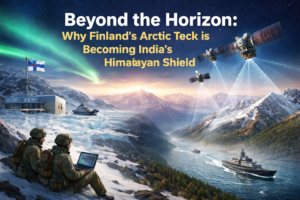
Beyond the Horizon: Why Finland’s Arctic Tech is Becoming India’s Himalayan Shield
In the intricate chessboard of international diplomacy, the most powerful moves are often the quietest. While the world’s attention remains fixed on the noise of traditional geopolitical rivalries, a significant, capability-driven partnership is taking shape between New Delhi and Helsinki. It is a relationship that bridges the Baltic Sea and the Indian Ocean, connecting a nation forged in Nordic resilience with a civilization-state racing toward its centenary of independence.
The recent op-ed by Partha P Roy Chowdhury, a veteran of the Indian Army and current Vice President at the Finnish space-tech firm ICEYE, pulls back the curtain on this evolving alliance. It articulates a shift that has been years in the making: the transition of India-Finland relations from a trade-led engagement to a strategic, technology-anchored partnership. But beneath the surface of diplomatic pleasantries and joint ventures lies a more profound narrative about how nations are redefining security in an age where the ultimate high ground is no longer a mountain peak, but low-earth orbit.
Space as the New Frontier of Strategic Infrastructure
For decades, India’s defense and disaster management strategies were constrained by geography and weather. The Himalayas—the world’s most formidable mountain range—present a surveillance nightmare. The Indian Ocean, a vast maritime commons, is notoriously difficult to monitor. The monsoon, a lifeline for the subcontinent, often acts as a veil, rendering optical satellites blind just when the risk of infiltration or flooding is highest.
The Indian establishment, under the frameworks of Aatmanirbhar Bharat (self-reliance) and Viksit Bharat (developed India), has come to a critical realization: space-based assets are no longer just tools for communication or navigation; they are foundational infrastructure. In modern warfare, where the line between peace and conflict is blurred by grey-zone tactics, situational awareness is not just intelligence—it is deterrence.
This is where Finland enters the equation. Unlike the legacy space powers that focus on large, expensive, and often vulnerable geostationary satellites, Finland’s space-tech ecosystem has emerged from a crucible of necessity. Operating in the Arctic’s extreme cold, darkness, and harsh conditions, Finnish engineers didn’t just build satellites; they built resilience.
The Radar Revolution: Why SAR Matters to India
The centerpiece of this emerging cooperation is Synthetic Aperture Radar (SAR) technology, pioneered by Finnish company ICEYE. The significance of SAR cannot be overstated. While optical satellites—the kind most people imagine when they think of space imagery—are essentially cameras in the sky, they are useless when clouds gather.
For India, which experiences some of the most intense cloud cover on the planet during the monsoon season, this creates a predictable and exploitable window of vulnerability. SAR technology bypasses this entirely. By using radar waves, it penetrates clouds, works in pitch darkness, and can even detect subtle changes in the Earth’s surface.
This technological capability aligns perfectly with India’s operational imperatives:
- Himalayan Surveillance: The same radar systems designed to monitor ice sheets in the Arctic can provide all-weather, persistent monitoring of the Line of Actual Control (LAC). They can track vehicle movements, infrastructure construction, and troop deployments regardless of whether the peaks are shrouded in mist or snow.
- Maritime Domain Awareness: In the Indian Ocean, SAR is a game-changer for detecting “dark vessels”—ships that turn off their Automatic Identification Systems (AIS) to engage in illegal fishing, smuggling, or espionage. The ability to track these vessels in real-time, day or night, is a critical boost to India’s naval capabilities.
- Disaster Resilience: From the floods in Kerala to the landslides in Uttarakhand, SAR provides the ability to map inundated areas in real-time, even during cyclonic conditions. This allows for more efficient rescue operations and damage assessment, turning disaster response from a reactive scramble into a coordinated, data-driven operation.
From Startup to Strategic Asset
One of the most telling aspects of the article is the positioning of ICEYE not merely as a commercial entity, but as a “strategic defence collaborator.” The company’s trajectory—from a Finnish startup to a key partner for European defense giants like Rheinmetall—reflects a broader trend in the West. The “New Space” movement, characterized by small, agile, and cost-effective satellite constellations, is maturing into a critical component of national security architectures.
For India, this presents a unique opportunity. Historically, India’s defense procurement has been plagued by the “strategic partnership” paradox: the desire for top-tier technology versus the non-negotiable need for indigenous capability and data sovereignty. The potential collaboration with Finland, as outlined by Chowdhury, suggests a path forward that avoids the pitfalls of simple procurement.
Instead of buying imagery, the model appears to be shifting toward co-development and co-production. The proposal to establish data processing nodes and satellite assembly facilities within India is significant. It aligns perfectly with the government’s push to build a domestic defense-industrial base. It would allow India to access world-class SAR technology while ensuring that the most sensitive data—related to border surveillance and national security—remains on sovereign soil, processed and analyzed by Indian agencies.
Data Sovereignty: The New Currency of Trust
In the 20th century, alliances were built on shared borders or shared enemies. In the 21st century, they are increasingly built on shared data architectures. The article correctly identifies that “technological sovereignty, resilient supply chains, and trusted industrial partnerships are now central pillars of geopolitical alignment.”
Finland, as a NATO member with a long history of technological neutrality and a deep distrust of authoritarian regimes, represents a “trusted partner” for India. In a world where technology is weaponized, and where hardware can come with hidden backdoors or data can be siphoned off to adversarial nations, the ability to collaborate with a democracy that respects institutional transparency is invaluable.
This partnership offers a blueprint for how Western tech can integrate into India’s strategic framework without triggering the sovereignty alarms that have often scuttled similar deals. It’s a model based on mutual dependency: India gains access to cutting-edge radar tech and the industrial ecosystem to support it; Finland gains a massive market, manufacturing scale, and a long-term partner in the Indo-Pacific.
The Road Ahead: From Helsinki to the Himalayas
Looking toward 2026 and beyond, the trajectory of this partnership will depend on institutionalization. The current momentum—driven by high-level visits and strategic dialogues like the Raisina Dialogue—must translate into concrete joint research centers, co-developed satellite missions, and exchanges that build a specialized workforce.
For the Indian Armed Forces, the integration of Finnish SAR data into existing command-and-control structures could revolutionize tactical decision-making. For Indian industry, it represents a chance to leapfrog into the high-value segment of the global space supply chain.
The article’s author, with his unique background as a former officer in the Ladakh Scouts—an elite regiment specialized in high-altitude warfare—and now a leader at a Finnish space-tech firm, embodies this convergence. He represents a new class of strategic thinkers who understand that the soldier on the Siachen Glacier and the engineer in Espoo, Finland, are now connected by a shared need for precision, reliability, and resilience.
As India navigates a complex multipolar world, the relationship with Finland serves as a case study in strategic evolution. It is a partnership built not on immediate quid pro quos, but on the recognition that in an era of climate crisis and great-power competition, the nations that control the high ground of space—and the data that flows from it—will dictate the terms of security. From the frozen expanses of the Arctic to the rugged peaks of the Himalayas, a new axis of stability is being forged, one satellite pass at a time.
You must be logged in to post a comment.