
Beyond the Headlines: Why the US-India AI Partnership Could Reshape Global Technology
Rubrik CEO Bipul Sinha, speaking ahead of the India AI Impact Summit in New Delhi, emphasized that the strong partnership between the US and India presents a “tremendous opportunity” to leverage artificial intelligence for large-scale social transformation, particularly in healthcare, education, job training, and digital literacy. Sinha highlighted the natural synergy between the two nations, where the US contributes technological expertise and intellectual property while India offers its massive “human scale” of 1.4 billion people and a growing youth population. He framed AI as the “most transformational technology of our lifetime” and a critical tool for moving hundreds of millions into the middle class, but also warned of the significant risks associated with “agentic” AI systems. He stressed that for the Global South to benefit from AI in essential services, building trust through proper governance and guardrails is essential, which is the focus of his discussions at the summit centered on the themes of “People, Planet and Progress.”
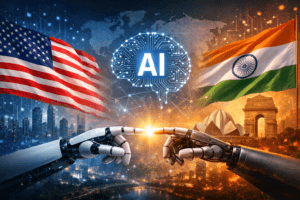
Beyond the Headlines: Why the US-India AI Partnership Could Reshape Global Technology
A Conversation With Rubrik’s Bipul Sinha Reveals the Deeper Stakes Behind This Week’s Landmark Summit in New Delhi
The entrance to Bharat Mandapam in New Delhi hums with an unusual energy this week. Security personnel check credentials with quiet efficiency while delegates from three dozen countries stream through the gates, their conversations a polyglot mix of English, Hindi, Mandarin, and French. Inside, the first-ever India AI Impact Summit is underway—the Global South’s inaugural gathering of its kind—and the stakes extend far beyond the usual conference circuit platitudes about innovation and disruption.
When Bipul Sinha steps into that venue over the coming days, the Rubrik chairman and CEO will carry with him a perspective shaped by an unusual journey: from his days as an undergraduate at IIT Kharagpur, through Wharton, to co-founding a company now valued at nearly $70 billion. But in an exclusive interview before his departure from New York, Sinha made clear that his focus isn’t on Rubrik’s market cap or the usual corporate talking points. Instead, he painted a vision of what happens when the world’s most technologically advanced nation and its largest democracy truly collaborate—and why artificial intelligence makes that partnership not just advantageous, but potentially transformative for billions of people.
The Symmetry That Matters
“We have to understand the fundamental complementarity here,” Sinha told me, leaning forward in his chair at Rubrik’s New York offices. “The United States possesses technological know-how, intellectual property, and scale in innovation. India possesses human scale—1.4 billion people, a youth population that’s the envy of the developed world, and a growth rate that continues to surprise.”
This isn’t the usual outsourcing narrative repackaged for an AI era. Sinha’s argument runs deeper. When he speaks of “human scale,” he means something more profound than labor arbitrage or cost efficiency. He means the raw material of civilization itself: minds to educate, bodies to heal, potential to unlock.
Consider the numbers that rarely make it into technology headlines. India adds approximately 12 million people to its workforce annually—roughly the entire population of Greece or Portugal, every single year. These young Indians enter an economy that has grown at 6-7% for two decades, lifting more than 400 million people out of extreme poverty in the process. But the next stage of that journey—moving hundreds of millions more into a genuine middle-class existence—requires something different from the manufacturing-led growth that transformed China or the service-sector revolution that created India’s IT industry.
“Technology is the answer,” Sinha said flatly. “There’s simply no other way to do it at this scale.”
And here’s where artificial intelligence enters the equation not as a corporate buzzword but as perhaps the most powerful social lever ever invented. Healthcare, education, job training, digital literacy—these are not abstract concepts in a country where a rural farmer’s access to a specialist physician might require a two-day bus journey, where a child’s educational prospects can depend entirely on whether a qualified teacher happens to live nearby, where skill development has traditionally meant migration to distant cities.
“AI could be the bridge,” Sinha suggested. “Not just for India—but the model matters for the entire Global South.”
The New Factory of Intelligence
The industrial metaphor is deliberate. Sinha repeatedly returned to the phrase “factory of intelligence” during our conversation, framing AI infrastructure as the equivalent of steel mills or automobile assembly lines in previous eras of economic transformation.
But these factories look different. They require graphics processing units instead of blast furnaces, data centers instead of assembly halls, and investment at a scale that might have seemed impossible for developing economies just a decade ago. The numbers Sinha cited are staggering: Indian government and businesses have already committed approximately $100 billion toward this infrastructure, with data center investments accelerating and tax incentives creating what he called “a unique moment.”
“India is taking significant strides,” he said. “The production of intelligence itself is becoming an industry, and India has positioned itself to be a major participant.”
Yet the critical insight here—the one that separates thoughtful analysis from boosterism—lies in what happens after the infrastructure exists. AI doesn’t deliver value through processing power alone. It delivers value through solutions that understand context, that grasp business processes, that reflect cultural reality.
“The technology must be adapted,” Sinha emphasized. “You can’t simply transplant American AI solutions into Indian contexts and expect them to work. The business understanding, the process understanding, the cultural understanding—that has to be local.”
This is where the US-India partnership becomes genuinely interesting. American companies possess the foundational technology, the research depth, the venture capital ecosystem that continues to produce breakthrough after breakthrough. Indian organizations possess the contextual knowledge, the scale of implementation, the understanding of how technology actually reaches people who need it most. The combination, in theory, could produce something neither nation could achieve alone.
The Promise and the Peril
Sinha describes artificial intelligence as “the most transformational technology of our lifetime”—a phrase that risks banality through overuse until you actually examine what it means across different levels of society.
For individuals, AI represents both opportunity and existential anxiety. Job training becomes simultaneously more essential and more complex as work patterns shift beneath our feet. The young Indian professional today must prepare for roles that may not exist in their current form five years from now, while the mid-career worker faces the prospect of fundamental retooling.
For businesses, Sinha offered a striking formulation: “AI promises 100 times more opportunity and also 100 times more risk.” The opportunity half is well-documented—automation, insight, efficiency, new product categories. The risk half receives less attention. “Someone could control your entire business operations remotely and do tremendous damage,” he noted. “The attack surface expands exponentially.”
For nation-states, the implications become even more profound. We are living through what Sinha called “a new industrial age,” and the positioning of countries within this age will determine economic trajectories for decades. The traditional hierarchy—technology creators in the West, technology consumers elsewhere—could persist. Or it could shift toward something more distributed, more multipolar, more reflective of where data and talent and need actually reside.
“India being the technology hub, India being the largest at-scale technology talent pool—this matters enormously,” Sinha said. “AI is particularly important for Indian businesses to serve the world.”
The Agentic Question
The technical term “agentic AI” doesn’t appear in the India AI Impact Summit’s promotional materials, but it will likely dominate conversations among the technologists gathering in New Delhi this week. And Sinha, whose company has positioned itself at the intersection of AI deployment and cybersecurity, has been thinking deeply about what happens when AI systems don’t just analyze but act.
“How do you adopt agentic work at scale without undertaking huge risk?” he framed the question. “How do you deploy agents, monitor them, govern them? How do you ensure trust in the AI system?”
These questions become particularly acute in the contexts Sinha cares about most. Healthcare delivery through AI agents could reach millions who currently lack access to physicians—but what happens when an agent makes a mistake? Educational systems could personalize learning for every child—but how do parents verify what their children are being taught? Job training could be democratized across geography and income—but who ensures that the training actually prepares people for real opportunities?
“From monitoring agentic work to governance to creating guardrails—and if they misbehave, how do you undo the damage?” Sinha ticked through the challenges. “These are critical questions. If you think about the Global South and the need for services, all of that requires huge trust in the system.”
This is where Rubrik’s stated mission—”unleash agents, not risk”—intersects with national policy. The company has built tools for monitoring agentic actions, enforcing real-time guardrails, fine-tuning for accuracy, and rolling back mistakes when they occur. But technology alone cannot solve trust problems. Regulation matters. Norms matter. The slow, messy process of building consensus around what acceptable AI deployment looks like matters perhaps most of all.
People, Planet, Progress
The India AI Impact Summit organized its agenda around three themes: People, Planet, and Progress. Sinha, who will participate in multiple sessions throughout the week, described these as “aligned” with the conversations we need to be having.
People: The human implications of AI deployment, from job displacement to enhanced capabilities, from privacy concerns to access questions. In a country of 1.4 billion, the distributional effects of technology matter enormously. Will AI concentrate opportunity in already-advantaged urban centers, or can it reach rural communities, small towns, marginalized populations? The answer depends on choices being made today.
Planet: The energy implications of AI infrastructure are non-trivial. Data centers consume electricity at industrial scale, and the training of large models carries a carbon footprint that rivals air travel. But AI also enables optimization that could reduce waste, improve efficiency, accelerate climate solutions. The balance is not predetermined.
Progress: The direction of technological development—whose problems get solved, whose needs get prioritized, whose values get embedded in systems. Progress can be inclusive or exclusive, trusted or resisted, beneficial to billions or beneficial to few.
“These are the right discussions,” Sinha said. “We are excited to be part of them and to do our bit in ensuring that agentic deployments happen with confidence.”
The View From New York
Our conversation ended, as these conversations often do, with a return to the personal. Sinha’s journey from IIT Kharagpur to the corner office of a major American technology company traces the arc of globalization itself—talent flowing toward opportunity, networks forming across oceans, success creating responsibility for what comes next.
“I have been a huge proponent of the India-US relationship,” he said simply. Not because of sentiment, though that’s clearly present. Not because of business opportunity, though Rubrik’s growth speaks for itself. But because the complementarity is real, the stakes are high, and the window for action is now.
The summit in New Delhi will produce the usual deliverables: white papers, working groups, memoranda of understanding, press releases. But beneath that surface, something more important may be happening. Leaders from government and business, from the Global North and Global South, from technology companies and civil society organizations are beginning to ask the questions that will shape AI’s actual impact on actual lives.
What does healthcare delivery look like when AI extends the reach of every physician? What does education become when every child has access to personalized instruction? What does economic development mean when job training can scale to reach millions? What does sovereignty require when intelligence itself becomes an industrial product?
The answers won’t emerge from a single summit, however well-attended. They will emerge from the messy, frustrating, exhilarating process of building things that work for people who need them. And if Sinha’s vision proves accurate, they will emerge from a partnership between two countries that, together, possess both the technological depth and the human scale to show what’s possible.
“The opportunity is tremendous,” he said one last time. It was not a sound bite. It was a statement of fact, grounded in numbers and history and the stubborn conviction that technology, properly directed, can still do what it has always promised: make life better for more people.
Whether that promise is fulfilled depends on the conversations happening this week in New Delhi—and on what happens after the delegates go home.
You must be logged in to post a comment.